BEIRUT: President Donald Trump’s announcement that the US will ease sanctions on Syria could eventually facilitate the country’s recovery from years of civil war and transform the lives of everyday Syrians.
But experts say it will take time, and the process for lifting the sanctions — some of which were first introduced 47 years ago — is unclear.
“I think people view sanctions as a switch that you turn on and off,” said Karam Shaar, a Syrian economist who runs the consultancy firm Karam Shaar Advisory Limited. “Far from it.”
Still, the move could bring much-needed investment to the country, which is emerging from decades of autocratic rule by the Assad family as well as the war. It needs tens of billions of dollars to restore its battered infrastructure and pull an estimated 90 percent of population out of poverty.
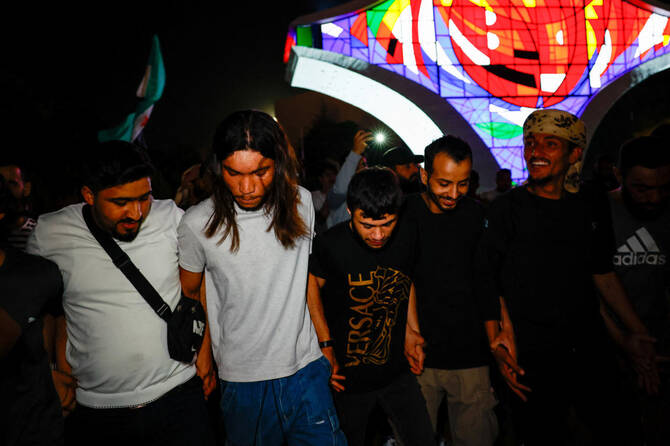
And Trump’s pledge has already had an effect: Syrians celebrated in streets across the country, and Arab leaders in neighboring nations that host millions of refugees who fled Syria’s war praised the announcement.
What are the US sanctions on Syria?
Washington has imposed three sanctions programs on Syria. In 1979, the country was designated a “state sponsor of terrorism” because its military was involved in neighboring Lebanon’s civil war and had backed armed groups there, and eventually developed strong ties with the powerful militant Hezbollah group.
In 2003, then-President George W. Bush signed the Syria Accountability Act into law, as his administration faced off with Iran and Tehran-backed governments and groups in the Mideast. The legislation focused heavily on Syria’s support of designated terror groups, its military presence in Lebanon, its alleged development of weapons of mass destruction, as well as oil smuggling and the backing of armed groups in Iraq after the US-led invasion.
In 2019, during Trump’s first term, he signed the Caesar Act, sanctioning Syrian troops and others responsible for atrocities committed during the civil war.
Caesar is the code name for a Syrian photographer who took thousands of photographs of victims of torture and other abuses and smuggled them out of the country. The images, taken between 2011 and 2013, were turned over to human rights advocates, exposing the scale of the Syrian government’s brutal crackdown on political opponents and dissidents during countrywide protests.
What has been the impact of US sanctions on Syria?
The sanctions — along with similar measures by other countries — have touched every part of the Syrian economy and everyday life in the country.
They have led to shortages of goods from fuel to medicine, and made it difficult for humanitarian agencies responding to receive funding and operate fully.
Companies around the world struggle to export to Syria, and Syrians struggle to import goods of any kind because nearly all financial transactions with the country are banned. That has led to a blossoming black market of smuggled goods.
Simple tasks like updating smartphones are difficult, if not impossible, and many people resort to virtual private networks, or VPNs, which mask online activity, to access the Internet because many websites block users with Syrian IP addresses.
The impact was especially stark after a devastating 7.8 magnitude earthquake hit Turkiye and northern Syria in February 2023, compounding the destruction and misery that the war had already brought.
Though the US Treasury issued a six-month exemption on all financial transactions related to disaster relief, the measures had limited effect since banks and companies were nervous to take the risk, a phenomenon known as over-compliance.
Interim Syrian President Ahmad Al-Sharaa — who led the insurgency that ousted President Bashar Assad — has argued the sanctions have outlived their purpose and are now only harming the Syrian people and ultimately preventing the country from any prospect of recovery.
Trump and Al-Sharaa met Wednesday.
Washington eased some restrictions temporarily in January but did not lift the sanctions. Britain and the European Union have eased some of their measures.
What could lifting the sanctions mean for Syria?
After Trump’s announcement, Syria’s currency gained 60 percent on Tuesday night — a signal of how transformational the removal of sanctions could be.
Still, it will take time to see any tangible impact on Syria’s economy, experts say, but removing all three sanctions regimes could bring major changes to the lives of Syrians, given how all-encompassing the measures are.
It could mean banks could return to the international financial system or car repair shops could import spare parts from abroad. If the economy improves and reconstruction projects take off, many Syrian refugees who live in crowded tented encampments relying on aid to survive could decide to return home.
“If the situation stabilized and there were reforms, we will then see Syrians returning to their country if they were given opportunities as we expect,” says Lebanese economist Mounis Younes.
The easing of sanctions also has an important symbolic weight because it would signal that Syria is no longer a pariah, said Shaar.
Mathieu Rouquette, Mercy Corps’ country director for Syria, said the move “marks a potentially transformative moment for millions of Syrians who have endured more than 13 years of economic hardship, conflict, and displacement.”
But it all depends on how Washington goes about it.
“Unless enough layers of sanctions are peeled off, you cannot expect the positive impacts on Syria to start to appear,” said Shaar. “Even if you remove some of the top ones, the impact economically would still be nonexistent.”


What would lifting US sanctions on Syria mean to the war-torn country?
https://arab.news/62y5a
What would lifting US sanctions on Syria mean to the war-torn country?

- After Trump’s announcement, Syria’s currency gained 60 percent on Tuesday night
- Experts says the process for lifting the US sanctions is unclear
- Syria needs tens of billions of dollars to restore its battered infrastructure and pull an estimated 90 percent of population out of poverty


Israel says it has launched ‘broad wave’ of strikes on Iran, as Tehran widens its response across the region
- US military says 17 Iranian navy ships destroyed, struck nearly 2,000 targets in Iran thus far
- US and Israeli attacks have killed 787 people in Iran: Iranian Red Crescent
JERUSALEM/DUBAI/TEHRAN: Israel early Wednesday launched new attacks on Iran as the US military said it has hit nearly 2,000 targets inside the Islamic republic, which tried to impose a cost by expanding a missile and drone barrage across the region.
With global energy prices on the rise, President Donald Trump said the US Navy was ready to escort oil tankers through the Strait of Hormuz, the vital chokepoint into the Gulf that Iran has threatened to seal off.
Israel’s military said it launched a “broad wave of strikes” after midnight across Iran, which in the hours before had launched three separate missile barrages at Israel, causing mild injuries to a woman in Tel Aviv.
The US military has destroyed 17 Iranian ships, including a submarine, and struck nearly 2,000 targets in Iran, the commander of the US Central Command said on Tuesday.
“Today, there is not a single Iranian ship underway in the Arabian Gulf, Strait of Hormuz, or Gulf of Oman,” US Central Command’s Brad Cooper said in a video posted to X.
Cooper said the US military has “severely degraded Iran’s air defenses” and taken out hundreds of ballistic missiles, launchers and drones.
The video showed missiles and jets launching from US ships, and targets exploding on the ground.
Cooper noted that Iran has launched over 500 ballistic missiles and more than 2,000 drones in retaliation.
But he said the US is “hunting” Iran’s last remaining mobile ballistic missile launchers to eliminate their “lingering launch capability.”
Cooper said the operation has involved more than 50,000 troops, 200 fighter jets, two aircraft carriers and bombers, and “more capability is on the way.”
“We’ve just begun,” Cooper said, adding that the US military is targeting “all the things that can shoot at us.”
“These forces bring a massive amount of firepower, representing the largest buildup by the US in the Middle East in a generation,” he said in the video message, describing the first day’s barrage as bigger than the so-called “shock and awe” against Saddam Hussein’s Iraq in 2003.
Iran‘s response
The US and Israeli attacks have killed 787 people in Iran, according to the Iranian Red Crescent, a toll that could not be independently confirmed.
Iran vowed to inflict a heavy price in retaliation. Drones struck adjacent the US consulate in Dubai, starting a fire but inflicting no casualties, and against the US military base at Al-Udeid in Qatar.
The attacks came a day after strikes on the US embassies in Riyadh and Kuwait City and on a US air base in Bahrain.
“We are saying to the enemy that if it decides to hit our main centers, we will hit all economic centers in the region,” Islamic Revolutionary Guard General Ebrahim Jabbari said.
Iranian attacks have killed at least nine people and wounded dozens in the Gulf region, according to various reports quoting local authorities.

Among the latest death was an 11-year-old girl who was killed after shrapnel fell in a residential area in Kuwait City, health authorities said Wednesday.
The Kuwait army said in a statement the shrapnel fell over a house and left casualties while forces were intercepting “several hostile aerial targets” over the country.
The Health Ministry said in a separate statement that the child died of her wounds at the hospital.
The child’s mother and three other relatives were injured and being treated at the hospital, it said.
Vessel hit in Gulf of Oman
A vessel was hit by a projectile early Wednesday in the Gulf of Oman off the United Arab Emirates, an agency of the UK military said.
There were no reported casualties.
The United Kingdom Maritime Trade Operations Center said the vessel was struck 8 miles east of Fujairah, one of the UAE’s seven emirates.
The attack damaged the vessel’s steel plating.
No fire or water intake was reported, it said.

Iran hits US embassies
The US State Department said Tuesday it’s preparing military and charter flights for Americans who want to leave the Middle East. Several other countries also arranged evacuation flights for their citizens.
An attack from two drones on the US Embassy in Riyadh caused a “limited fire,” according to the Saudi Arabian Defense Ministry, and the embassy urged Americans to avoid the compound.
An Iranian drone struck a parking lot outside the US consulate in Dubai, sparking a small fire, Secretary of State Marco Rubio said in Washington. He said all personnel were accounted for.
The United Arab Emirates said it has intercepted the vast majority of more than 1,000 Iranian missile and drone attacks against it.
US embassies in Saudi Arabia, Kuwait and Lebanon said they were closed to the public.
The US State Department ordered the evacuation of non-emergency personnel and family in Kuwait, Bahrain, Iraq, Qatar, Jordan and the United Arab Emirates. And US citizens were urged to leave more than a dozen Middle Eastern countries, though many were stranded because of airspace closures.
The US military has confirmed six deaths of American service members.
Four of the American soldiers killed were identified as Capt. Cody A. Khork, 35, of Winter Haven, Florida; Sgt. 1st Class Noah L. Tietjens, 42, of Bellevue, Nebraska; Sgt. 1st Class Nicole M. Amor, 39, of White Bear Lake, Minnesota; and Sgt, Declan J. Coady, 20, of West Des Moines, lowa, who received a posthumous promotion in rank. They were assigned to the Iowa-based 103rd Sustainment Command.
Ghost town
In Tehran, residents who have not fled remained shut away in their homes for fear of the US-Israeli bombardment.
The Iranian capital is normally home to around 10 million people, but in recent days “there are so few people that you’d think no one ever lived here,” said Samireh, a 33-year-old nurse.
Authorities had previously urged people to leave the city, and police officers, armed security forces and armored vehicles have been stationed at main junctions, carrying out random checks on vehicles.
In the more upmarket north of Tehran, the meowing of cats and chirping of birds replaced the usual din of traffic jams.
Iranian authorities said a strike on a school in the city of Minab on the first day of the war killed more than 150 people.
Drone downed near Baghdad airport
In Baghdad, a drone was shot down on Wednesday near Baghdad’s international airport, a day after a similar attack on the facility, two security sources told AFP.
“A drone was downed near Baghdad airport, with no casualties or material damage reported,” an Iraqi security source said. Another security source in Baghdad confirmed the incident.
The airport includes a military base that hosts a US diplomatic facility and previously housed US-led coalition troops.


