Trump meets new Syria leader after lifting sanctions

1 / 5
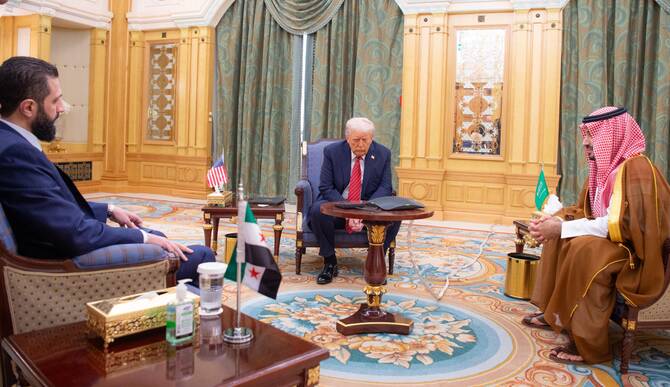
Al-Sharaa was named president of Syria in January, a month after a stunning offensive by insurgent groups led by Al-Sharaa’s Hayat Tahrir Al-Sham, or HTS, stormed Damascus and ended the 54-year rule of the Assad family. (AFP)
2 / 5
Al-Sharaa was named president of Syria in January, a month after a stunning offensive by insurgent groups led by Al-Sharaa’s Hayat Tahrir Al-Sham, or HTS, stormed Damascus and ended the 54-year rule of the Assad family. (AFP)
3 / 5
Al-Sharaa was named president of Syria in January, a month after a stunning offensive by insurgent groups led by Al-Sharaa’s Hayat Tahrir Al-Sham, or HTS, stormed Damascus and ended the 54-year rule of the Assad family. (AFP)
4 / 5
Al-Sharaa was named president of Syria in January, a month after a stunning offensive by insurgent groups led by Al-Sharaa’s Hayat Tahrir Al-Sham, or HTS, stormed Damascus and ended the 54-year rule of the Assad family. (AFP)
5 / 5
Al-Sharaa was named president of Syria in January, a month after a stunning offensive by insurgent groups led by Al-Sharaa’s Hayat Tahrir Al-Sham, or HTS, stormed Damascus and ended the 54-year rule of the Assad family. (AFP)
Short Url
Updated 14 May 2025
Follow

Trump meets new Syria leader after lifting sanctions

  • Al-Sharaa was named president of Syria in January, a month after a stunning offensive by insurgent groups
  • Trump said he agreed to meet with Al-Sharaa after being encouraged to do so by Saudi Crown Prince Mohammed bin Salman

RIYADH: Donald Trump became the first US president in 25 years to meet a Syrian leader on Wednesday after he offered sanctions relief in hopes of offering a new path to the war-battered country.

Trump, in Riyadh on the first state visit of his second term, met with Ahmed Al-Sharaa, an erstwhile Islamist guerrilla turned interim president after the December of longtime strongman Bashar Assad.

The two held brief talks ahead of a larger gathering of Gulf leaders in Saudi Arabia during Trump’s tour of the region, a White House official said.

No US president has met a Syrian leader since Bill Clinton saw Hafez Assad, Bashar’s father, in Geneva in 2000 in a failed effort to persuade him to make peace with Israel.

Trump announced on Tuesday that he was lifting “brutal and crippling” Assad-era sanctions on Syria in response to demands from Sharaa’s allies in Turkiye and Saudi Arabia — in his latest step out of tune with US ally Israel.

Trump said it was Syrians’ “time to shine” and that easing sanctions would “give them a chance at greatness.”

Syrians celebrated the news, with dozens of men, women and children gathering in Damascus’s Umayyad Square.

“My joy is great. This decision will definitely affect the entire country positively. Construction will return, the displaced will return, and prices will go down,” said Huda Qassar, a 33-year-old English-language teacher.

The Syrian foreign ministry called Trump’s decision a “pivotal turning point” that would help bring stability.

Opinion

This section contains relevant reference points, placed in (Opinion field)

The United States imposed sweeping restrictions on financial transactions with Syria during the brutal civil war and made clear it would use sanctions to punish anyone involved in reconstruction so long as Assad remained in power without accountability for atrocities.

Trump gave no indication that the United States would remove Syria from its blacklist of state sponsors of terrorism — a designation dating back to 1979 over support to Palestinian militants that severely impedes investment.

Other Western powers including the European Union have already moved to lift sanctions but the United States had earlier held firm on conditions.

A senior envoy of the Joe Biden administration met Sharaa in Damascus in December and called for commitments, including on the protection of minorities.

In recent weeks, Syria has seen a series of bloody attacks on minority groups, including Alawites — the sect of the largely secular Assad family — and the Druze.

Israel has kept up a bombing campaign against Syria both before and after the fall of Assad, with Israel pessimistic about change under Sharaa and hoping to degrade the military capacity of its longtime adversary.

Rabha Seif Allam of the Al-Ahram Center for Political and Strategic Studies in Cairo said that the easing of US sanctions would allow Syria to reintegrate with the global economy, including by allowing bank transfers from investors and some of the millions of Syrians who fled during the civil war.

“Lifting sanctions will give Syria a real opportunity to receive the funding needed to revive the economy, impose central state authority and launch reconstruction projects with clear Gulf support,” she said.


Lebanon approves financial gap draft law despite opposition from Hezbollah and Lebanese Forces

Lebanon's Prime Minister Nawaf Salam speaking during a press conference after a cabinet session in Beirut on December 26, 2025.
Updated 21 min 28 sec ago
Follow

Lebanon approves financial gap draft law despite opposition from Hezbollah and Lebanese Forces

  • Legislation aims to address the fate of billions of dollars in deposits that have been inaccessible to Lebanese citizens during the country’s financial meltdown

BEIRUT: Lebanon’s Cabinet on Friday approved a controversial draft law to regulate financial recovery and return frozen bank deposits to citizens. The move is seen as a key step in long-delayed economic reforms demanded by the International Monetary Fund.

The decision, which passed with 13 ministers voting in favor and nine against, came after marathon discussions over the so-called “financial gap” or deposit recovery bill, stalled for years since the banking crisis erupted in 2019. The ministers of culture and foreign affairs were absent from the session.

The legislation aims to address the fate of billions of dollars in deposits that have been inaccessible to Lebanese citizens during the country’s financial meltdown.

The vote was opposed by three ministers from the Lebanese Forces Party, three ministers from Hezbollah and the Amal Movement, as well as the minister of youth and sports, Nora Bayrakdarian, the minister of communications, Charles Al-Hajj, and the minister of justice, Adel Nassar.

Finance Minister Yassin Jaber broke ranks with his Hezbollah and Amal allies, voting in favor of the bill. He described his decision as being in line with “Lebanon’s supreme financial interest and its obligations to the IMF and the international community.”

The draft law triggered fierce backlash from depositors who reject any suggestion they shoulder responsibility for the financial collapse. It has also drawn strong criticism from the Association of Banks and parliamentary blocs, fueling fears the law will face intense political wrangling in Parliament ahead of elections scheduled in six months.

Prime Minister Nawaf Salam confirmed the Cabinet had approved the bill and referred it to Parliament for debate and amendments before final ratification. Addressing public concerns, he emphasized that the law includes provisions for forensic auditing and accountability.

“Depositors with accounts under $100,000 will be repaid in full with interest and without any deductions,” Salam said. “Large depositors will also receive their first $100,000 in full, and the remainder will be issued as negotiable bonds backed by the assets of the Central Bank, valued at around $50 billion.”

He said further that bondholders will receive an initial 2 percent payout after the first tranche of repayments is completed.

The law also includes a clause requiring criminal accountability. “Anyone who smuggled funds abroad or benefited from unjustified profits will be fined 30 percent,” Salam said.

He emphasized that Lebanon’s gold reserves will remain untouched. “A clear provision reaffirms the 1986 law barring the sale or mortgaging of gold without parliamentary approval,” he said, dismissing speculation about using the reserves to cover financial losses.

Salam admitted that the law was not perfect but called it “a fair step toward restoring rights.”

“The banking sector’s credibility has been severely damaged. This law aims to revive it by valuing assets, recapitalizing banks, and ending Lebanon’s dangerous reliance on a cash economy,” he said. “Each day of delay further erodes people’s rights.”

While the Association of Banks did not release an immediate response after the vote, it previously argued during discussions that the law would destroy remaining deposits. Bank representatives said lenders would struggle to secure more than $20 billion to cover the initial repayment tier and accused the state of absolving itself of responsibility while effectively granting amnesty for decades of financial mismanagement and corruption.

The law’s fate now rests with Parliament, where political competition ahead of the 2025 elections could complicate or delay its passage.

Lebanon’s banking sector has been at the heart of the country’s economic collapse, with informal capital controls locking depositors out of their savings and trust in state institutions plunging. International donors, including the IMF, have made reforms to the sector a key condition for any financial assistance.