

Pakistani official says 1.3 million Afghans repatriated since November 2023

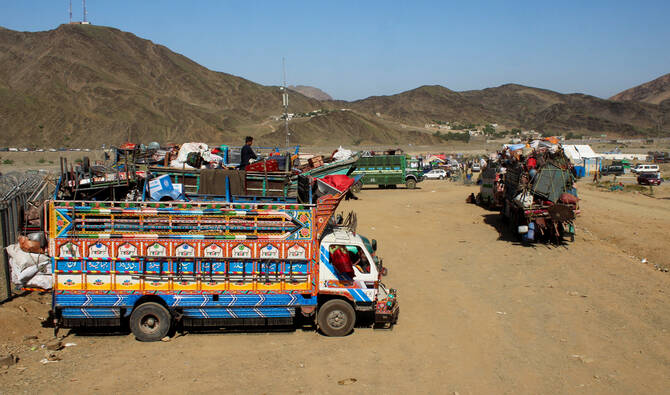
Trucks transporting Afghan nationals, who were expelled from Pakistan, are parked as refugees wait for registration at the Omari refugee camp in Mohmand Dara, Torkham border, Nangarhar province, Afghanistan, on April 15, 2025. (REUTERS/File)
Short Url
Updated 14 May 2025
Follow

Pakistani official says 1.3 million Afghans repatriated since November 2023

  • Pakistan launched deportation drive in November 2023 against foreigners residing illegally in country amid militancy surge
  • Pakistan has hosted over 2.8 million Afghan refugees who crossed the border during 40 years of conflict in their homeland

ISLAMABAD: Pakistani authorities have repatriated approximately 1.3 million Afghan refugees in a deportation drive launched since November 2023, Parliamentary Secretary Mukhtar Ahmad Malik said on Wednesday, the state-run Associated Press of Pakistan (APP) reported.

Pakistan launched a repatriation drive of foreign citizens that began in November 2023, with thousands of Afghan nationals expelled since. The government initially said it was first focusing on expelling foreigners with no legal documentation and other categories, such as Afghan Citizen Card (ACC) — a document launched in 2017 to grant temporary legal status to Afghan refugees — would be included later.

Earlier this year, the country’s interior ministry asked all “illegal foreigners” and ACC holders to leave the country before Mar. 31, warning that they would otherwise be deported from April 1. Authorities subsequently started deporting thousands of Afghan nationals from all parts of the country.

“Parliamentary Secretary Mukhtar Ahmad Malik informed the National Assembly on Wednesday that approximately 1.3 million Afghan refugees have been repatriated from Pakistan so far,” APP reported.

Responding to a question raised by lawmaker Anjum Aqeel Khan during a parliamentary session, Malik said around 3 million Afghan refugees were residing in Pakistan.

“Of these, 813,000 hold Afghan Citizen Cards (ECC) while 1.3 million possess Proof of Registration (PoR) cards,” he was quoted as saying.

He emphasized that Afghan nationals who wish to enter Pakistan for medical treatment, education, or business purposes are welcome to do so provided they obtain a Pakistani visa and carry valid documentation with them.

In total, Pakistan has hosted over 2.8 million Afghan refugees who crossed the border during 40 years of conflict in their homeland.

The deportation drive was launched in November 2023 after Islamabad witnessed a surge in suicide attacks and militancy that it blamed on Afghan nationals, without providing evidence.

Local and international rights organizations have accused Pakistani authorities of harassing Afghan nationals while forcefully repatriating them. The same has been accused by the Afghan Taliban, who have called on Islamabad to allow its nationals to return to their homeland with dignity.

Islamabad denies the harassment allegations and says it is ensuring Afghan nationals are deported with dignity.


Pakistan president meets UAE counterpart, explores trade, investment opportunities

Updated 27 January 2026
Follow

Pakistan president meets UAE counterpart, explores trade, investment opportunities

  • Asif Ali Zardari is in UAE on four-day visit to strengthen bilateral ties, review bilateral cooperation
  • Both sides discuss regional, international developments, reaffirm commitment to promote peace

ISLAMABAD: President Asif Ali Zardari met his UAE counterpart Sheikh Mohammed bin Zayed Al-Nahyan in Abu Dhabi on Tuesday during which both sides explored new opportunities in trade, investment, energy and other sectors, Zardari's office said. 

Zardari arrived in Abu Dhabi on Monday evening with a high-level delegation on a four-day official visit to the UAE to review trade, economic and security cooperation. 

"The leaders discussed ways to further deepen the longstanding and brotherly relations between Pakistan and the UAE," a statement from Zardari's office said about his meeting with the UAE president. 

"They reviewed the full spectrum of bilateral cooperation and explored new opportunities in trade, investment, energy, infrastructure, technology, and people-to-people exchanges, highlighting the significant potential for expanding economic and strategic partnership.

Zardari highlighted the significance of Al-Nayhan's visit to Pakistan last month, the statement said, expressing appreciation for the UAE's continued support for strengthening bilateral ties.

It said both sides also exchanged views on a range of regional and international developments, reaffirming their commitment to promoting peace, stability and sustainable development.

The meeting was also attended by Pakistan's First Lady Aseefa Bhutto-Zardari, the Pakistani president's son Bilawal Bhutto-Zardari, who is also the chairman of the Pakistan Peoples Party, Interior Minister Mohsin Naqvi and Pakistan's ambassador to the UAE. 

ZARDARI MEETS AD PORTS CEO

Zardari earlier met AD Ports Group CEO Captain Mohamed Juma Al-Shamisi to discuss the group's investment initiatives in Karachi. 

"Both sides agreed that the expansion and modernization of port infrastructure would strengthen trade flows and support Pakistan’s broader economic development and country’s seaborne trade," the President's Secretariat said in a statement.

It added that Zardari described the AD Ports Group's long-term investment and expanding role in Pakistan's maritime and logistics sector as a key pillar of Pakistan–UAE economic cooperation.

Pakistan and the UAE maintain close political and economic relations, with Abu Dhabi playing a pivotal role in supporting Islamabad during periods of financial stress through deposits, oil facilities and investment commitments. 

The UAE is Pakistan's third-largest trading partner, after China and the United States, and a key destination for Pakistani exports, particularly food, textiles and construction services.

The Gulf state is also home to more than 1.5 million Pakistani expatriates, one of the largest overseas Pakistani communities in the world, who contribute billions of dollars annually in remittances, a crucial source of foreign exchange for Pakistan’s economy.

Beyond trade and labor ties, Pakistan and the UAE have steadily expanded defense and security cooperation over the years, including military training, joint exercises and collaboration in counter-terrorism and regional security matters.