

Dubai-based racing talent targets F1 goals after ‘milestone’ Alpine move

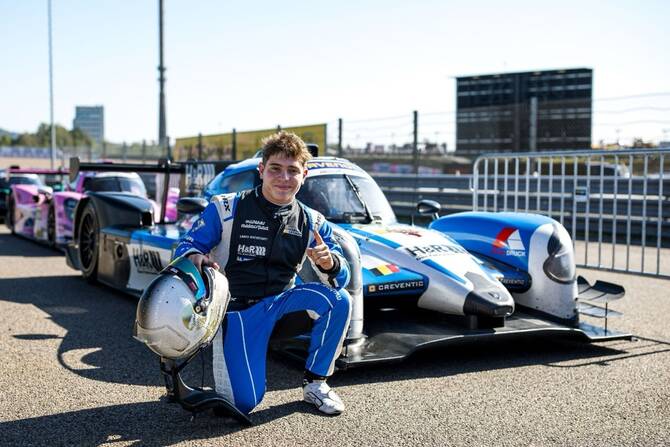
Keanu Al-Azhari will race in the GB3 Championship this season after joining Alpine. (Supplied)
Short Url
Updated 14 May 2025
Follow

Dubai-based racing talent targets F1 goals after ‘milestone’ Alpine move

  • Keanu Al-Azhari, 17, recently joined the French team and will race in the GB3 Championship this season

DUBAI: A young UAE motorsport driver hopes his move to Alpine Academy can help him achieve his goal of racing in Formula 1 in the future.

Dubai-based Keanu Al-Azhari, 17, recently joined F1’s Alpine Academy and will race for Hitech GP in the GB3 Championship this year after two seasons in Formula 4.

He praised Dubai Autodrome, a subsidiary of Union Properties, for its role in his sporting development.

Al-Azhari described his move to Alpine Academy as a “milestone” achievement, especially as he comes from a racing family. The 17-year-old is now looking forward to the latest chapter in his racing journey, hoping it can eventually lead to a seat in the pinnacle of motorsport — Formula 1.

“Joining Alpine is a big milestone in my career and a reflection of all the hard work that I have put in,” he said. “I’m really proud to be part of the Alpine family, and they will help develop me during my junior single-seater career. Hopefully, this move will be another step toward reaching my career goal of reaching F1 one day, as that is my dream. It’s going to be a tough few years, but I am ready to show everyone what I have now.”

Al-Azhari has made an impressive start to his motorsport career. Last year, he secured four wins, nine podiums and five pole positions, finishing runner-up in the Formula 4 Spanish Championship, while in the Formula 4 UAE Championship in the same year, he earned two wins, five podiums and four pole positions to secure third place overall.

Before getting behind the wheel, he came through the ranks in karting at Dubai Kartdrome, where he was part of its DAKA program, and raced in some prominent competitions, including the IAME Series UAE.

His fond memories of the venue came at a very early age, having followed his father, Karim, in his motorsport journey. Al-Azhari also spoke of his gratitude to Dubai Autodrome for supporting his career.

He said: “The Dubai Autodrome and Kartdrome have been a big part of my life. My first memories of going to the track were at a very young age, when I was 3 years old, when my dad, Karim Al-Azhari, was racing in local competitions. After finishing my karting career, it was the place where I learned how to drive a racing car and got my racing license.

“I have taken to the track and driven in so many different layouts of the track, which helped me develop before I went into the Formula 4 European Series races. I’m really grateful for their support, as they have played a big role in my journey today.”

Al-Azhari is among a number of young drivers who have transitioned from karting to motorsport with the help of Dubai Kartdrome.

The list includes UAE’s Rashid Al-Dhaheri, former Dubai Kartdrome O Plate champion, who recently joined Mercedes’ Junior Driver Program; Zack Scoular, competing in British GB3; Jamie Day, an ex-karting champion and part of the Aston Martin drivers’ junior team in European Endurance GT3; Edward Jones, who finished third in Indy 500; and Federico Rifai, a multiple-karting champion and former Saudi F4 winner.

Having seen Al-Azhari come through the ranks, Dubai Autodrome general manager Faisal Al-Sahlawi said the 17-year-old’s rapid progress is a testament to the Dubai Autodrome’s efforts to produce future motorsport stars.

He added: “We are extremely pleased to see how far Keanu Al-Azhari has come so early in his career, and we are delighted Dubai Autodrome has played a key role in helping make him the driver he is today.

“Ever since he started coming to Dubai Autodrome, he always had a passion for motorsport and the hunger to succeed in every race, and it is wonderful to see that he still has that commitment. With plenty of years ahead of him, he possesses all the correct attributes to be an even better driver and become a future world motorsport champion.

“We hope many young drivers across the UAE can follow in his footsteps and begin their motorsport journey with Dubai Autodrome.”


Football’s return to Syrian pitches brings fanfare — and friction

Updated 11 sec ago
Follow

Football’s return to Syrian pitches brings fanfare — and friction

RIYADH: Just 10 days after the first anniversary of Syria’s Liberation Day, and one week after the historic performance of the country’s football team at the 2025 Arab Cup — where they reached the quarterfinals — domestic football returned as the Syrian Premier League kicked off its new season.

While league football has continued intermittently since a one-year suspension in 2011, this season represents a notable shift.

For the first time since 2017, the competition features 16 teams playing a full round-robin format — a return to structural normality after years of disrupted campaigns, withdrawals and operational challenges caused by conflict and deteriorating infrastructure.

Foreign players have also returned in significant numbers. A total of 25 overseas players are registered across the 16 clubs in what is now known as the “Prime TV” Syrian Premier League, following the broadcaster’s acquisition of domestic broadcasting rights for the season.

Yet despite the sense of renewal, the league’s reset has been far from smooth. Average attendances remain well below pre-war levels, while the season itself was delayed multiple times before eventually beginning in mid-December — a schedule that is now expected to extend deep into the summer months.

Concerns over facilities and fan safety have already sparked internal tension. The anticipated Matchday Two fixture between Tishreen and Hottin — also known as the Latakia Derby — was postponed by the Syrian Football Association until further notice. No official explanation was provided, but stadium readiness and crowd safety has been at the core of football discussion in Syria.

Supporters have also voiced their frustration over the newly announced ticket prices. Entry fees increased from 5,000 Syrian pounds ($0.45) to 15,000 SYP, a threefold rise announced by the SFA and widely cited as a factor behind subdued crowds.

Infrastructure remains a pressing issue. Historic venues such as Khalid Ibn Al-Walid Stadium in the city of Homs are still not cleared to host games due to pitch conditions and safety requirements, reinforcing the sense of uneven progress — advances made, but frequently offset by new obstacles.

Operational shortcomings were evident as early as the first game of the season. In the opening fixture between Al-Shorta and Hottin, a formal warning was issued to the former by the Disciplinary and Ethics Committee due to a breach in organizational arrangements for the match, including the failure to provide ball boys, which led to a five-minute delay to kick-off.

Political sensitivities have not been easy to navigate either. Al-Karamah were fined 1,500,000 SYP after fans directed verbal abuse at Al-Wahda player Milad Hamad, due to previous political posts made on his Facebook account.

Five days later, Al-Wahda announced Hamad’s suspension from all sporting activities pending review by the relevant committee at the SFA. “This decision comes in solidarity with all our beloved Syrian fans and as a reaffirmation of our commitment to the unity of our people and our land, and to the fact that the blood of our martyrs in the Syrian Revolution has not been shed in vain,” the club said in a statement posted via their official Facebook page.

Rebuilding a sustainable football system in Syria has proven complex. The league’s return has brought moments of excitement alongside renewed tension — a reminder that restoring domestic football is not simply about restarting competition, but about addressing the structures that support it. The Syrian Football Association was contacted for comment, but did not respond.