

Lebanese hairstylist expands footprint in Pakistan with Lahore salon launch

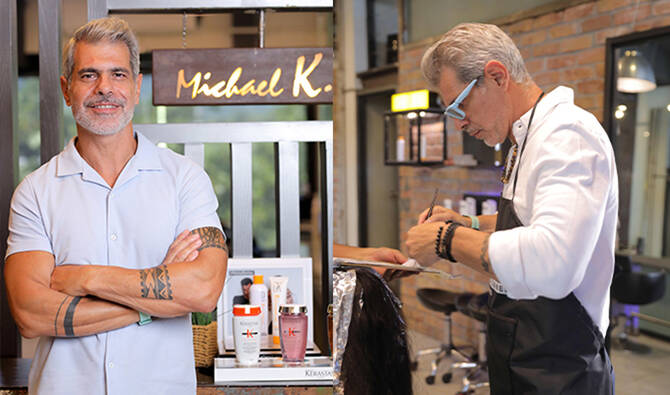
Handout photos released by Michael K. Salon shows Lebanese hairstylist Michael Kanaan at work in his salon in Lahore, Pakistan.
Short Url
Updated 14 May 2025
Follow

Lebanese hairstylist expands footprint in Pakistan with Lahore salon launch

  • Michael Kanaan moved to Pakistan over two decades ago and has worked in Beirut, Cairo and Dubai
  • Luxury salons are gaining ground in Pakistan amid rising demand in a largely informal grooming market

ISLAMABAD: A Lebanese hairstylist known for bringing international styling techniques to Pakistan has opened a new salon in the eastern city of Lahore, expanding his presence in the country’s high-end grooming market.

Michael Kanaan, who began his career as a teenage apprentice in Mount Lebanon, has worked in Beirut, Cairo, Dubai and Abu Dhabi. He moved to Pakistan more than two decades ago and launched his first salon in Islamabad in 2009 with his wife and business partner, Elizabeth Whitney Kanaan.

Known for his distinctive personal style and precision-based technique, Kanaan has built a reputation among diplomats, socialites and professionals in the Pakistani capital. His salons now employ more than 30 staff, including four international stylists.

“Expanding into Lahore is a big step for us,” Kanaan was quoted in a statement circulated after the launch of the Lahore branch last week.

“It’s fresh energy and a new audience. We’re quite excited about bringing what we do to a whole new community while growing the brand in a way that still feels personal and true to our roots.”

With rising demand for luxury grooming services in Pakistan’s urban centers, salons offering international standards are carving out space in a market still dominated by informal setups.

Kanaan said a key focus remains on consistent training and long-term client relationships.

“The beauty industry has evolved in so many ways,” he said, “but at its heart, it’s always been about making people feel beautiful, confident and empowered.”


Rating firm S&P says it won’t rush Iran war downgrades, sees risks for countries like Pakistan

Updated 12 March 2026
Follow

Rating firm S&P says it won’t rush Iran war downgrades, sees risks for countries like Pakistan

  • Agency says it is monitoring indebted energy importers as higher oil prices strain finances
  • Gulf economies seen better placed to weather shock, though Bahrain flagged as vulnerable

LONDON: S&P Global ‌said it would not make any knee-jerk sovereign rating cuts following the outbreak of war in the ​Middle East, but warned on Thursday that soaring oil and gas prices were putting a number of already cash-strapped countries at risk.

The firm’s top analysts said in a webinar that the conflict, which has involved US and Israeli strikes ‌against Iran and Iranian ‌strikes against Israel, ​US ‌bases ⁠and Gulf ​states, ⁠was now moving from a low- to moderate-risk scenario.

Most Gulf countries had enough fiscal buffers, however, to weather the crisis for a while, with more lowly rated Bahrain the only clear exception.

Qatar’s banking sector could ⁠also struggle if there were significant ‌deposit outflows in ‌reaction to the conflict, although there ​was no evidence ‌of such strains at the moment, they ‌said.

“We don’t want to jump the gun and just say things are bad,” S&P’s head global sovereign analyst, Roberto Sifon-Arevalo, said.

The longer the crisis ‌was prolonged, though, “the more difficult it is going to be,” he ⁠added.

Sifon-Arevalo ⁠said Asia was the second-most exposed region, due to many of its countries being significant Gulf oil and gas importers.

India, Thailand and Indonesia have relatively lower reserves of oil, while the region also had already heavily indebted countries such as Pakistan, Bangladesh and Sri Lanka whose finances would be further hurt by rising energy prices.

“We ​are closely monitoring ​these (countries) to see how the credit stories evolve,” Sifon-Arevalo said.