

Trump calls for deeper India-Pakistan engagement, hails US role in ceasefire at Riyadh forum

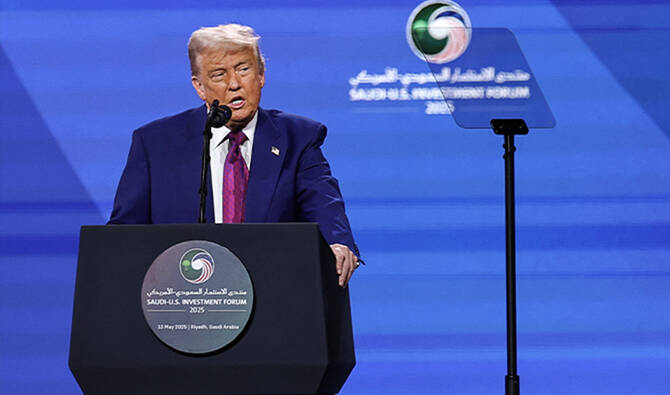
US President Donald Trump speaks at the Saudi-US Investment Forum, in Riyadh, Saudi Arabia on May 13, 2025. (Reuters)
Short Url
Updated 14 May 2025
Follow

Trump calls for deeper India-Pakistan engagement, hails US role in ceasefire at Riyadh forum

  • The US president says he used trade as leverage to secure the ceasefire, a claim India denies
  • He asks Marco Rubio to help leaders of both countries ‘go out and have a nice dinner together’

ISLAMABAD: United States President Donald Trump on Tuesday reiterated he had brokered a “historic ceasefire” between India and Pakistan using trade as leverage, while urging his administration to help build diplomatic ties strong enough for the nuclear-armed rivals to someday “go out and have a nice dinner together.”

The statement came days after a major standoff between the two South Asian neighbors, which saw both sides exchange missile and drone attacks as well as artillery fire across the Line of Control in Kashmir.

Trump, who announced the ceasefire on Saturday, said it followed a night of intense diplomatic activity. Subsequently, US Secretary of State Marco Rubio informed the two countries had agreed to hold talks at a neutral venue to discuss a broad range of outstanding issues.

Trump made the remarks about the ceasefire during his address to the Saudi-US Investment Forum in Riyadh, shortly after arriving in the Kingdom where he met Crown Prince Mohammed bin Salman and senior Saudi officials. 

The visit also saw the signing of more than $300 billion in defense and economic deals.

“Just days ago, my administration successfully brokered a historic ceasefire to stop the escalating violence between India and Pakistan,” he said. “And I used trade to a large extent to do it and I said, ‘Fellas, come on, let’s make a deal. Let’s do some trading. Let’s not trade nuclear missiles. Let’s trade the things that you make so beautifully.’”

Trump praised the efforts of his top aides, including Vice President JD Vance and Rubio, and called the leadership in both India and Pakistan “strong and smart.”

“Maybe we can even get them together a little bit, Marco, where they go out and have a nice dinner together,” he added. “Wouldn’t that be nice?”

He warned that the recent crisis, which he said “started off small,” had the potential to spiral into a broader conflict with devastating consequences.

“Millions of people could have died,” he said.

India, however, negated shortly before Trump’s speech that trade was a factor in the US-mediated truce.

Randhir Jaiswal, spokesperson for India’s Ministry of External Affairs, confirmed that top leaders in New Delhi and Washington remained in close contact during the standoff, but denied that trade was discussed.

“The issue of trade didn’t come up in any of these discussions,” he said, referring to calls between Vance and Prime Minister Narendra Modi, as well as between Rubio and External Affairs Minister Subrahmanyam Jaishankar.

With input from AP


Sindh assembly passes resolution rejecting move to separate Karachi

Updated 21 February 2026
Follow

Sindh assembly passes resolution rejecting move to separate Karachi

  • Chief Minister Shah cites constitutional safeguards against altering provincial boundaries
  • Calls to separate Karachi intensified amid governance concerns after a mall fire last month

ISLAMABAD: The provincial assembly of Pakistan’s southern Sindh province on Saturday passed a resolution rejecting any move to separate Karachi, declaring its territorial integrity “non-negotiable” amid political calls to carve the city out as a separate administrative unit.

The resolution comes after fresh demands by the Muttahida Qaumi Movement (MQM) and other voices to grant Karachi provincial or federal status following governance challenges highlighted by the deadly Gul Plaza fire earlier this year that killed 80 people.

Karachi, Pakistan’s largest and most densely populated city, is the country’s main commercial hub and contributes a significant share to the national economy.

Chief Minister Syed Murad Ali Shah tabled the resolution in the assembly, condemning what he described as “divisive statements” about breaking up Sindh or detaching Karachi.

“The province that played a foundational role in the creation of Pakistan cannot allow the fragmentation of its own historic homeland,” Shah told lawmakers, adding that any attempt to divide Sindh or separate Karachi was contrary to the constitution and democratic norms.

Citing Article 239 of Pakistan’s 1973 Constitution, which requires the consent of not less than two-thirds of a provincial assembly to alter provincial boundaries, Shah said any such move could not proceed without the assembly’s approval.

“If any such move is attempted, it is this Assembly — by a two-thirds majority — that will decide,” he said.

The resolution reaffirmed that Karachi would “forever remain” an integral part of Sindh and directed the provincial government to forward the motion to the president, prime minister and parliamentary leadership for record.

Shah said the resolution was not aimed at anyone but referred to the shifting stance of MQM in the debate while warning that opposing the resolution would amount to supporting the division of Sindh.

The party has been a major political force in Karachi with a significant vote bank in the city and has frequently criticized Shah’s provincial administration over its governance of Pakistan’s largest metropolis.

Taha Ahmed Khan, a senior MQM leader, acknowledged that his party had “presented its demand openly on television channels with clear and logical arguments” to separate Karachi from Sindh.

“It is a purely constitutional debate,” he told Arab News by phone. “We are aware that the Pakistan Peoples Party, which rules the province, holds a two-thirds majority and that a new province cannot be created at this stage. But that does not mean new provinces can never be formed.”

Calls to alter Karachi’s status have periodically surfaced amid longstanding complaints over governance, infrastructure and administrative control in the megacity, though no formal proposal to redraw provincial boundaries has been introduced at the federal level.