Uruguay’s ex-president Jose ‘Pepe’ Mujica dead at 89

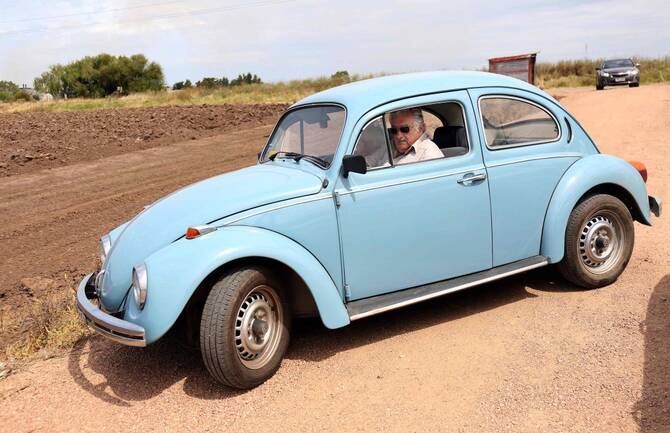
Uruguay’s former President Jose Mujica drives a 1987 Volkswagen Beetle, which he considered as his prized possession, near his house after leaving the presidency, March 1, 2015. (File/AFP)
Short Url
Updated 14 May 2025
Follow

Uruguay’s ex-president Jose ‘Pepe’ Mujica dead at 89

  • Jose 'Pepe' Mujica was a guerrilla fighter and hero of the Latin American left
  • Mujica won fame as the 'world’s poorest president' for giving away much of his salary to charity

MONTEVIDEO: Uruguay’s former president Jose “Pepe” Mujica, a guerrilla fighter and hero of the Latin American left, has died at the age of 89, the government in Montevideo said Tuesday.
“With deep sorrow, we announce the passing of our comrade Pepe Mujica. President, activist, guide and leader. We will miss you greatly, old friend,” the country’s current president, Yamandu Orsi, said on X.
Mujica won fame as the “world’s poorest president” for giving away much of his salary to charity, during his 2010-2015 presidency.
In May 2024, he was diagnosed with cancer of the esophagus, which later spread to his liver.
His wife Lucia Topolansky said this week he was receiving palliative care.
The man who made Uruguay into a paragon of progressive politics by legalizing abortion, gay marriage and the use of recreational cannabis, campaigned for the left until the end.
In a November 2024 interview with AFP he described the presidential victory of his political heir, history teacher Orsi, as “a reward” at the end of his career.
The blunt-spoken, snowy-haired politician was a fierce critic of consumer culture.
As president he walked the talk by actively rejecting the trappings of office.
He attended official events in sandals and continued living on his small farm on the outskirts of Montevideo, where his prized possession was a 1987 Volkswagen Beetle.
Tupamaros movement
In the 1960s, he co-founded the Marxist-Leninist urban guerrilla movement Tupamaros, which started out robbing from the rich to give to the poor but later escalated its campaign to kidnappings, bombings and assassinations.
During those years, Mujica lived a life of derring-do. He sustained multiple gunshot wounds and took part in a mass prison breakout.
But when the Tupamaros collapsed in 1972, he was recaptured and spent all of Uruguay’s 1973-1985 dictatorship in prison, where he was tortured and spent years in solitary confinement.
After his release, he threw himself into politics and in 1989 founded the Movement of Popular Participation (MPP), the largest member of the leftist Broad Front coalition.
Elected to parliament in 1995, he became a senator in 2000 and then agriculture minister in Uruguay’s first-ever left-wing government.
He served just one five-year term as president, in line with Uruguay’s term limits.
Mujica had no children and is survived by fellow ex-guerrilla Topolansky.


Hundreds of thousands of Catholics join Black Nazarene procession in Manila

Updated 6 sec ago
Follow

Hundreds of thousands of Catholics join Black Nazarene procession in Manila

  • Around 80 percent of Philippines’ 110 million population are Roman Catholics 
  • The annual 6km procession began at 4 a.m. on Friday

MANILA: Hundreds of thousands of Catholics took part in a barefoot procession in Manila on Friday, carrying the Black Nazarene, a centuries-old ebony statue of Jesus Christ believed by devotees to have miraculous powers.

Around 80 percent of the Philippines’ 110 million population identify as Roman Catholic, a legacy of more than 300 years of Spanish colonization.

After a midnight mass joined by tens of thousands of worshippers, the procession began at the Quirino Grandstand at 4 a.m., with the statue of Jesus placed on a cross carried by a four-wheel carriage, which then slowly traveled through Manila’s roads, thronged by massive crowds, for around 6 kilometers. 

The procession — which is known as the Traslacion (“transfer”) or as the Feast of the Black Nazarene — commemorates the 1787 relocation of the Black Nazarene from a church inside the colonial Spanish capital of Intramuros in Manila’s center to its present location in Quiapo Church. 

For many Filipino Catholics, the annual procession and the festivities surrounding it are deeply personal — a way of expressing deep faith and spiritual devotion, and conveying their personal prayers. 

“As early as Jan. 8, you will already see a long queue of devotees near the Quirino Grandstand. Many of them are there to get the chance to wipe a towel on the image of the Nazarene. That’s their devotion,” Jomel Bermudez told Arab News. 

Many devotees believe the statue is miraculous, and that touching it, or the ropes attached to its float, can heal illness or help provide good health, jobs and a better life. This belief is partly because the statue has survived multiple earthquakes, fires, floods, and even the bombing of Manila in the Second World War.

“We wipe (the towels) on our bodies, especially on sick people,” Bermudez continued. “My father, for example, was diagnosed with leukemia and now he is already recovered. He was one of my prayers last year. He is 56, and he survived.” 

On Friday, many devotees were clad in maroon and yellow as they flooded the streets to swarm the statue, jostling for a chance to pull its thick rope. 

Bermudez, who first participated in the procession in 2014, said he was inspired to do so by seeing the effect it had had on friends who had taken part.  

“I saw friends whose lives really changed. That encouraged me to change too,” he said, adding that this year he is one of a group on the sidelines helping to keep the procession moving. 

“My prayers before were already answered. This time, I’m praying for my children’s success in life,” he said. 

Jersey Banez, a 23-year-old devotee, was among those who arrived as early as 2 a.m. to take part in the procession. 

“I do this every year. I’m just grateful for a happy life,” he told Arab News. “My prayer is still the same: to have a happy family and a happy life, and that everyone and everything that needs to change will change.”