India rejects Trump’s claim his trade concessions de-escalated tensions with Pakistan

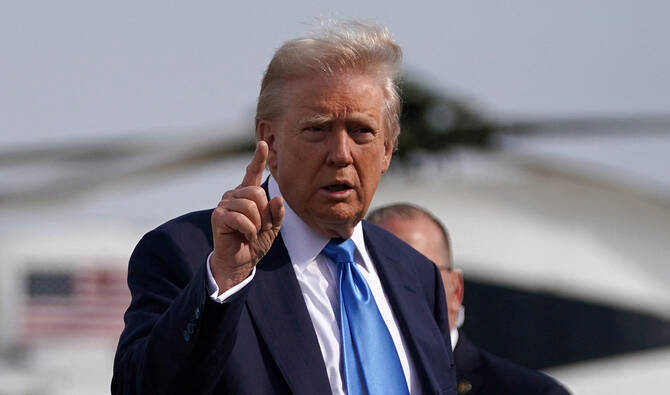
US President Donald Trump gestures as he walks to board Air Force One to depart for Rome, Italy, to attend Pope Francis’ funeral, at Joint Base Andrews in Maryland, US, on April 25, 2025. (REUTERS)
Short Url
Updated 13 May 2025
Follow

India rejects Trump’s claim his trade concessions de-escalated tensions with Pakistan

  • The India, Pakistan militaries last week engaged in one of their most serious confrontations in decades
  • Trump told reporters on Monday he had offered to help both nations with trade if they agreed to de-escalate

NEW DELHI: The Indian government on Tuesday rejected US President Donald Trump’s claim that he helped broker a ceasefire between India and Pakistan in exchange for trade concessions.

Addressing a weekly news conference, Randhir Jaiswal, the spokesman for India’s foreign ministry, said top leaders in New Delhi and Washington were in touch last week following the Indian military’s intense standoff with Pakistan, but there was no conversation on trade.

“The issue of trade didn’t not come up in any of these discussions,” Jaiswal said, referring to the conversations held between US Vice President JD Vance and Indian Prime Minister Narendra Modi, as well as between US Secretary of State Marco Rubio and his Indian counterpart, S. Jaishankar.

Following Saturday’s understanding reached between India and Pakistan in what was a US-mediated ceasefire to stop military action on land, in the air and at sea, Trump told reporters on Monday that he offered to help both the nations with trade if they agreed to de-escalate.

“I said, ‘Come on, we’re going to do a lot of trade with you guys. Let’s stop it. Let’s stop it. If you stop it, we’ll do a trade. If you don’t stop it, we’re not going to do any trade’,” Trump said.

“And all of a sudden, they said, ‘I think we’re going to stop’,” Trump said, crediting trade leverage for influencing both the nations’ decision. “For a lot of reasons, but trade is a big one.”

The militaries of India and Pakistan had been engaged in one of their most serious confrontations in decades since last Wednesday, when India struck targets inside Pakistan it said were affiliated with militants responsible for the killing of 26 tourists last month in Indian-administered Kashmir.

After India’s strikes in Pakistan, both sides exchanged heavy fire along their de facto border, followed by missile and drone strikes into each other’s territories, mainly targeting military installations and air bases.

The escalating hostilities between the nuclear-armed rivals threatened regional peace, leading to calls by world leaders to cool down tempers.

Trump said he not only helped mediate the ceasefire, but also offered mediation over the simmering dispute in Kashmir, a Himalayan region that both India and Pakistan claim in entirety but govern in part. The two nations have fought two wars over Kashmir, which has long been described as the regional nuclear flashpoint.

New Delhi also rejected Trump’s offer for mediation on Tuesday.

“We have a longstanding national position that any issues related to the federally controlled union territory of Jammu and Kashmir must be addressed by India and Pakistan bilaterally. There has been no change to the stated policy,” Jaiswal said.


Pakistani politicians urge dialogue with Imran Khan’s party as PM offers talks

Updated 07 January 2026
Follow

Pakistani politicians urge dialogue with Imran Khan’s party as PM offers talks

  • National Dialogue Committee group organizes summit attended by prominent lawyers, politicians and journalists in Islamabad
  • Participants urge government to lift alleged ban on political activities and media restrictions, form committee for negotiations 

ISLAMABAD: Participants of a meeting featuring prominent politicians, lawyers and civil society members on Wednesday urged the government to initiate talks with former prime minister Imran Khan’s Pakistan Tehreek-e-Insaf (PTI) party, lift alleged bans on political activities after Prime Minister Shehbaz Sharif recently invited the PTI for talks. 

The summit was organized by the National Dialogue Committee (NDC), a political group formed last month by former PTI members Chaudhry Fawad Husain, ex-Sindh governor Imran Ismail and Mehmood Moulvi. The NDC has called for efforts to ease political tensions in the country and facilitate dialogue between the government and Khan’s party. 

The development takes place amid rising tensions between the PTI and Pakistan’s military and government. Khan, who remains in jail on a slew of charges he says are politically motivated, blames the military and the government for colluding to keep him away from power by rigging the 2024 general election and implicating him in false cases. Both deny his allegations. 

Since Khan was ousted in a parliamentary vote in April 2022, the PTI has complained of a widespread state crackdown, while Khan and his senior party colleagues have been embroiled in dozens of legal cases. Prime Minister Shehbaz Sharif last month invited the PTI for talks during a meeting of the federal cabinet, saying harmony among political forces was essential for the country’s progress.

“The prime objective of the dialogue is that we want to bring the political temperatures down,” Ismail told Arab News after the conference concluded. 

“At the moment, the heat is so much that people— especially in politics— they do not want to sit across the table and discuss the pertaining issues of Pakistan which is blocking the way for investment.”

Former prime minister Shahid Khaqan Abbasi, who heads the Awaam Pakistan political party, attended the summit along with Jamaat-e-Islami senior leader Liaquat Baloch, Muttahida Quami Movement-Pakistan’s Waseem Akhtar and Haroon Ur Rashid, president of the Supreme Court Bar Association. Journalists Asma Shirazi and Fahd Husain also attended the meeting. 

Members of the Pakistan Peoples Party, the ruling Pakistan Muslim League-Nawaz (PML-N) and the PTI did not attend the gathering. 

The NDC urged Prime Minister Shehbaz Sharif, President Asif Ali Zardari and PML-N chief Nawaz Sharif to initiate talks with the opposition. It said after the government forms its team, the NDC will announce the names of the opposition negotiating team after holding consultations with its jailed members. 

“Let us create some environment. Let us bring some temperatures down and then we will do it,” Ismail said regarding a potential meeting with the jailed Khan. 

Muhammad Ali Saif, a former adviser to the Khyber Pakhtunkhwa chief minister, told participants of the meeting that Pakistan was currently in a “dysfunctional state” due to extreme political polarization.

“The tension between the PTI and the institutions, particularly the army, at the moment is the most fundamental, the most prominent and the most crucial issue,” Saif noted. 

‘CHANGED FACES’

The summit proposed six specific confidence-building measures. These included lifting an alleged ban on political activities and the appointment of the leaders of opposition in Pakistan’s Senate and National Assembly. 

The joint communique called for the immediate release of women political prisoners, such as Khan’s wife Bushra Bibi and PTI leader Yasmin Rashid, and the withdrawal of cases against supporters of political parties.

The communiqué also called for an end to media censorship and proposed that the government and opposition should “neither use the Pakistan Armed Forces for their politics nor engage in negative propaganda against them.”

Amir Khan, an overseas Pakistani businessperson, complained that frequent political changes in the country had undermined investors’ confidence.

“I came here with investment ideas, I came to know that faces have changed after a year,” Amir Khan said, referring to the frequent change in government personnel. 

Khan’s party, on the other hand, has been calling for a “meaningful” political dialogue with the government. 

However, it has accused the government of denying PTI members meetings with Khan in the Rawalpindi prison where he remains incarcerated. 

“For dialogue to be meaningful, it is essential that these authorized representatives are allowed regular and unhindered access to Imran Khan so that any engagement accurately reflects his views and PTI’s collective position,” PTI leader Azhar Leghari told Arab News last week.