


BEIRUT: Art lovers may embark on an astonishing exploration with Joana Hadjithomas and Khalil Joreige into the depths of the waters and soil of Lebanon in search of the hidden secrets of its unseen subterranean worlds.
At the Sursock Museum on Beirut’s historic Sursock Street, Hadjithomas and Joreige have unveiled the results of a decade of research and experimentation in an exhibition titled “Remembering the Light.”
This exhibition serves as a transcendent experience that explores various expressive forms, delving into reflections on time, memory, and the profound transformations of cities, bodies, and history.
The outcome of this research has taken the form of artistic installations, photographs, and sculptures that narrate the intricacies of archaeology, infused with imaginative elements and references to fragility and permanence.
These works evoke perspectives on materiality, memory, and undiscovered narratives, delving into what is buried, forgotten or obscured, at depths reaching 45 meters in a remarkable journey through time.
The exhibition derives its title from a video produced in 2016, in which the two artists explored the spectrum of light underwater and the glow emanating from its depths, addressing the present by collaborating with geologists, archaeologists, poets, divers, and scientists.
The artists said that through the exhibition’s paintings is shown how “unexpected phenomena occur underwater. Sensory perception changes as one descends deeper into the water. The light spectrum diminishes and colors fade, with red disappearing first, followed by orange, yellow, green, and blue, until everything is engulfed in darkness. However, when the dark seabed is illuminated, the obstacles recall the memory of light and reflect it.”
Hadjithomas and Joreige state that the experience undertaken by the divers they enlisted mirrors the dangers faced by migrants crossing the Mediterranean Sea. They accompanied this with a scene of a scarf cascading downward, symbolizing memories of a war submerged over time.
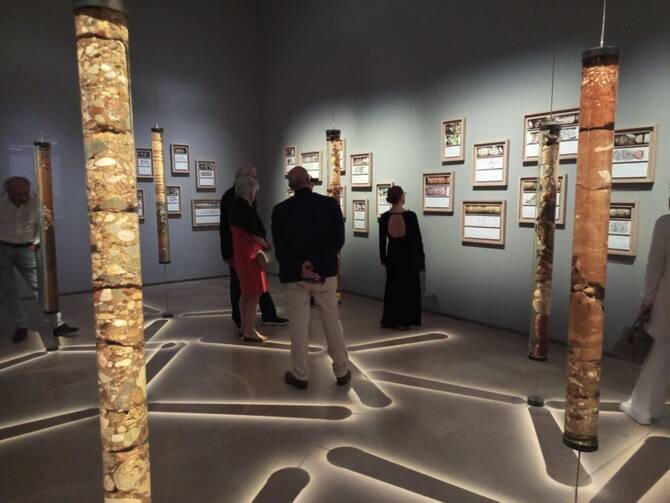
The exhibition features a pile of earth layers bearing the material traces of archaeological and geological times in the cities of Beirut, Nahr Al-Bared in northern Lebanon, and Tripoli, completed over the past decade.
The rubble of cities, Palestinian refugee camps, and construction sites was rearranged into images and transparent capsules, revealing shattered scenes of people’s lives over time. The land has therefore turned into a notebook on which Hadjithomas and Joreige recorded the erased stories.
One unfolds in Nahr Al-Bared (Cold River Bed) camp, which was established in 1948 and destroyed after the 100-day conflict in 2007 between Fateh Al-Islam and the Lebanese Army. As reconstruction efforts began and rubble was cleared, layers of archaeological ruins unexpectedly surfaced: the remains of the mythical Roman city of Orthosia, believed to have been destroyed by a tsunami in 551 AD.
At the exhibition, the artists, guided by archaeologists, present the city’s entangled history through sculptural forms echoing both the soil and red sand used to cover the land.
A slideshow of images or testimonies narrates a story that vertiginously weaves together human displacement, military conflict, and archaeological discovery.
Matter extracted from core samples — soil, rocks, clay, and limestone — is carefully stored for analysis by engineers, prior to any construction.
Guided by those archeologists and geologists, the artists collected and re-sculpted these remains of buried worlds to make visible the imprints of successive human occupations, ecological upheavals, and lost civilizations.
History does not unfold as a coherent succession of chronological layers, but rather as a dynamic entanglement of epochs, marked by ruptures, where traces and civilizations intermingle.
Joreige dedicated part of the exhibition to his uncle, who was abducted in 1985 during the Lebanese civil war, piecing together some of his memories.
He gathered whatever undeveloped films he could from his abandoned home, each lasting 180 seconds, and before they faded, he printed them on blank sheets, producing faint impressions that could only be deciphered by looking closely.
Joreige describes them as “an attempt to resist disappearance.”
He said: “It’s a form of mourning that has yet to find closure, memories that have faded but won’t disappear.”


