

Jordan’s industrial index rises 2.73% in Q1 2025: official data

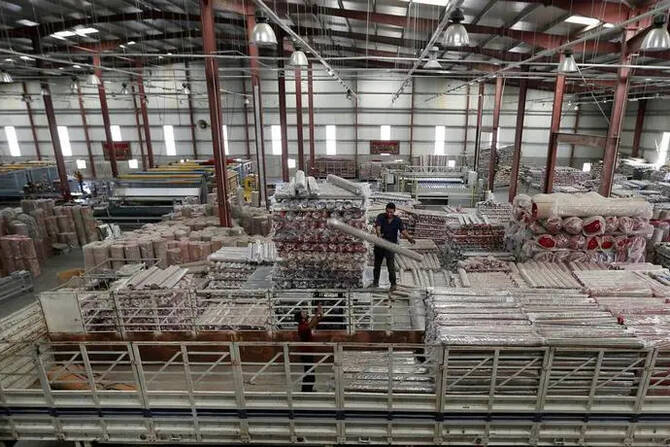
Manufacturing production rose 3.2 percent during the first three months of the year, while electricity output increased 4.97 percent, the Jordan News Agency, Petra, reported. File
Short Url
Updated 13 May 2025
Follow

Jordan’s industrial index rises 2.73% in Q1 2025: official data

RIYADH: Jordan’s industrial production index climbed 2.73 percent year on year in the first quarter of 2025, reaching 87.62 points, driven by robust growth in manufacturing and electricity output, according to data released by the Department of Statistics.

Manufacturing production rose 3.2 percent during the first three months of the year, while electricity output increased 4.97 percent, the Jordan News Agency, Petra, reported. However, the extractive industries sector declined by 8.03 percent over the same period.

The rise in industrial activity comes as Jordan’s inflation rate accelerated by 2.21 percent annually during the first two months of 2025, fueled by rising prices in several key commodity groups.

The upward trend in the index was also reflected in January’s figures, which showed a 2.76 percent annual increase to 88 points.

In March alone, the industrial index grew by 1.73 percent year on year, reaching 87.62 points compared to 86.13 points in March 2024. Petra noted this growth was supported by a 3.38 percent increase in manufacturing and a 4.02 percent rise in electricity production, despite a sharp 23.89 percent decline in extractive industries.

Month on month, the index rose 0.44 percent from February to March, increasing from 87.24 to 87.62 points. During this period, the extractive sector rebounded with a 9.96 percent increase, while manufacturing inched up 0.41 percent. The electricity sector, however, contracted by 7.18 percent.

Meanwhile, Fitch Ratings earlier this month affirmed Jordan’s long-term foreign currency issuer default rating at “BB-” with a stable outlook, citing macroeconomic stability and ongoing fiscal and economic reforms.

The US-based agency highlighted Jordan’s resilient financing environment, supported by a well-capitalized banking sector, a robust public pension fund, and sustained international assistance.

Despite the stable outlook, Jordan’s credit rating remains lower than several of its regional peers. In February, Fitch reaffirmed Saudi Arabia’s rating at “A+” with a stable outlook and the UAE’s at “AA-.”

A “BB” rating indicates a higher vulnerability to default risk in the event of unfavorable economic or business conditions, although some financial flexibility remains.


Saudi Arabia opens 3rd round of Exploration Empowerment Program

Updated 01 February 2026
Follow

Saudi Arabia opens 3rd round of Exploration Empowerment Program

RIYADH: Saudi Arabia’s Ministry of Industry and Mineral Resources, in collaboration with the Ministry of Investment, has opened applications for the third round of the Exploration Empowerment Program, part of ongoing efforts to accelerate mineral exploration in the Kingdom, reduce early-stage investment risks, and attract high-quality investment from local and international mining companies.

The third round of the Exploration Empowerment Program offers a comprehensive support package targeting exploration companies and mineral prospecting license holders.

The initiative aims to lower investment risks for projects and support a faster transition from prospecting to development.

"The program provides coverage of up to 70 percent of the total salaries of Saudi technical staff, such as geologists, during the first two years, increasing to 100 percent thereafter, in line with program requirements.

This support aims to develop talent, build national capabilities in mineral exploration, promote job localization, and facilitate the transfer of geological knowledge.

The application for the third round opened on Jan. 14, allowing participants to benefit from the Kingdom’s attractive investment environment, its stable legal framework, and streamlined regulatory structures, as well as integrated infrastructure that supports the transition from mineral resources to operational mines.

The ministry has set the timeline for the third round, with the application period running from Jan. 14 to March 31.

This will be followed by the evaluation, approval, and signing of agreements from April 1 to May 31, with the eligible projects set to be announced between June 1 and July 31 of the same year.

The program stages include submitting exploration data during the reimbursement and payment phase from Sept. 1 to Nov. 30, followed by technical and financial verification of work programs and approval of the disbursement of support funds in January 2027.

The exploration data will then be published on the National Geological Database in April 2027.

The ministry emphasized that the EEP focuses on supporting the exploration of strategically important minerals with national priority. It also contributes to enhancing geological knowledge by providing up-to-date data that meets international standards, helping investors make informed decisions and supporting the growth of national companies and local supply chains.

The ministry urged companies to apply early to benefit from the program’s third round, which coincided with the fifth edition of the International Mining Conference, which was held from Jan. 13 to 15.