



BAGH, AZAD KASHMIR: The walls of late Usama Ishrat’s modest two-room house in Azad Kashmir are pocked with gaping mortar holes, impossible to miss for anyone visiting the family. Shards of glass still cling to a nearby window, a stark reminder of the devastation unleashed by Indian shelling last week.
Residents living near the border in the disputed Kashmir region — administered in parts by bitter rivals India and Pakistan — have long borne the brunt of cross-border fire whenever tensions escalate.
The latest flare-up, from Wednesday to Saturday, saw both sides trade drones, missiles, fighter jets and artillery fire. In just four days, May 8 to 11, at least 31 people were killed and 123 injured across various districts of Azad Kashmir, according to official figures.
Among the dead was 22-year-old Usama Ishrat, a cashier at a local store in Bagh district. The eldest of five siblings, Ishrat had been married only days earlier, on April 26 — less than two weeks before his life was cut short by shelling on Friday.
“I married him off with great joy,” a grief-stricken Shakeela Khanum, Ishrat’s mother, told Arab News. “He was married for just 13 days. With henna still on, the bride and groom got separated like this.”
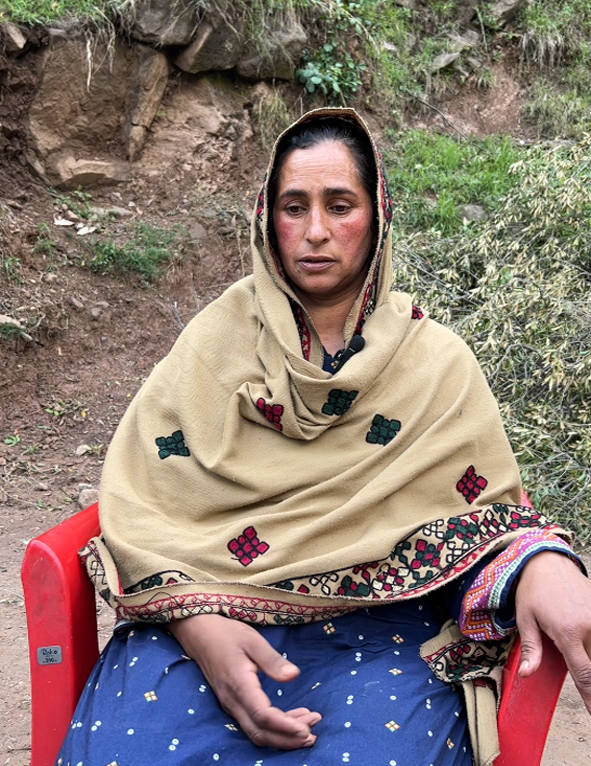
Usama Ishrat’s mother Shakeela Khanum, speaks during an interview with Arab News outside his home in a border town of Bagh district, in Pakistan’s Azad Kashmir region, on May 10, 2025. (AN Photo)
Ishrat Mehmood, the father, recalled that the attack took place at dawn on Friday, while he was standing outside his house. As mortar shells rained down, he fell and blacked out. He regained consciousness when his daughter collapsed beside him, and rushed her inside, only to find that his other two daughters had also been wounded.
That’s when he heard his daughter-in-law’s screams.
“I thought, ‘Maybe she got hit too.’ When I went there, I saw my son was drenched in blood,” he added.
Mehmood said his wounded son, bleeding from a large head injury, appeared to look at them once before passing away.
“A little bit of his brain had come out from here,” Mehmood said, gesturing toward his head. “He was martyred right there on the spot.”
Ehsam, Ishrat’s 12-year-old brother, picked up the pillow where Usama drew his final breath. His hand was immediately stained with dried blood. The pillow and its cover had already been separated. When the cover was unfolded, parts of what still appeared to carry the remnants of Ishrat’s brain matter could be seen.
“My brother’s brain…parts of it are still on this,” Ehsam said.

Top view of the house of Usama Ishrat killed during cross-border escalation in a border town of Bagh district, in Pakistan’s Azad Kashmir region, on May 10, 2025. (AN Photo)
From the next room, Ishrat’s wife could be heard sobbing. Her family had arrived to take her back as she prepared for “iddah,” the mourning period women in Islam are required to observe following the husband’s death or in the event of a divorce.
The attack had also wounded Khanum, who said a splinter had injured her leg.
“Don’t know, a fragment or something is still inside,” she said. “Today, I am feeling it is still inside. I didn’t even try to get it out.”
Two of her daughters are being treated at the Pakistan Institute of Medical Sciences (PIMS) in Islamabad.
The world breathed a sigh of relief when US President Donald Trump announced Washington had brokered a ceasefire between the two hostile neighbors on Saturday. After initial accusations of violations by both sides, the ceasefire continues to hold.
But for Ishrat’s family, the damage has been done.
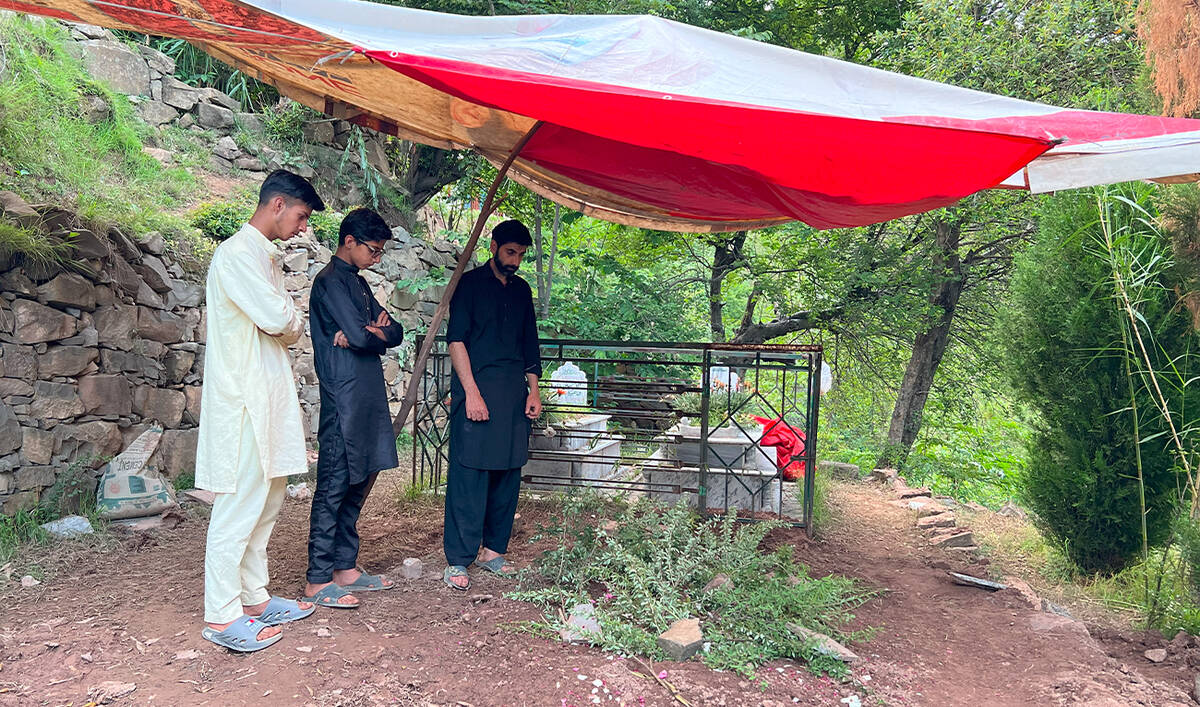
Ajmal Zulfiqar (right) stands at the grave of his deceased cousin Usama Ishrat, killed during cross-border escalation in a border town of Bagh district, in Pakistan’s Azad Kashmir region, on May 10, 2025. (AN Photo)
“I want to say this to the whole world that they agreed to a ceasefire between themselves,” Ajmal Zulfiqar, his cousin, told Arab News. “But our beloved is gone. He is not going to come back.”


