VATICAN CITY: They went into last week’s conclave vastly outnumbered and smarting after being sidelined by Pope Francis for 12 years.
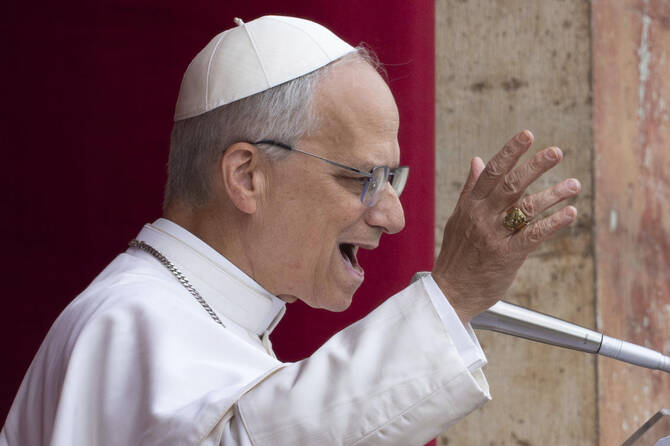
And yet conservatives and traditionalist Catholics are cautiously optimistic over the historic election of Pope Leo XIV, hopeful that he will return doctrinal rigor to the papacy, even as progressives sense he will continue Francis’ reformist agenda.
Cardinal Gerhard Mueller, a titan of the conservative bloc, said Monday he was very pleased with the election and expected that Leo would heal the divisions that escalated during Francis’ pontificate. Mueller, who was fired by Francis as the Vatican’s doctrinal chief, suggested as a first step that Leo should restore access to the old Latin Mass that his predecessor had greatly restricted.
“I am convinced that he will overcome these superfluous tensions (which were) damaging for the church,” Mueller said in an interview with The Associated Press. “We cannot avoid all the conflicts, but we have to avoid the not necessary conflicts, the superfluous conflicts.”
His sense of hope is significant, given that conservative cardinals went into the conclave at a numerical disadvantage. Francis appointed 108 of the 133 electors, including the former Cardinal Robert Prevost and other pastors in his image.
But in the secret dynamics of the conclave, the Augustinian missionary who spent most of his priestly life in Peru secured far more than the two-thirds majority needed on the fourth ballot in an exceptionally quick, 24-hour conclave. The speed and margin defied expectations, given that this was the largest, most geographically diverse conclave in history and the cardinals barely knew each other.
A ‘good impression’ in the conclave
“I think it was a good impression of him to everybody, and in the end it was a great concordia, a great harmony,” Mueller said. “There was no polemics, no fractionizing.”
Speaking in an interview in his apartment library just off St. Peter’s Square, Mueller said Francis’ crackdown on traditionalists and the old Mass created unnecessary divisions that Leo knows he must heal.
Pope Benedict XVI had loosened restrictions on celebrations of the Latin Mass, which was used for centuries before the modernizing reforms of the 1960s Second Vatican Council, which allowed the liturgy to be celebrated in the vernacular. Francis reversed Benedict’s signature liturgical legacy, saying the spread of the Latin Mass had created divisions in dioceses. But the crackdown had the effect of galvanizing Francis’ conservative foes.
“We cannot absolutely condemn or forbid the legitimate right and form of the Latin liturgy,” Mueller said. “According to his character, I think (Leo) is able to speak with people and to find a very good solution that is good for everybody.”
A pleasant surprise over the name ‘Leo’
Mueller is not alone in his optimism.
Benedict’s longtime secretary, Archbishop Georg Gaenswein, who also was fired by Francis and exiled from the Vatican, said he was pleasantly surprised by Leo’s election and hopeful for the future.
In an interview with Corriere della Sera, Gaenswein said the new pontiff’s choice of his name, referencing Pope Leo XIII, who led the church from 1878-1903, as well as Leo the Great and other popes, sent a signal that he would respect tradition, restore doctrinal clarity and pacify divisions.
“Pope Prevost gives me great hope,” Gaenswein was quoted as saying.
In newspaper stories, social media posts, TV interviews and private conversations among friends, some of Francis’ most vocal critics also are sounding cautiously optimistic, rejoicing over some of the smallest — but to them significant — gestures.
They liked that Leo read a written statement when he emerged from the conclave on the loggia of St. Peter’s Basilica, rather than improvise. They liked that his first words referenced Jesus Christ. They loved that he decided to wear the formal red cape, or mozzetta, of the papacy, which they viewed as a show of respect for the office that Francis had eschewed.
Another plus: He sang the noontime Regina Caeli Latin prayer on Sunday, instead of reciting it.
Many point to a report in Corriere that one evening before the conclave began, Prevost was seen entering the apartment building of Cardinal Raymond Burke, another tradition-minded cardinal whom Francis fired as the Vatican’s supreme court chief. Burke, who didn’t respond to a request for comment, could have played the role of a “kingmaker” in the conclave, rallying conservative votes behind a particular candidate.
Mueller said he knew nothing about such a meeting and insisted he was unaware of behind-the-scenes pushing of Prevost. Such lobbying occurred when Jorge Mario Bergoglio had more progressive cardinals promoting his candidacy in 2005 and 2013.
Asked if he voted for Prevost, Mueller demurred.
“Oh, I cannot say. But I am content, no?” he replied.
And yet Prevost also pleased moderates, with many seeing in his first words a continuation of Francis’ priorities to build bridges. The buzzwords signal to some a pope who reaches out to the LGBTQ+ community and people of other faiths. But to others, it is the literal meaning of “pontifex” and a sign of internal bridge-building to heal divisions.
“The pope, as successor of St. Peter, has to unite the church,” Mueller said.
Mueller said he expected Leo would move into the papal apartments at the Apostolic Palace, which he said was the proper place for a pope. Francis chose to live in the Vatican’s Domus Santa Marta hotel because he said he needed to be around people. But the decision had the practical effect of taking over the entire second floor of the hotel, reducing rooms for visiting priests.
Both progressives and conservatives see what they want in Leo
Part of the dynamic at play in these early days of Leo’s papacy is that it appears progressives and conservatives can see in Leo what they want. He has virtually no published history, and played his cards very close to his vest while in Rome as head of the Vatican’s bishops office. He granted few interviews and shied away from the public appearances that fill Vatican cardinals’ days after hours: book presentations, conferences and academic lectures.
George Weigel, the biographer of St. John Paul II and senior fellow at the Ethics and Public Policy Center, said Leo’s doctrinal position should be self-evident: that “a man who spent a lot of his life in the Peruvian missions believes in the truth of the Gospel and the truth of the world.”
As for the papal cape and stole, it means “we have a pope who understands the nature of the Petrine Office, which should not be bent to personal idiosyncrasies,” Weigel said in an email.


![]()

Conservatives cautiously hopeful Pope Leo XIV will restore rigor to papacy
Short Url
https://arab.news/rv62h
Conservatives cautiously hopeful Pope Leo XIV will restore rigor to papacy
- Traditionalist Catholics are cautiously optimistic over the historic election of Pope Leo XIV, hopeful that he will return doctrinal rigor to the papacy,


Latest updates


Recommended


© 2026 SAUDI RESEARCH & PUBLISHING COMPANY, All Rights Reserved And subject to Terms of Use Agreement.