


RIYADH: As President Donald Trump embarks on the first and, arguably, the most significant overseas tour of his second term, both the US and Saudi Arabia are eyeing investments worth billions of dollars.
In a call in January immediately after Trump was sworn in, Crown Prince Mohammed bin Salman told the president that the Kingdom planned to increase the value of its trade and investments with the US by $600 billion over the coming four years. This suggested that the value of mutually beneficial deals between the two countries might potentially reach $1 trillion, indicating that the bilateral relationship was entering a bold new phase.
Driving this next chapter in the relationship are personal diplomacy, strategic commercial interests, and a shared vision for geopolitical alignment.
Trump’s first foreign visit as US president during his first term was to Riyadh in May 2017. This marked the beginning of a transformative economic partnership between the US and Saudi Arabia and a new era of cooperation centered on defense, energy and infrastructure agreements worth hundreds of billions of dollars.
Now, as the American president returns to the Kingdom, his first stop on a tour this week that will also take him to Qatar and the UAE, the foundations laid in 2017 are set to be built upon.

Trump’s first foreign visit as US president during his first term to Riyadh in May 2017 marked the beginning of a transformative economic partnership between the US and Saudi Arabia. (AFP)
Trump’s first term (2017–2021) was characterized by a national-interest-driven foreign policy. Saudi Arabia quickly emerged as a cornerstone ally in both economic and strategic terms, a dynamic cemented at the historic Riyadh Summit in May 2017, at which King Salman extended an exceptionally warm welcome to the president.
The summit produced a wave of landmark agreements, most notably a $110 billion arms deal — part of a broader $350 billion economic package encompassing defense, energy and infrastructure initiatives.
In addition to state-level commitments, major commercial accords were struck. Saudi Aramco signed agreements valued at approximately $50 billion with prominent US firms including General Electric, Schlumberger and Halliburton.
Then Saudi Energy Minister Khalid Al-Falih highlighted the private sector’s growing role, remarking: “Many of us sitting at the table are overseeing substantial investments in the United States.”
Further solidifying the economic partnership, the Kingdom’s Public Investment Fund pledged $20 billion to a US infrastructure initiative spearheaded by Blackstone.
This commitment helped to anchor a $40 billion fund dedicated to revitalizing American roads, bridges and airports. Simultaneously, Saudi Arabia announced a $45 billion investment in the SoftBank Vision Fund, directing capital toward cutting-edge US technology ventures.

President Trump, addressing the summit’s assembled dignitaries, emphasized the significance of the occasion.
“This historic and unprecedented gathering of leaders — unique in the history of nations — is a symbol to the world of our shared resolve and our mutual respect,” he said. “The United States is eager to form closer bonds of friendship, security, culture and commerce.”
Then Secretary of State Rex Tillerson said the investments were expected to create hundreds of thousands of jobs in both countries over the coming decade.
“They will lead to a transfer of technology from the US to Saudi Arabia, enhance our economy, and also enhance American investments in Saudi Arabia, which already are the largest investments of anyone,” he said.
Throughout his presidency, Trump consistently highlighted Saudi investments as a win for American industry. In 2018, he hosted Crown Prince Mohammed bin Salman at the White House, where he publicly displayed detailed charts of Saudi arms purchases and emphasized the job-creation benefits across multiple US states.
“We’ve become very good friends over a fairly short period of time,” Trump remarked.

Throughout his presidency, Trump consistently highlighted Saudi investments as a win for American industry. (SPA)
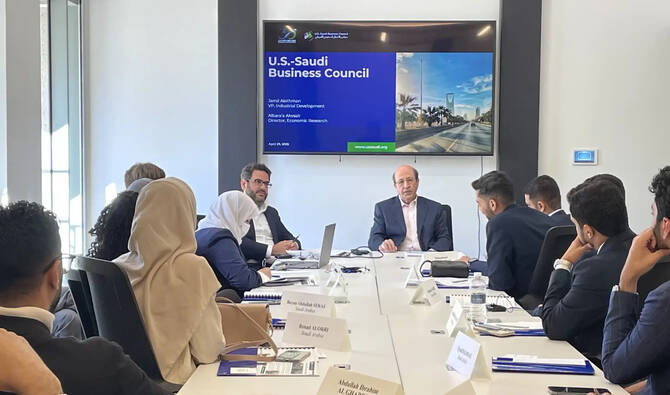
Reflecting on that period, Albara’a Al-Wazir, director of economic research at the US-Saudi Business Council, described the 2017 visit as an “inflection point” in bilateral economic relations.
“It wasn’t just the volume of deals — it was the alignment of strategic priorities between both governments and the private sector that defined the success of that moment,” he told Arab News in an interview.
“It marked a shift from transactional diplomacy toward long-term commercial integration.”
Trump’s 2024 re-election has reignited bilateral economic momentum and, according to Al-Wazir, this next wave of engagement reflects the Kingdom’s evolving priorities.
“Recent deals have spanned traditional sectors like defense and energy, but we are also seeing growth in advanced manufacturing, artificial intelligence, biotech and financial services,” he said, highlighting a broader, more diversified agenda than in Trump’s first term.
At the World Economic Forum in Davos in January, Trump hinted at even greater ambitions. He suggested he would ask the Saudi crown prince to raise the investment target to $1 trillion, describing it as a natural extension of a robust and trusted partnership.
Saudi Economy Minister Faisal Alibrahim confirmed at the forum that the $600 billion pledge encompassed both government-led procurement and private-sector investment in key areas such as defense, energy, infrastructure and technology.

A picture taken in the Saudi Red Sea coastal city of Jeddah on July 14, 2022, ahead of a visit by the US president to the kingdom, shows a Saudi host addressing guests during a presentation on the Saudi Green Initiative. (AFP)
The Saudi Ministry of Investment now ranks the US among its top five sources of foreign direct investment, particularly in sectors aligned with Vision 2030, such as infrastructure, technology and renewables.
As of January 2025, Saudi Arabia held $126.9 billion in US Treasury securities, making it the only Gulf Cooperation Council country among the top 20 foreign holders of American debt. This substantial stake underlines Riyadh’s continued confidence in US fiscal stability and reflects a longstanding strategy to diversify reserves via reliable, dollar-denominated assets.
The current holdings include $105.3 billion in long-term bonds and $21.6 billion in short-term instruments, reflecting a balanced approach between liquidity and capital preservation.
As the Saudi-US Investment Forum convenes on Tuesday at the King Abdulaziz International Conference Center in Riyadh, economic cooperation between the two nations will once again be in the global spotlight.
Timed to coincide with Trump’s visit, the forum aims to highlight nearly a century of bilateral partnership. It will bring together prominent investors, business leaders and policymakers from both nations to strengthen commercial ties and explore new avenues for collaboration.
According to figures released ahead of the event, the US remains the largest foreign investor in Saudi Arabia, with FDI stock totaling $54 billion as of 2023 — accounting for approximately 23 percent of all FDI in the Kingdom.
Currently, 1,266 American firms hold active licenses to operate in Saudi Arabia, including 440 new licenses issued in the past year alone. These companies are engaged in such critical sectors as transportation, manufacturing, retail, information and communications technology and professional services. Collectively, they employ more than 80,000 workers in the Kingdom, including over 44,000 Saudi nationals.

The Riyadh Chamber of Commerce organized in February bilateral meetings with a US trade delegation. (Supplied)
Saudi investment in the US is also on the rise, with FDI stock now exceeding $75 billion. Leading the way are key institutions such as the PIF, Aramco and SABIC, while US financial firms continue to play a pivotal role in channeling global capital into major Saudi initiatives.
Bilateral trade between the two countries remained strong in 2024. Saudi exports to the US reached $12.8 billion, including nearly $3 billion in non-oil goods — a testament to the Kingdom’s ongoing economic diversification efforts.
Meanwhile, US exports to Saudi Arabia totaled $19.7 billion, led by machinery and appliances at $5.1 billion, vehicles at $2.6 billion, and medical and optical equipment at $1.5 billion.
On the Saudi side, key exports to the US included mineral products ($10 billion), fertilizers ($830 million) and organic chemicals ($526 million).
This year’s forum is expected to highlight the expanding investment and trade relationship as a cornerstone of modern economic diplomacy between the two strategic allies.

Bilateral trade between the two countries remained strong in 2024. Saudi exports to the US reached $12.8 billion, including nearly $3 billion in non-oil goods — a testament to the Kingdom’s ongoing economic diversification efforts. (Supplied)
Trump’s visit to Riyadh is widely expected to focus also on new defense contracts and deepening economic cooperation.
Energy policy has also returned to the fore, with Trump urging Saudi Arabia to ramp up oil production in a bid to stabilize global markets and reduce pressure on fuel prices — linking economic alignment to broader geopolitical aims, including efforts to curtail Russian revenue.
Al-Wazir believes the visit may also accelerate progress in emerging technologies and industrial development: “US companies are particularly well positioned to support Saudi Arabia’s diversification goals under Vision 2030, especially in energy transition technologies, automation and data analytics,” he said.
There are signs that Gulf investors are already responding positively to the renewed partnership. Following the 2024 US election, Yasir Al-Rumayyan, governor of PIF, was photographed alongside President Trump and Elon Musk, who is now serving as a senior adviser to the White House. Bloomberg interpreted the image as a signal of renewed Gulf confidence in the Trump administration.
As Trump returns to Saudi Arabia, the US-Saudi economic alliance appears not only intact, but also on the cusp of expansion — driven by mutual interests, deepening personal ties and a shared belief that commerce remains a pillar of diplomacy in a rapidly shifting global order.


