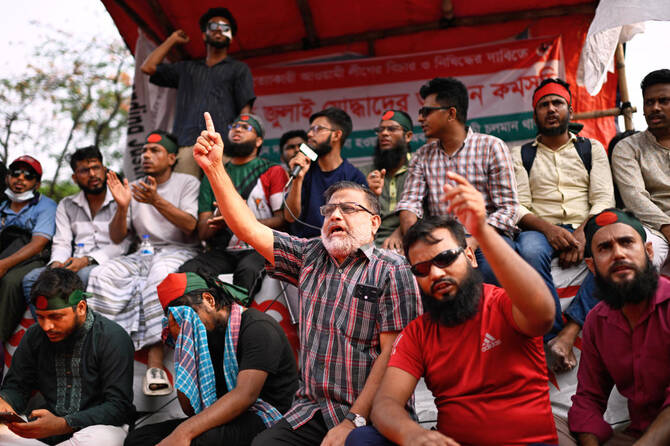
DHAKA: Bangladesh’s former prime minister Sheikh Hasina masterminded a deadly crackdown on mass protests that prompted her ouster last year, prosecutors at a domestic war crimes tribunal said Monday.
Up to 1,400 people died in July 2024 when Hasina’s government launched a brutal campaign to silence the opposition, according to the United Nations.
Hasina lives in self-imposed exile in India, where she fled by helicopter, and has defied an arrest warrant from Dhaka over charges of crimes against humanity.
“The investigation team has found Sheikh Hasina culpable in at least five charges,” Mohammad Tajul Islam, chief prosecutor at Bangladesh’s domestic International Crimes Tribunal (ICT), told reporters.
“They have brought charges of abetment, incitement, complicity, facilitation, conspiracy, and failure to prevent mass murder during the July uprising.”
Tajul Islam said the prosecution had submitted its first report to be presented at the court set to try Hasina and two of her aides — former home minister Asaduzzaman Khan Kamal and ex-police chief Abdullah Al Mamun.
“Sheikh Hasina directly ordered law enforcement agencies and auxiliary forces aligned with her party to kill and maim, and to burn corpses and even people who were still alive at certain points,” he added.
The ICT was set up in 2009 by Hasina to investigate crimes committed by the Pakistani army during Bangladesh’s war for independence in 1971.
Investigators have collected video footage, audio clips, Hasina’s phone conversations, records of helicopter and drone movements as well as statements from victims of the crackdown as part of their probe.
Bangladesh’s interim government on Saturday banned Hasina’s party, the Awami League, pending the outcome of the trial.
The decision was taken to ensure the country’s “sovereignty and security” as well as the safety of the protesters, plaintiffs and witnesses of the tribunal, Asif Nazrul, a government adviser on law and justice, told reporters.
Bangladesh has requested India to extradite her but has not yet received a response.

Bangladesh investigators say ousted PM behind deadly crackdown
https://arab.news/c4x5v
Bangladesh investigators say ousted PM behind deadly crackdown
- “Investigation team has found Sheikh Hasina culpable in at least five charges,” chief prosecutor at Bangladesh’s domestic International Crimes Tribunal said
From round fruits to lucky charms: How Filipinos invite prosperous New Year
- Lights are lit, doors and windows open to allow good spirits in
- Sticky rice dishes are served to keep family sticking together
MANILA: With the dining table set with symbolic foods, a bit of noise and rituals to invite good luck, Filipinos are ready to welcome the New Year, carefully observing every tradition and superstition to bring prosperity.
Media noche or the midnight dinner on New Year’s Eve is central to the celebration. Besides traditional meats, there will be sticky rice dishes to keep the family sticking together, and pancit or long rice noodles to represent long life.
There should also be 13 round fruits prepared specifically for the occasion, with 12 representing each month of the year, and the 13th adding extra luck. Because they are round like coins, they are believed to invite abundance, wealth and prosperity.
“We cook bilo-bilo (sticky rice balls) with coconut milk and palitaw (sweet rice cakes). It’s something we simply grew up with,” said Cel Reyes from Mabini in Batangas province, south of Manila.
“It’s sticky, so it symbolizes togetherness, and it is also round. Anything that’s round is prepared also as a symbol of prosperity.”
In Malabon, a coastal city in the northern part of Metro Manila, Priam Nepomuceno’s 86-year-old mother-in-law sets unhulled rice on the table.
“Because of the gold color, it’s believed to bring luck and abundance,” he said. “Grapes are also hung on the door. They’re not meant to be eaten and are kept hanging for the whole year as a symbol of prosperity.”
Some people also jump when the clock strikes 12, believing it will help them grow taller.
In many households, all lights are lit before midnight, with doors and windows open to allow good spirits to enter, while noise from firecrackers and party horns keeps the bad ones at bay.
“By nature, Filipinos are superstitious. We believe in good luck, deities. We give in to faith and luck, and it’s tied to deep spirituality,” said Juanita Galang-Trinidad, an 80-year-old editor from Bulacan province north of Manila.
“We also put 12 coins in varying amounts in our pockets and wear polka dot clothing. Rice, cereal, and salt containers should be full.”
New Year’s celebrations, like Christmas, bring families together, but with extra traditions for good luck. Beyond the midnight feast and keeping round objects on the table and at hand, Filipinos try to pay off debts to avoid financial trouble in the coming year.
On New Year’s Eve, they also avoid serving chicken, as chickens are believed to scratch backward when they eat, symbolically scratching away good fortune.
“We hold on to our traditions despite these growing changes, modernity, in our environment,” Trinidad said.
“We still hold on to our traditions and customs because they identify us as a people, as Filipinos.”


