KARACHI: Pakistani textile mill owners on Monday expressed their hopes that United States (US) President Donald Trump will reduce tariffs on Pakistan’s exports, in line with his announcement to “substantially” increase trade with Pakistan and India following a ceasefire between the two nations.
Trump’s announcement came a day after Washington brokered the ceasefire after four days of fighter jet, missile, drone and artillery strikes by India and Pakistan against the other, leaving nearly 70 people dead on both sides.
The US president has imposed a 10 percent baseline tariff on all imports to the US and higher duties on dozens of countries. Pakistan faces a 29 percent tariff due to a trade surplus with the US of about $3 billion, though the US last month announced a 90-day pause in reciprocal tariffs.
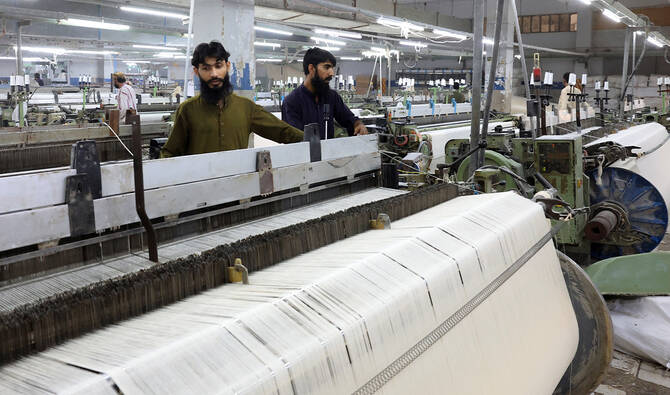
The All-Pakistan Textile Mills Association (APTMA) said Trump’s message was an “encouraging signal” for the future of US-Pakistan economic engagement, especially in the textile sector that serves as the backbone of Pakistan’s export economy.
“His statement is a timely recognition of the crucial role trade can play in this regard. The US remains Pakistan’s largest export destination, with textiles accounting for nearly 80 percent of total exports to the American market. Additionally, Pakistan is the second-largest importer of US cotton and has taken proactive steps to increase cotton imports in response to concerns over the trade imbalance,” APTMA said.
“In line with these increased imports, we expect the US to reduce existing and proposed tariffs on Pakistan’s exports, thereby enhancing market access and unlocking greater trade opportunities.”
Trump said on Sunday he would try to work with both India and Pakistan to see if they can resolve their dispute over Kashmir, which had been divided between India and Pakistan but claimed in full by both.
The two countries have fought two of their three wars over the region, while last week’s military conflict between them was also triggered by a militant attack in Indian-administered Kashmir that killed 26 tourists on April 22.
“While not even discussed, I am going to increase trade, substantially, with both of these great Nations,” Trump wrote on his social media platform, Truth Social, referring to India and Pakistan.
“Additionally, I will work with you both to see if, after a ‘thousand years,’ a solution can be arrived at concerning Kashmir,” he added.
APTMA said it supports international efforts, particularly those led by the US, aimed at fostering lasting peace in South Asia, including the resolution of long-standing disputes through dialogue and mutual understanding.
“We recognize that economic cooperation and regional stability are deeply interconnected and remain committed to promoting peace through trade-led engagement,” it said.
“Building on this momentum, we look forward to strengthening a resilient and mutually beneficial US-Pakistan trade partnership, grounded in respect, national sovereignty, and shared economic goals.”


![]()

Pakistani textile industrialists expect Trump to cut export tariffs after India ceasefire
Short Url
https://arab.news/yf7u8
Pakistani textile industrialists expect Trump to cut export tariffs after India ceasefire
- President Donald Trump said he will “substantially” increase trade with Pakistan and India after the US brokered a ceasefire between both nations
- Pakistan industrialists say they support Washington’s efforts and remain committed to promoting peace through Pakistan-US trade-led engagement
Latest updates


© 2026 SAUDI RESEARCH & PUBLISHING COMPANY, All Rights Reserved And subject to Terms of Use Agreement.