

Pakistan welcomes Kurdish PKK’s disbandment, ending 40-year Turkiye insurgency

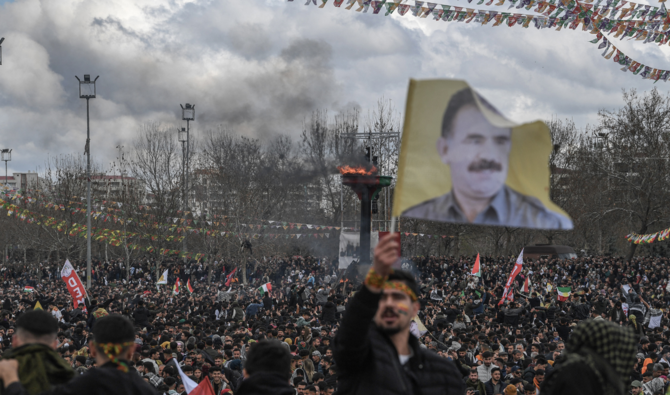
A man waves a flag depicting Abdullah Ocalan, Turkish-jailed founder of the Kurdistan Workers' Party (PKK) next to a bonfire during a gathering for Nowruz (aka Noruz or Newroz) celebrations marking the New Year of the Persian calendar and the first day of spring in Diyarbakir, south-eastern Turkey, on March 21, 2025. (AFP/ file)
Short Url
Updated 12 May 2025
Follow

Pakistan welcomes Kurdish PKK’s disbandment, ending 40-year Turkiye insurgency

  • Since the PKK launched its insurgency in 1984, the conflict has killed more than 40,000 people, exacted huge economic losses 
  • PKK’s decision will give President Tayyip Erdogan the opportunity to boost development in Turkiye’s mainly Kurdish southeast

ISLAMABAD: Pakistan on Monday welcomed the decision by the Kurdistan Workers Party (PKK) group, which has been locked in bloody conflict with the Turkish state for more than four decades, to disband and end its armed struggle.

Since the PKK launched its insurgency in 1984, the conflict has killed more than 40,000 people, exerted a huge economic burden and fueled social tensions. The PKK is designated a terrorist group by Turkiye and its Western allies.

Taking to X, Pakistani Prime Minister Shehbaz Sharif called the PKK’s dissolution a “historic development.”

“Pakistan welcomes the announcement of PKK’s dissolution, a significant step toward lasting peace and a terror-free Turkiye,” he wrote.

The Firat news agency, which is close to the group, reported on Monday that the PKK 12th Congress decided to “dissolve the PKK’s organizational structure and end the armed struggle.”

The PKK held the congress in response to a February call to disband from its jailed leader Abdullah Ocalan, who has been imprisoned on an island south of Istanbul since 1999. It said on Monday that he would manage the process.

On Mar. 1, the PKK announced a unilateral ceasefire, but attached conditions, including the creation of a legal framework for peace negotiations.

“The PKK has completed its historic mission,” the PKK statement said. “The PKK struggle has broken the policy of denial and annihilation of our people and brought the Kurdish issue to a point of solving it through democratic politics.”

The PKK’s decision will give President Tayyip Erdogan the opportunity to boost development in Turkiye’s mainly Kurdish southeast, where the insurgency has impaired the regional economy for decades.

A deputy leader of the pro-Kurdish DEM Party, the third largest in Turkiye’s parliament and which played a key role in facilitating Ocalan’s peace call, told Reuters the PKK decision was significant not just for Kurdish people but for the Middle East as a whole.

“It will also necessitate a major shift in the official state mentality of Turkiye,” DEM’s Tayip Temel said.

- With inputs from Reuters


Pakistan says will press ahead with trilateral cooperation with China and Bangladesh

Updated 4 sec ago
Follow

Pakistan says will press ahead with trilateral cooperation with China and Bangladesh

  • Islamabad signals closer engagement with Dhaka amid shifting regional dynamics
  • Trilateral platform gains traction after recent China-Pakistan strategic talks last week

ISLAMABAD: Pakistan said on Thursday it would continue to pursue a trilateral cooperation framework with China and Bangladesh aimed at boosting regional connectivity, trade and development, as consultations among the three countries move forward.

The framework, launched last year at the senior officials’ level, has gained renewed attention as ties between Pakistan and Bangladesh improve following years of limited engagement, while Dhaka’s relations with India, a longtime archrival of Pakistan, have come under strain amid domestic political upheaval.

Addressing reporters on Thursday, Pakistan’s Foreign Office spokesman Tahir Andrabi said Islamabad remained committed to the Pakistan-China-Bangladesh cooperation mechanism and intended to follow up on earlier consultations to deliver “practical outcomes.”

“On the Pakistan, Bangladesh and China mechanism, if you recall, a meeting took place last year [2025] at the level of vice ministers and foreign secretaries,” Andrabi told a weekly media briefing, adding that Pakistan looked forward to “positive outcomes” in line with an agreed joint communiqué.

“So of course, the consultations between the three of us would continue in the future to strive for outcomes which are beneficial for the peace, progress and prosperity of our people,” he said when asked specifically about Bangladesh’s role in the framework.

The trilateral cooperation was also referenced in a joint press communiqué issued after the Seventh Round of the China-Pakistan Foreign Ministers’ Strategic Dialogue held last week.

“The two sides expressed readiness to continue leveraging the China-Afghanistan-Pakistan Trilateral Foreign Ministers’

Dialogue and the China-Bangladesh-Pakistan cooperation mechanism to deliver new outcomes,” the statement said.
Andrabi said Pakistan’s engagement with China would continue across bilateral and trilateral formats, underscoring Islamabad’s preference for cooperative regional approaches focused on economic development rather than bloc politics.

Bangladesh was part of Pakistan until 1971, when it gained independence following a bloody war of independence. Relations between the two countries have shown signs of improvement in recent months, as Dhaka recalibrates its foreign policy after the ouster of former prime minister Sheikh Hasina in 2024. India has so far declined Bangladesh’s request to extradite Hasina, who fled to New Delhi after violent student-led protests.

In a related development, Pakistan’s Air Chief Marshal Zaheer Ahmed Baber Sidhu earlier this week held talks with a high-level Bangladeshi defense delegation on strengthening air force cooperation, including the potential sale of JF-17 Thunder fighter jets jointly developed by Pakistan and China.