ISLAMABAD: Pakistan is committed to upholding a ceasefire with India but it will take “all appropriate steps” to preserve the Indus Waters Treaty (IWT), the Pakistani Foreign Office said on Sunday, saying the treaty is critical for Pakistan’s water security and economy.
Pakistan and India engaged in a military conflict and attacked the other with fighter aircraft, missiles, drones and artillery fire, following weeks of tensions between the two over an attack in the disputed Kashmir region that India blamed on Pakistan, Islamabad denies it.
The incursions that targeted several cities for four days killed nearly 60 people on both sides as major world powers scrambled for a ceasefire between the nuclear-armed arch-foes. On Saturday, US President Donald Trump announced a ceasefire that has largely held, except for some violations in Kashmir.
However, tensions remain high since Saturday’s announcement by Indian Foreign Secretary Vikram Misri that the 1960 World Bank-brokered treaty would remain in abeyance, signaling deeper diplomatic rifts despite the temporary cessation of hostilities between the two neighbors.
“We are committed on ceasefire but the IWT is of critical importance for Pakistan’s water security and economy,” Pakistani Foreign Office spokesperson Shafqat Ali Khan told Arab News.
“Naturally, we will take all appropriate steps to preserve its sanctity and smooth implementation.”
India suspended the treaty, which ensures water for 80 percent of Pakistani farms, a day after the April 22 attack in Indian-administered Kashmir’s Pahalgam that killed 26 tourists. Islamabad has called for a credible, international probe into the attack and described the Indian move to suspend the treaty as “act of war.”
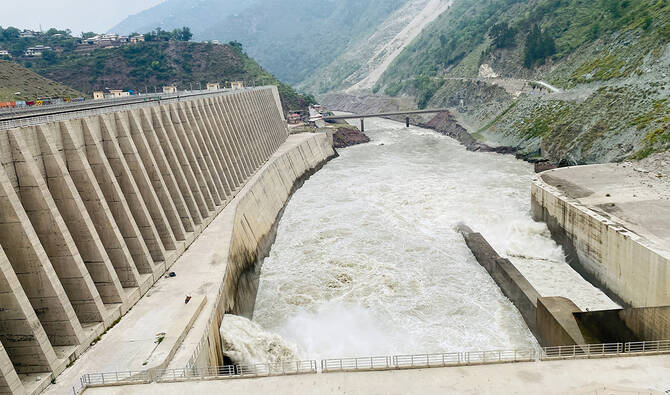
The IWT grants Pakistan rights to the western rivers — Indus, Jhelum, and Chenab — for irrigation, drinking, and non-consumptive uses like hydropower, while India controls the eastern rivers — Ravi, Beas, and Sutlej — for unrestricted use but must not significantly alter their flow. India can use the western rivers for limited purposes such as power generation and irrigation, without storing or diverting large volumes, according to the agreement.
“The fact is that there have been fundamental changes in the circumstances in which the Indus Waters Treaty was concluded,” Indian Foreign Secretary Misri was quoted as saying by NDTV on Thursday.
He said there is now a need to “reassess the obligations under that treaty.”
Khan, the Pakistani Foreign Office spokesperson, said India is in no position to unilaterally hold the treaty in abeyance in the absence of any relevant legal provisions in the agreement.
“Water is a vital national interest of Pakistan, a lifeline for its 240 million people and its availability will be safeguarded at all costs,” he said, reiterating Islamabad’s position that any attempt to stop or divert the flow of its water would be “responded with full force across the complete spectrum of national power.”
Pakistan’s Federal Minister for Kashmir Affairs Amir Muqam said any attempt to stop Pakistan’s share of water could lead to dangerous escalation between the two nuclear-armed neighbors.
“Stopping or reducing our share is absolutely not acceptable and can lead to further and dangerous escalation,” he told Arab News. “The revival of the Indus Waters Treaty in its current form remains a top priority on the agenda in any negotiations between the two countries.”
Muqam further stated that India must revive the IWT in its original form to maintain long-term peace in the region.
“There can be no compromise on it as it is a matter of life and death for us and there is no question of it that they [Indians] stop our water and we will remain silent,” the minister added.
Pakistan and India have a history of bitter relations, having fought two of their three wars over Kashmir, a region split between them, since gaining independence from the former British colonial rule in 1947.


![]()

Pakistan vows to preserve Indus Waters Treaty amid ceasefire with India
Short Url
https://arab.news/2qjun
Pakistan vows to preserve Indus Waters Treaty amid ceasefire with India
- India suspended the treaty, which ensures water for 80 percent of Pakistani farms, a day after an April 22 attack in Indian-administered Kashmir killed 26 tourists
- Tensions between the two neighbors over the attack, Islamabad denies any complicity in, escalated and both launched air and ground strikes against the other this week
Latest updates


© 2026 SAUDI RESEARCH & PUBLISHING COMPANY, All Rights Reserved And subject to Terms of Use Agreement.