Pakistani health tech platform raises $6 million to expand across GCC

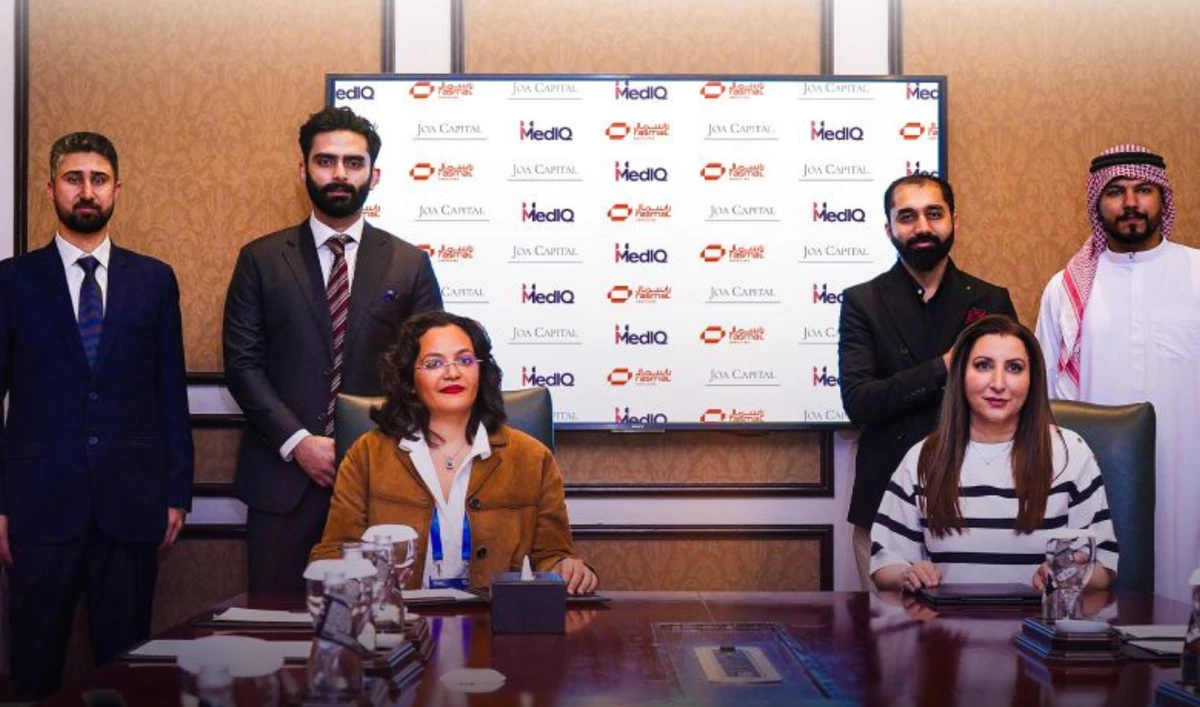
The undated photo shows representatives from shows Pakistan-based health tech platform MedIQ and Saudi Arabia’s venture capital Rasmal Ventures. (MedIQ Smart Healthcare/ Instagram)
Short Url
Updated 11 May 2025
Follow

Pakistani health tech platform raises $6 million to expand across GCC

  • Founded in 2020, MedIQ says it provides convenient on-demand and cashless walk-in services to its customers
  • MedIQ says will use funding to strengthen technology stack, scale operations in Kingdom’s health tech market

ISLAMABAD: Pakistan-based health tech platform MedIQ recently announced it has raised $6 million in a series A funding round led by Saudi Arabia’s venture capital Rasmal Ventures and the Kingdom’s investment company, Joa Capital. 

MedIQ was founded by Dr. Saira Siddiqui, a doctor who holds a PhD in Health Economics from the University of Yorkshire, in 2020 in Pakistan’s capital Islamabad. 

The startup aims to redefine health care through a digitally enabled hybrid ecosystem and is currently operating in Pakistan, Saudi Arabia, the United Arab Emirates (UAE) and Canada.

“This over-subscribed round signals strong investor confidence in our accelerated market traction, validates our excellence in engineering to support in becoming the leading health tech player in MENA, and reinforces the great experience our customers have with MedIQ Solutions,” the platform said in a LinkedIn post on May 4. 

“With fresh capital, a focused team, and a purpose-driven founder, MedIQ is now primed to scale across the GCC to become a regional leader,” it added. 

The company, which expanded into Saudi Arabia in 2023, said it will use the funding to strengthen its technology stack, scale operations in the Kingdom’s health tech market and support entry into Qatar and neighboring Gulf markets.

In an interview with Arab News in 2023, Dr. Siddiqui expressed her desire to see the platform expand across GCC countries. 

Siddiqui had said women were the bulk users of MedIQ’s products as it is usually hard for them to visit hospitals without male companions in Pakistan and the Middle East. 

“According to the figures which we have, about 74 percent of our users are women and [the] women having children or dependents such as older parents,” she had said.
Ramadan tests Pakistan’s daily wage workers but faith endures

Updated 8 sec ago
Follow

Ramadan tests Pakistan’s daily wage workers but faith endures

  • Reduced work hours during fasting month cut already fragile incomes
  • Charities, local businesses step in as laborers try to support families back home

ISLAMABAD: Abdul Waqif grips a worn-out shovel and digs into the earth beneath the harsh midday sun, his body bent with age but still moving steadily. Moments later, the 70-year-old hoists a heavy bag of cement onto his shoulders and carries it toward an under-construction house, all while fasting.

For Waqif and thousands of daily wage laborers across Pakistan, Ramadan is not just a month of spiritual devotion. It is also a month of shrinking incomes.

Waqif migrated from Mohmand tribal district in northwestern Pakistan to Islamabad two decades ago in search of work. Like many laborers from rural and former tribal areas, he left behind limited local opportunities to earn a living in larger cities such as Islamabad, Lahore and Karachi.

In Pakistan, daily wage workers, particularly in construction and manual labor, are among the most economically vulnerable. They are paid only for days worked, receive no job security or benefits, and often rely on informal arrangements. Any slowdown in economic activity directly affects their ability to feed their families.

Economic activity typically slows during Ramadan, when Muslims fast from dawn to sunset. Employers often reduce work hours or postpone physically demanding projects to ease the burden on fasting workers. While intended as a gesture of consideration, it means fewer working hours and fewer earnings.

For laborers such as Waqif, who earns between Rs1,000-1,200 [$3.59-4.31] per day, even a slight reduction in work can be devastating.

His suhoor, the pre-dawn meal before fasting begins, usually consists of a few chapatis from a nearby hotel. The hunger and thirst that follow him through the day are constant companions as he lifts bricks and mixes cement in the heat.

But so is his faith.

“Allah gives me courage. I am hungry and thirsty, but I keep working,” Waqif said while wiping the sweat off his brow.

Back in Mohmand district, his wife, four daughters and two sons depend on the money he sends home. Every rupee matters.

“I support them with this work,” Waqif said. “I eat three meals a day here and I also have to save money for my children and send it to them.”

The reduction in work during Ramadan weighs heavily on him.

“I don’t find much work in Ramadan, and I’m worried for my family,” Waqif said.

‘HONEST LIVING’

Finding food for suhoor is sometimes a challenge. On some mornings, someone offers him a piece of flatbread. Other times, he buys what little he can afford from a nearby eatery.

Muhammad Sajid, owner of Al-Hadi restaurant in Islamabad’s G-15 sector, says he tries to ease that burden by offering meals to laborers at half price.

“We don’t let anyone go hungry,” Sajid told Arab News. “We offer sehri and iftar as much as anyone can afford.”

The restaurant serves tea, yogurt, several types of curries and parathas.

Charity groups also expand operations during Ramadan, when community support traditionally increases. The Junaid Welfare Foundation runs a roadside dastarkhwan, or communal meal spread, serving hundreds daily.

Haq Rawan Shareefi, a manager at the foundation, said around 500 people are provided iftar meals each day. The cost of one person’s iftar is Rs200 [$0.72].

“That means, on iftar and sehri, our expenses range from Rs150,000 [$538.97] to Rs200,000 [$718.63],” Shareefi said.

For Waqif, breaking his fast at sunset brings temporary relief from the physical strain of the day. But the financial uncertainty remains.

“I ask Allah for this,” he said. “May Allah give me strength to earn honest living for my children.”