

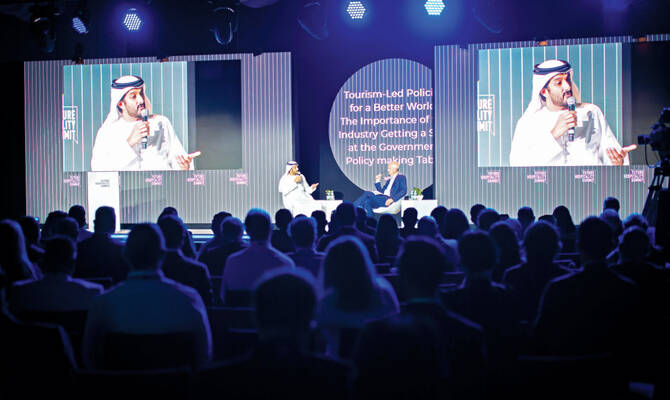

RIYADH: More than 1,000 tourism innovators, global investors and hotel operators from around the world will join government officials in Riyadh for the 2025 edition of the Future Hospitality Summit.
Scheduled for May 11–13 at the Mandarin Oriental Al Faisaliah, the three-day event will revolve around the theme “Where Vision Shapes Opportunity,” featuring a dynamic agenda of panel discussions, investment showcases, and high-profile deal signings.
Organized by The Bench, the 2024 edition of FHS Saudi Arabia resulted in over $1.1 billion in business opportunities and 17 major deals, reaffirming the event’s status as one of the region’s most impactful dealmaking platforms.
The 2025 summit, held alongside strategic partners such as NEOM, Red Sea Global, Taiba Investments, and the Tourism Development Fund, comes as Saudi Arabia advances one of the world’s most ambitious tourism and hospitality strategies.
Backed by a $110 billion development pipeline, the Kingdom aims to deliver more than 362,000 new hotel rooms by 2030.
In 2023 alone, the hospitality sector contributed SR444.3 billion ($118.4 billion) to the national gross domestic product.
Industry leaders at FHS 2025 will explore innovative investment models, address talent development needs, and strengthen partnerships aligned with Vision 2030’s mission to diversify the economy and establish Saudi Arabia as a premier global destination for business, culture, and religious tourism.
“FHS Saudi Arabia continues to be a key engine for hospitality investment and 2025 is shaping up to be no exception,” Jonathan Worsley, chairman of The Bench told Arab News.

“With over 1,000 delegates expected in Riyadh, including an expanded pool of investors, we anticipate a strong uplift in deal volume and a substantial wave of new opportunities. While it’s difficult to quantify exact outcomes, all signs point to another record-breaking year.”
According to Worsley, over a dozen agreements have already been confirmed ahead of the summit.
“Last year, 17 major agreements were signed at FHS Saudi Arabia and we’re well on track to exceed that number this year. We anticipate total deal value to surpass previous records driven by significant projects and opportunities across both primary hubs and emerging destinations such as Aseer, Al-Ahsa,” he said.
Worsely added:“The partnerships forged at FHS Saudi Arabia will further elevate Saudi Arabia’s global hospitality positioning.” Riyadh, Jeddah, Makkah, and Madinah continue to serve as key investment hubs, while interest grows in mixed-use developments, branded residences, and eco-luxury projects.
Worsely said: “There’s strong demand for distinctive, high-end products — from fine dining and leisure assets to mixed-use developments that blend hospitality, retail, and culture.”
He added: “Our summit is not merely a forum for discussion — it’s a marketplace where investors meet opportunities. Every panel discussion and networking session is engineered to move the conversation forward.”
The 2025 agenda will also debut two new platforms: the “NextGen Investment Forum,” focused on addressing workforce development in the hospitality sector, and the second edition of “Startup Den,” spotlighting early-stage companies driving innovation.
Saudi Arabia’s tourism sector is experiencing rapid growth, with international arrivals reaching 30 million in 2024, with a target of hitting 70 million by 2030, according to a Ministry of Tourism press release.
Revenue from international tourists surged 148 percent in 2024 compared to 2019 — the highest growth rate among G20 nations.

Saudi Arabia is undergoing one of the most ambitious hospitality and tourism transformations the world has ever seen.
Duncan O’Rourke Accor’s, CEO for the Middle East, Africa and Asia Pacific
An annual performance report published in April highlighted record-breaking pilgrim numbers, cultural milestones, and major international events, all driven by strategic investments, regulatory reforms, and transformative mega-projects.
“Fueled by ambitious Vision 2030 goals, Saudi Arabia’s tourism sector presents a compelling investment landscape, evidenced by its record-breaking SR444.3 billion GDP contribution in 2023, accounting for 11.5 percent of the national economy,” Oussama El-Kadiri, partner and head of hospitality, tourism and leisure at Knight Frank said in a statement.
He added: “This growth reflects the Kingdom’s strategic initiative to position itself as a leading global tourism destination.”
Hospitality operators are swiftly expanding their presence to match the sector’s growth, with Accor — one of the event’s headline sponsors — broadening its footprint across both primary and secondary cities.
“Saudi Arabia is undergoing one of the most ambitious hospitality and tourism transformations the world has ever seen,” Duncan O’Rourke, Accor’s CEO for the Middle East, Africa and Asia Pacific told Arab News.
He added: “Accor’s footprint in Saudi Arabia includes 45 hotels across 15 brands and over 17,000 keys. This is more than growth. It’s about legacy, partnership, and purpose. And we are honored to be a part of it.”
O’Rourke stated that demand for diversified products is rising. “From Accor’s perspective, we are seeing strong traction across segments, with a focus on branded residences, extended stay, and midscale brands, which offer compelling value while supporting long-stay and group needs.”
On pricing, O’Rourke noted that the Kingdom’s average daily rate in 2024 reflects solid fundamentals with “Riyadh’s ADR rising by approximately 10-12 percent year on year.”
In preparation for global megaevents such as Expo 2030 and the FIFA World Cup 2034, Accor is also prioritizing flexibility and localized strategies to meet evolving market demands.
“Preparing our teams for the future is not just a strategic priority, it’s how çwe live our purpose,” said O’Rourke. “In short, we’re not just responding to labor market shifts, we’re helping to shape them.”
FHS Saudi Arabia 2025 will offer a dynamic blend of keynote sessions, investor roundtables, and sector-specific panels, with a strong focus on ESG, cultural integration, and effective project delivery.
As giga-projects gain momentum, record deal activity is forecast, and investor interest expands into new sub-sectors, this year’s summit is set to be a pivotal moment for Saudi Arabia’s hospitality industry.


