

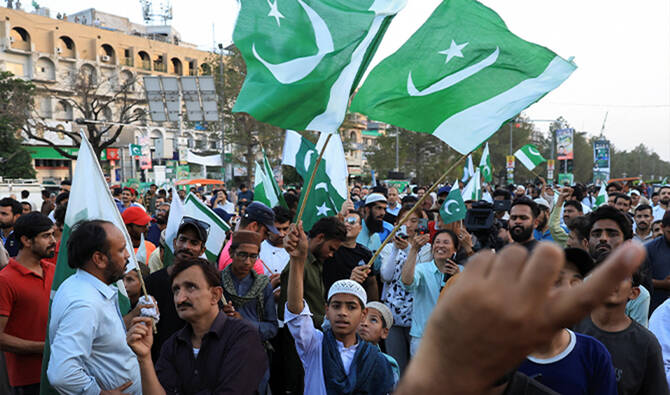

KARACHI/ISLAMABAD: People in Pakistan on Saturday welcomed the announcement of a ceasefire with India after heavy cross-border missile and drone exchange between the two countries, though some expressed skepticism about New Delhi’s willingness to uphold the truce.
The ceasefire brought an end to one of the most serious military standoffs between the two nuclear-armed neighbors in decades, triggered by a deadly attack in Indian-administered Kashmir last month that killed 26 tourists.
India blamed Pakistan for the incident and launched missile strikes on what it called “terrorist camps” in five Pakistani cities. Islamabad denied involvement and retaliated by targeting Indian military sites.
The hostilities escalated until Washington brokered a truce, announced Saturday by US President Donald Trump.
“Look, the ceasefire announcement has been beneficial for both countries,” said Abbas Raza, a trader in Karachi, while speaking to Arab News. “Who wins when there’s loss? No one wins in loss. People only suffer.”
Muhammad Shehbaz, a local businessman in the city, said Pakistan had exercised restraint for days despite repeated “Indian provocations.”
“India was pushing, trying to provoke Pakistan into escalating the conflict,” he said. “They kept at it, but Pakistan showed restraint again and again.”
“Then yesterday, when Pakistan carried out a retaliatory strike, they were shaken within three hours,” he continued. “They were brought to their knees. And today, they called in Trump and agreed to a ceasefire.”
Zubia Mehfooz, a woman visiting Karachi, said she had been unable to return to the United States, where her family lives, due to the airspace shutdown caused by the conflict.
“I was here for some work and got stuck,” she said. “I have a flight Monday morning. There’s never an issue from our [Pakistani] side. You know where the issue comes from. If the ceasefire holds, it’s a very good thing.”
But in Islamabad, some urged caution, citing past episodes.
“We don’t fully trust India’s statements,” said Muhammad Farhan Hameed, a veterinarian. “Past experiences have shown this. Many treaties have been signed before, but sometimes they behave unpredictably and break from what was agreed.”


