US mission in Islamabad eases staff movement curbs after India-Pakistan ceasefire

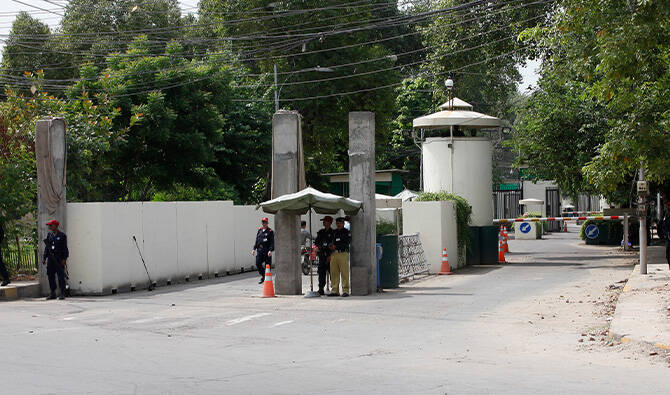
A policeman (2nd R) and private security personnel stand guard at the entrance of a road leading towards the U.S. consulate in Lahore August 9, 2013. (Reuters/File)
Short Url
Updated 10 May 2025
Follow

US mission in Islamabad eases staff movement curbs after India-Pakistan ceasefire

  • The embassy upholds ‘Do Not Travel’ statue for areas near the eastern border
  • It also maintains a ‘Reconsider Travel’ advisory in the country more broadly

ISLAMABAD: The United States eased movement restrictions on its diplomatic personnel in Pakistan on Saturday, following a ceasefire agreement between India and Pakistan that brought a pause to days of cross-border military exchanges.
The conflict was sparked by a deadly attack in Indian-administered Kashmir last month that killed 26 tourists, with New Delhi blaming Pakistan for the incident despite Islamabad’s denial of the allegation.
India launched missile strikes on what it said were “terrorist camps,” prompting Pakistan to respond with attacks on Indian military targets.
A ceasefire brokered by Washington was announced Saturday afternoon by President Donald Trump, with Secretary of State Marco Rubio saying both sides had agreed to hold talks at a neutral venue.
“Movement restrictions on US government personnel in Islamabad, Karachi, and Lahore have been adjusted to allow travel within city limits,” the US mission said in a security alert.
However, it reiterated its “Do Not Travel” advisory for areas near the India-Pakistan border and the Line of Control, citing “terrorism” and the risk of “armed conflict.”
It also maintained a “Reconsider Travel” advisory for Pakistan more broadly, reflecting long-standing US concerns about militant violence and limited consular access in parts of the country.
Earlier this year, the US State Department had cited Pakistan’s deteriorating security conditions, especially in the Khyber Pakhtunkhwa and Balochistan provinces.
In its recent alert, the US embassy advised citizens in Pakistan to review their security plans and stay alert.
It noted that flight availability remained fluid in Pakistan, urging travelers to confirm schedules with their airlines.



UN agencies report spike in Afghan arrests as nearly two million return from Pakistan

Updated 8 sec ago
Follow

UN agencies report spike in Afghan arrests as nearly two million return from Pakistan

  • UNHCR and IOM data show weekly spike in detentions, with Balochistan emerging as main hotspot
  • International rights groups say the deportation drive risks violating international protection obligations

ISLAMABAD: United Nations agencies for refugees and migration recorded a sharp rise in the arrest and detention of Afghan nationals in Pakistan since the beginning of the year, highlighting in a report this week that about two million Afghans have been repatriated to their country since late 2023.

According to a joint report released by the Office of the United Nations High Commissioner for Refugees (UNHCR) and the International Organization for Migration (IOM), the scale of the movement has gone up significantly.

“During the reporting period (4 – 10 January), a total of 1,726 Afghan nationals were arrested and detained, marking an 18 percent increase compared to the previous week,” the report said. “Cumulatively, from 15 September 2023 to 10 January 2026, 1,957,694 individuals have returned.”

The mass migration and deportation drive began on November 1, 2023, after Pakistani authorities announced a repatriation plan for “illegal immigrants,” mostly Afghans. The decision followed a spike in suicide bombings, which the Pakistani government said were carried out by Afghan nationals or by militants launching cross-border attacks from neighboring Afghanistan.
Islamabad has also blamed illegal Afghan immigrants and refugees for involvement in smuggling and other crimes, though Afghanistan denies the allegations.

In 2025, Pakistan expanded the scope of its deportation drive, moving beyond undocumented foreign nationals to include holders of Afghan Citizen Cards (ACC). The campaign was later extended to bearers of Proof of Registration (PoR) cards after their validity expired in June.

While PoR cards were meant to recognize Afghan refugees under a formal registration framework, ACCs were merely introduced to document Afghan nationality without conferring refugee status on those in possession of them.
“Out of all arrests and detentions during the reporting period ... ACC holders and undocumented Afghans represented 87 percent of the total rate of arrest and detentions, and PoR holders represented 13 percent,” the report said.

In addition to the arrests, the reporting period saw a marked increase in activity at the border. Between January 4 and January 10, 2026, alone, an estimated 19,666 Afghans returned through various crossing points including Torkham and Chaman, representing a 38 percent increase in returns and a 17 percent increase in deportations compared to the week prior.

The UN report noted that “fear of arrest remained the main reason for return among undocumented individuals and ACC holders (95 percent)” while PoR card holders cited “strict border entry requirements” as their primary driver for leaving.
Geographically, 73 percent of recent arrests occurred in Balochistan, with the Islamabad Capital Territory (ICT) also being a focal point with 16 percent of the total arrests following government directives for Afghans to relocate from the capital.

Earlier in January, Amnesty International renewed pressure on Islamabad, urging it to stop deportations.

“Amnesty International calls on the Pakistani authorities to halt the deportation of Afghan refugees and ensure that individuals with international protection needs are safeguarded as per international human rights law,” it said in an open letter addressed to Prime Minister Shehbaz Sharif.

Amnesty maintained Pakistan’s repatriation policy violated the principle of non-refoulement, which prohibits returning refugees to countries where they could face persecution or serious harm, and described the campaign as potentially “one of the largest forcible returns of refugees in modern history.”