Pope Leo XIV lays out his vision of the papacy and identifies AI as a main challenge for humanity

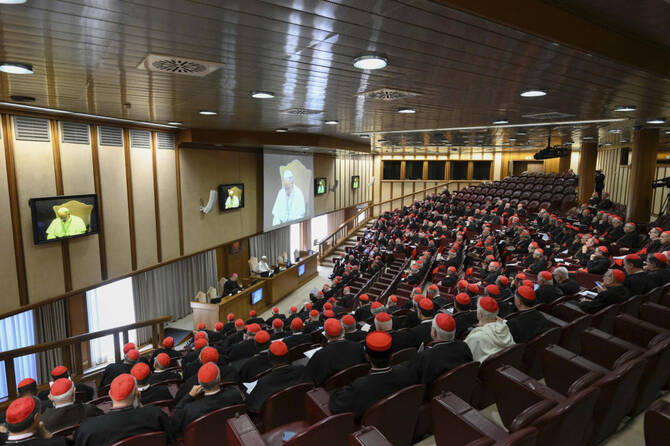
Pope Leo XIV meets the College of Cardinals in the New Synod Hall at the Vatican, May 10, 2025. (AP)
Short Url
Updated 10 May 2025
Follow

Pope Leo XIV lays out his vision of the papacy and identifies AI as a main challenge for humanity

  • Leo said he identified with his predecessor, who addressed the great social question of the day posed by the industrial revolution in the encyclical
  • “In our own day, the church offers everyone the treasury of its social teaching in response to another industrial revolution”

VATICAN CITY: Pope Leo XIV laid out the vision of his papacy Saturday, identifying artificial intelligence as one of the most critical matters facing humanity and vowing to continue in some of the core priorities of Pope Francis.

In his first formal audience, Leo repeatedly cited Francis and the Argentine pope’s own 2013 mission statement, making clear a commitment to making the Catholic Church more inclusive, attentive to the faithful and a church that looks out for the “least and rejected.”

Leo, the first American pope, told the cardinals who elected him that he was fully committed to the reforms of the Second Vatican Council, the 1960s meetings that modernized the church.

He identified AI as one of the main issues facing humanity, saying it poses challenges to defending human dignity, justice and labor.

Leo referred to AI in explaining the choice of his name: His namesake, Pope Leo XIII, was pope from 1878 to 1903 and laid the foundation for modern Catholic social thought. He did so most famously with his 1891 encyclical Rerum Novarum, which addressed workers’ rights and capitalism at the dawn of the industrial age. The late pope criticized both laissez-faire capitalism and state-centric socialism, giving shape to a distinctly Catholic vein of economic teaching.

In his remarks Saturday, Leo said he identified with his predecessor, who addressed the great social question of the day posed by the industrial revolution in the encyclical.

“In our own day, the church offers everyone the treasury of its social teaching in response to another industrial revolution and to developments in the field of artificial intelligence that pose new challenges for the defense of human dignity, justice and labor,” he said.

Toward the end of his pontificate, Francis became increasingly vocal about the threats to humanity posed by AI and called for an international treaty to regulate it.

He warned that such powerful technology risks turning human relations into mere algorithms. Francis brought his message to the Group of Seven industrialized nations when he addressed their summit last year, insisting AI must remain human-centric so that decisions about when to use weapons or even less-lethal tools always remain made by humans and not machines.

The late Argentine pope also used his 2024 annual peace message to call for an international treaty to ensure AI is developed and used ethically, arguing that a technology lacking human values of compassion, mercy, morality and forgiveness is too perilous to develop unchecked.

In the speech, delivered in Italian in the Vatican’s synod hall – not the Apostolic Palace – Leo made repeated references to Francis and the mourning over his death. He held up Francis’ mission statement at the 2013 start of his pontificate, “The Joy of the Gospel,” as something of his own marching orders, suggesting he intends very much to continue in Francis’ priorities.

He cited Francis’ insistence on the missionary nature of the church and the need to make its leadership more collegial. He cited the need to pay attention to what the faithful say “especially in its most authentic and inclusive forms, especially popular piety.” Again, referring to Francis’ 2013 mission statement, Leo cited the need for the church to express “loving care for the least and rejected” and engage in courageous dialogue with the contemporary world.

Greeted by a standing ovation as he entered, Leo read from his prepared text, only looking up occasionally. Even when he first appeared to the world on the loggia of St. Peter’s Basilica on Thursday night, Leo read from a prepared text that he must have drafted sometime before his historic election or the hour or so after.


Israel is risking global security, warns Somali Information Minister

Updated 6 sec ago
Follow

Israel is risking global security, warns Somali Information Minister

  • Tel Aviv’s actions boost terror groups he tells Arab News in exclusive interview
  • Jama accuses Tel Aviv of wanting to relocate Palestinians from Gaza to region

RIYADH: Israel’s recognition of Somaliland and its presence in the region risks inflaming the situation there, allowing terrorist groups to undermine regional security and stability, according to Somali Information, Culture and Tourism Minister Daud Aweis Jama.

In a special interview with Arab News, Jama insisted that Israel’s unprecedented Dec. 26 move to recognize Somaliland as a sovereign state represents a major setback for Mogadishu’s fight against terrorist organizations like Al-Shabab and Daesh.

“The presence of Israel will be used by the terrorist groups to expand their operations in the region. (They will) have a pretext to spread their ideologies in the region,” he said.

“That is another factor that is also risking global security and regional stability, because we have been in the last stage of overcoming the challenges of the terrorist groups Al-Shabab and ISIS,” he added, using another term for Daesh.

Jama added: “We have been putting all our resources and all our time into making sure that we finalize the final stages of the fight against Al-Shabab. So, if something else interrupts us, that means that we are not going to focus fully on the operations against Al-Shabab. And that means we are giving more opportunities to Al-Shabab or other organizations.”

The consequences of this hit to Somalia’s ability to fight terror will not be restricted to the country’s borders, according to Jama, but will spread across the region and beyond.

“This might invite other, external terrorist groups to the region, because they will take advantage of this crisis and will make sure that they take over all the areas that have been defeated before,” the minister said.

“We believe this has come at a time that is going to affect our security as a Somali government, the security of the Horn of Africa, the security of the Gulf of Aden, the security of the Red Sea, the security of the Middle East and global stability. This is a very important location that holds the trade of the world.”

The minister underlined that Israel’s recognition and larger presence in the region are leading to more challenges, “putting more fuel on the ongoing challenges that exist in the region, especially in Somalia.” He added: “And at this time, it is not only limited to Somalia, but it’s going to be a challenge that is going to spread like a fire all over the region and all over the world.”

Jama told Arab News that Israel has other strategic motives for its recognition of Somaliland — including the forced resettlement of Palestinians from Gaza.

“According to reliable sources that our intelligence gathered, one of the conditions that Israel put forward (for recognizing Somaliland) was to have a place that they can settle the people from Gaza,” he said.

“We find that it is a violation also of the people of Palestine, because we believe that the people of Palestine have the right to self-determination. The two-state solution that has been the call of the international community has to be adhered to and implemented.”

Israel’s coalition government, the most right-wing ‌and religiously conservative in its history, includes far-right politicians who advocate the ‍annexation of both Gaza and the West ‍Bank and encouraging Palestinians to leave their homeland.

Somalia’s UN Ambassador Abukar Dahir Osman said ‍Security Council members Algeria, Guyana, Sierra Leone and Somalia “unequivocally reject any steps aimed at advancing this objective, including any attempt by Israel to relocate the Palestinian population from Gaza to the northwestern region of Somalia.”

Israel last month became the first country to recognize Somaliland as an independent nation. In the three-plus decades since its self-declaration of independence in 1991, no state had recognized the northwestern territory as being separate from Somalia.

Mogadishu immediately rejected the Israeli move, alongside countries all over the world.

Saudi Arabia affirmed its rejection of any attempts to impose parallel entities that conflict with the unity of Somalia. It also affirmed its support for the legitimate institutions of the Somali state and its keenness to preserve the stability of Somalia and its people.

A group of foreign ministers from Arab and Islamic countries, alongside the Organization of Islamic Cooperation, also firmly rejected Israel’s announcement. In a joint statement, the ministers warned that the move carries “serious repercussions for peace and security in the Horn of Africa and the Red Sea region” and undermines international peace and security.

The 22-member Arab League rejected “any measures arising from this illegitimate recognition aimed at facilitating forced displacement of the Palestinian people or exploiting northern Somali ports to establish military bases,” the organization’s UN Ambassador Maged Abdelfattah Abdelaziz told the UN Security Council.

In the most recent development in Israel-Somaliland relations, less than two weeks after Tel Aviv’s recognition, Israeli Foreign Minister Gideon Saar visited the region on Tuesday to publicly formalize diplomatic relations.

“It was a blatant violation of Somalia’s sovereignty that Israel recognized a region within the Somali Federal Republic as an independent state,” Jama underlined. “That was a total violation of international laws. It was a violation of the territorial integrity and sovereignty of Somalia.

“From the beginning, our path was to follow diplomatic efforts. And we kind of started with a successful UN Security Council meeting that supported Somalia’s territorial integrity and sovereignty. (This was) followed by other international actors like the Arab League, the Organization of Islamic Cooperation, the African Union and regional bodies like the East African Community and IGAD.

“Also, the Peace and Security Council of the African Union has reiterated the importance of supporting Somali sovereignty and territorial integrity.”