

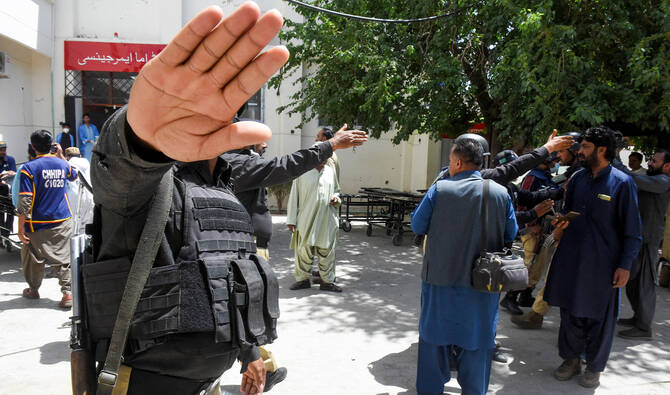

QUETTA: Gunmen killed three people, including two barbers from the eastern Punjab province, and set a police vehicle ablaze in Pakistan’s restive Balochistan province in the southwest, police and paramilitary Levies officials said on Saturday.
Balochistan, Pakistan’s most impoverished province, has been the site of a decades-old insurgency, where separatist militants often target security forces, police, foreigners and ethnic Punjabi commuters and workers, who they see as “outsiders,” by wresting control of highways and remote towns.
In this first attack, gunmen shot dead three people and injured another one inside a barber shop in Lasbela, a district adjacent to Pakistan’s commercial capital of Karachi, according to Senior Superintendent of Police (SSP) Atif Amir.
“Two of the deceased hailed from Bahawalpur (Punjab) and one from Quetta,” the official told Arab News. “Hunt for the attackers is underway.”
In another incident, dozens of armed men entered the Panjgur district late on Friday night and attempted to seize control of the Panjgur city and nearby areas.
“The armed men set a police vehicle and record of the Panjgur police station on fire,” Abdullah Baloch, an official at the Panjgur Levies control room, told Arab News.
“No casualty was reported despite an exchange of fire between security forces and armed men in Panjgur city and Goran, another area located 15 kilometers from Panjgur.”
No group immediately claimed responsibility for the attacks, but Baloch separatists have carried out similar assaults on law enforcers and ethnic Punjabis in the past.
The separatists accuse Islamabad of exploiting the province’s natural resources, such as gold and copper, and accuse foreigners and people from other province of backing the Pakistani state. Successive Pakistani governments have denied the allegations and said they only worked for the uplift of the region and its people.
The latest attacks come at a time, when Pakistan is fighting another insurgency by religiously motivated militant groups in its northwestern Khyber Pakhtunkhwa (KP) province, while the country’s eastern border with India has also flared up in recent weeks over an attack in Indian-administered Kashmir that killed 26 tourists last month.
Islamabad has variously accused Afghanistan and India of supporting the Pakistani Taliban and Baloch separatist groups, an allegation denied by Kabul and New Delhi.
In March, the Baloch Liberation Army separatist group hijacked a train with hundreds of passengers aboard near Balochistan’s Bolan Pass, which resulted in the deaths of 23 soldiers, three railway employees and five passengers. At least 33 insurgents were also killed, according to officials.
Late last month, police killed nine suspected militants in an intelligence-based operation in Balochistan’s Pishin district.


