

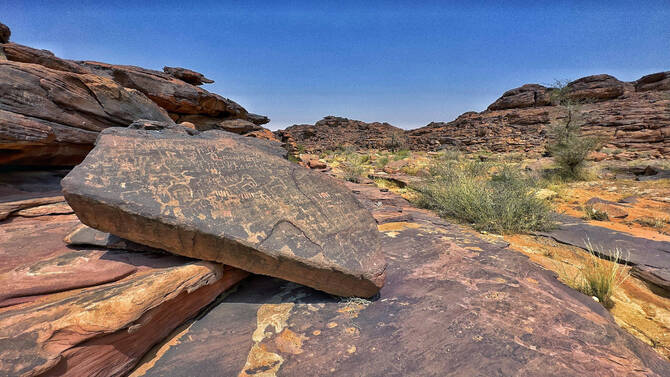

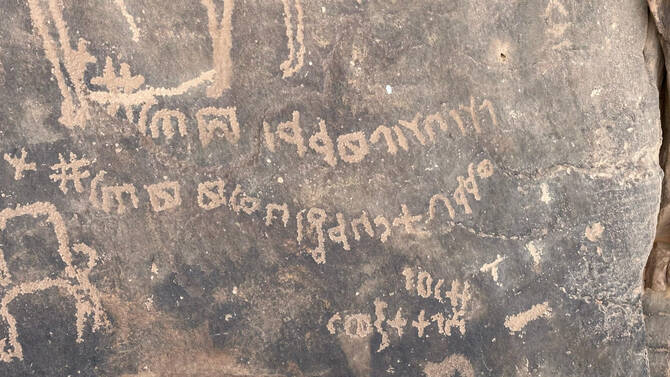

MAKKAH: Carved into the rocks of Hail, across its mountains and plateaus, Thamudic inscriptions stand as enduring testaments to a civilization that flourished over thousands of years ago.
More than mere markings, these inscriptions form a visual archive that offers rich insights into the lives, beliefs, customs and language of ancient Arabs, preserving their names, expressions, and everyday experiences.
Mamdouh Al-Fadel, a researcher into the history of Hail and ancient Thamudic Arabic inscriptions, told Arab News that Thamudic script was one of the most important early forms of Arabic writing.
“These inscriptions offer detailed insights into both religious and social life. They preserve a vivid record of names and ancient Arabic vocabulary.
“And portray animals that inhabited the region at the time, such as camels, ibex, gazelles, lions, cheetahs, and ostriches, helping to paint a comprehensive picture of the desert environment and way of life during that period.”

The Thamudic scripts had been found across many regions, particularly in the north, including Hail, Tayma, Tabuk and AlUla. (Supplied)
Al-Fadel said that among the most significant sites preserving these rock arts and inscriptions are Jabal Umm Sinman in the city of Jubbah, as well as the sites of Yatab, Janine Mountain, Al-Tuwal Mountain, Al-Julf, Habran, Al-Musma, and Arnan.
He said the rich vocabulary and the diversity of names found at these sites reflect the depth and complexity of social and cultural life during that era.
He highlighted the significant global impact of these discoveries, which have turned the inscription sites in Hail into important destinations for researchers and visitors from around the world.
Several of these locations, such as Jubbah, Jabal Al-Manjor, and Jabal Raat at Shuwaymis are on UNESCO’s World Heritage List, reflecting their profound archeological significance and cultural value on the global stage.
Al-Fadel said the Ministry of Culture is preserving these ancient petroglyphs by documenting archeological sites, conducting regular inspections, and fostering continuous research and academic studies.
When asked about the most striking aspects of life portrayed in the inscriptions, Al-Fadel explained: “They reveal a wealth of information about religious rituals, diverse hunting techniques, and the tools used, such as bows and arrows, spears, and even boomerangs.
“The inscriptions also depict clever hunting strategies, festive occasions like wedding dances, methods of adapting to the desert environment, the domestication of animals, and scenes of horse and camel racing, all illustrated with remarkable realism and detail.”

The script encompasses thousands of inscriptions written in various ancient Arabic languages and dialects. (SUpplied
The Thamudic inscriptions in Hail stand as timeless historical treasures that transport us to the far reaches of antiquity, placing the Kingdom among the earliest cradles of human civilization.
Saad Al-Sharif, a researcher in ancient Arabic inscriptions, notes that the Thamudic script is among the oldest and most significant writing systems used in the Arabian Peninsula.
It has been found across many regions, particularly in the north, including Hail, Tayma, Tabuk and AlUla.
He said that the script is not directly attributed to the Thamud tribe, but scholars had adopted the term “Thamudic” as a convenient label to categorize it.
The script encompasses thousands of inscriptions written in various ancient Arabic languages and dialects.
Al-Sharif said Thamudic inscriptions are a vital source for understanding the linguistic evolution of Arabic, acting as a transitional link between ancient scripts such as Lihyanite and Nabataean and the modern Arabic script.
He underscored the importance of continued research and exploration in this field to deepen understanding of the Arabian Peninsula’s history.


