

Pakistan military says it will not let India set precedent for cross-border strikes

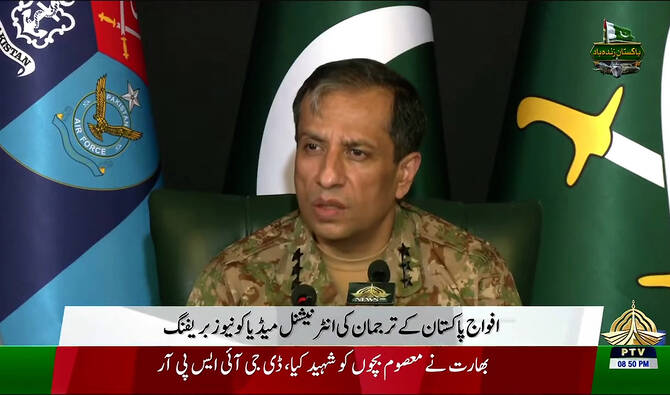
Pakistan military spokesperson Lt. Gen. Ahmed Sharif Chaudhry addresses a briefing to foreign journalists in Islamabad, Pakistan, on May 9, 2025. (PTV News/Screengrab)
Short Url
Updated 09 May 2025
Follow

Pakistan military says it will not let India set precedent for cross-border strikes

  • Military spokesperson says Pakistan has ‘every right to protect its honor, integrity and sovereignty’
  • He says India has been equipping people against Pakistan while running ‘terrorist’ training camps

ISLAMABAD: Pakistan’s military said on Friday it would not allow India to “set a new norm” where it could carry out cross-border strikes at will, vowing to defend the country’s sovereignty and respond at a time and place of its choosing.

The two South Asian nuclear rivals have been on the brink of a full-scale war since India carried out strikes on multiple locations in Pakistan on Wednesday, in response to a deadly April 22 attack in Indian-administered Kashmir that left 26 tourists dead. New Delhi blamed Islamabad for the attack, a charge Pakistan has denied.

In the days since, Pakistan has claimed to have downed five Indian fighter jets and over 75 drones, while India said it had retaliated against Pakistani air and drone assaults by destroying an air defense system in Lahore.

Global powers have urged both sides to exercise restraint, but tensions remain high.

“They want to set a new norm that at their convenience, whenever they feel like it, they will go cross-border, cross-international, and hit wherever they like,” Pakistan military spokesperson Lt. Gen. Ahmed Sharif Chaudhry said in a briefing to foreign media.

“What do you think of Pakistan — that we will allow all this to happen after clearly saying we have every right to protect the honor, integrity and sovereignty of our people?”

He added that Pakistan would respond “at the time, place and method of our choosing.”

During the briefing, Chaudhry displayed images of children killed in Indian strikes and asked journalists to keep them in mind.

“Please remember these pictures when you talk about what’s happening on the ground and when you ask us what Pakistan is going to do,” he said.

Accusing India of sponsoring “terrorism,” Chaudhry alleged that Indian agencies were operating training camps inside their country and directing armed groups to increase attacks on Pakistani soil.

“They have networks of people whom they train and equip with weapons,” he said. “Instructions have been issued to terrorist groups to ramp up activities against Pakistan.”

India and Pakistan have fought multiple wars, but this is the most serious escalation since both countries became declared nuclear powers in May 1998.

The disputed Himalayan region of Kashmir, which both sides claim in full but control in part, has long been a flashpoint and the cause of repeated military skirmishes.


Islamabad dismisses claims about paying up to 8 percent interest on foreign loans as ‘misleading’

Updated 22 February 2026
Follow

Islamabad dismisses claims about paying up to 8 percent interest on foreign loans as ‘misleading’

  • Pakistan has long relied on external loans to help bridge persistent gaps in public finances and foreign exchange reserves
  • Pakistan’s total external debt, liabilities stand at $138 billion at an overall average cost of around 4 percent, ministry says

KARACHI: Pakistan’s finance ministry on Sunday dismissed as “misleading” claims that the country is paying up to 8 percent interest on external loans, saying the overall average cost of external public debt is approximately 4 percent.

Pakistan has long relied on external loans to help bridge persistent gaps in public finances and foreign exchange reserves, driven largely by a narrow tax base, chronic trade deficits, rising debt-servicing costs and repeated balance-of-payments pressures.

Over the decades, successive governments have turned to multilateral and bilateral lenders, including the International Monetary Fund, the World Bank and the Asian Development Bank, to support budgetary needs and shore up foreign exchange reserves.

The finance ministry on Sunday issued a clarification in response to a “recent press commentary” regarding the country’s external debt position and associated interest payments, and said the figures required contextual explanation to ensure accurate understanding of Pakistan’s external debt profile.

“Pakistan’s total external debt and liabilities currently stand at $138 billion. This figure, however, encompasses a broad range of obligations, including public and publicly guaranteed debt, debt of Public Sector Enterprises (both guaranteed and non-guaranteed), bank borrowings, private-sector external debt, and intercompany liabilities to direct investors. It is therefore important to distinguish this aggregate figure from External Public (Government) Debt, which amounts to approximately $92 billion,” it said.

“Of the total External Public Debt, nearly 75 percent comprises concessional and long-term financing obtained from multilateral institutions (excluding the IMF) and bilateral development partners. Only about 7 percent of this debt consists of commercial loans, while another 7 percent relates to long-term Eurobonds. In light of this composition, the claim that Pakistan is paying interest on external loans ‘up to 8 percent’ is misleading.

The overall average cost of External Public Debt is approximately 4 percent, reflecting the predominantly concessional nature of the borrowing portfolio.”

With respect to interest payments, public external debt interest outflows increased from $1.99 billion in Fiscal Year (FY) 2022 to $3.59 billion in FY2025, representing an increase of 80.4 percent, not 84 percent as reported. In absolute terms, interest payments rose by $1.60 billion over this period, not $1.67 billion, it said.

According to the State Bank of Pakistan’s records, Pakistan’s total debt servicing payments to specific creditors during the period under reference were as follows: the IMF received $1.50 billion, of which $580 million constituted interest; Naya Pakistan Certificates payments totaled $1.56 billion, including $94 million in interest; the Asian Development Bank received $1.54 billion, including $615 million in interest; the World Bank received $1.25 billion, including $419 million in interest; and external commercial loans amounted to nearly $3 billion, of which $327 million represented interest payments.

“While interest payments have increased in absolute terms, this rise cannot be attributed solely to an expansion in the debt stock,” the ministry said. “Although the overall debt stock has increased slightly since FY2022, the additional inflows have primarily originated from concessional multilateral sources and the IMF’s Extended Fund Facility (EFF) under the ongoing IMF-supported program.”

Pakistan secured a $7 billion IMF bailout in Sept. 2024 as part of Prime Minister Shehbaz Sharif’s efforts to stabilize the South Asian economy that narrowly averted a default in 2023. The government has since been making efforts to boost trade and bring in foreign investment to consolidate recovery.

“It is also important to note that the increase in interest payments reflects prevailing global interest rate dynamics. In response to the inflation surge of 2021–22, the US Federal Reserve raised the federal funds rate from 0.75-1.00 percent in May 2022 to 5.25–5.50 percent by July 2023. Although rates have since moderated to around 3.75 percent, they remain significantly higher than 2022 levels,” the finance ministry said.

“The government remains committed to prudent debt management, transparency, and the continued strengthening of Pakistan’s macroeconomic stability,” it added.