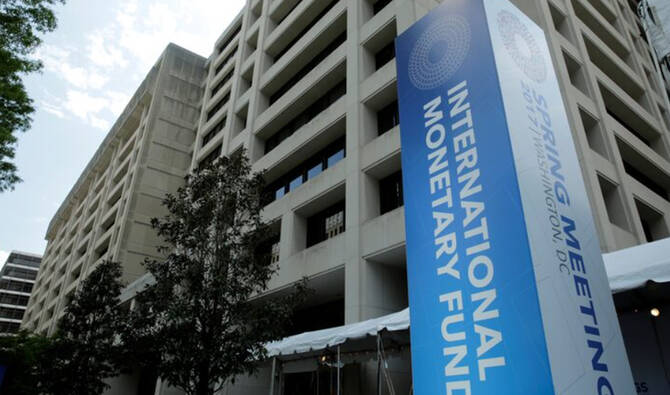
KARACHI: The International Monetary Fund (IMF) executive board is scheduled to meet on Friday to discuss the first review of Pakistan’s $7 billion bailout program, the lender said on Thursday.
The IMF executive board is expected to sign off on a staff-level agreement that would trigger a $1 billion payout as well as Pakistan’s new $1.3 billion arrangement under a climate resilience loan program granted in March.
The development comes amid Pakistan’s efforts to boost investment amid a gradually healing macroeconomic environment after a prolonged downturn that forced Islamabad to seek external financing from friendly nations and multilateral donors.
On Thursday, the IMF shared a tentative calendar of formal meetings and seminars of its executive board on its website, with the first review of Pakistan’s loan program scheduled to take place on Friday, May 9.
“First review under the extended arrangement under the Extended Fund Facility, request for modification of performance criteria, and request for an arrangement under the Resilience and Sustainability Facility,” it read.
Debt-ridden Pakistan, which had repaid or rolled over most of the $26 billion foreign loans it had to repay this year, expects its foreign exchange reserves to increase to $14 billion by the end of next month on the back of expected realization of planned official inflows.
The South Asian country was able to build some trust with the IMF by completing a short-term, nine-month program last year. Previous loan programs in Pakistan ended prematurely or saw delays after the governments at the time faltered on meeting key conditions.
The board’s approval has most of the time been a formality after the signing of a staff-level agreement between the Washington-based lender and the authorities in Islamabad.


IMF board to meet today for first review of Pakistan’s $7 billion bailout
https://arab.news/zbt7j
IMF board to meet today for first review of Pakistan’s $7 billion bailout

- Pakistan, which repaid or rolled over most of $26 billion foreign loans this year, expects its foreign exchange reserves to increase to $14 billion after expected inflows
- Previous programs in Pakistan ended prematurely or saw delays, but Islamabad built some trust with IMF by completing a short-term, nine-month program last year
Pakistan bank enables Shariah-compliant digital payment facility for passengers at Islamabad airport

Pakistan bank enables Shariah-compliant digital payment facility for passengers at Islamabad airport
- Pakistan is a cash-dominated market where a significant portion of transactions in the informal sector are made without any taxes, officials say
- The move comes amid Pakistan’s efforts to introduce a cashless model at airports under which only digital service providers can provide services
KARACHI: Aik, Pakistan’s first Islamic digital bank, has enabled fully digital payments at Islamabad International Airport to offer travelers and passengers secure, Shariah compliant digital transaction facility.
The development comes amid Pakistan’s efforts to introduce a cashless model at airports across the country, under which only digital service providers can provide services to customers.
Aik, a subsidiary of Bank Islami, said it has onboarded merchants across the Islamabad airport and integrated QR code deployments at key touchpoints to allow passengers and visitors to make secure, seamless, and Shariah-compliant digital transactions at all counters, retail outlets, and service points.
It said the implementation complies with the regulations and framework set by the State Bank of Pakistan (SBP) and is a working model for a large-scale adoption of cashless systems in public infrastructure.
“This deployment reflects our commitment to building practical digital infrastructure that improves everyday transactions,” Aik Chief Officer Ashfaque Ahmed said in a statement.
“By enabling a fully cashless environment at a major national gateway, we are supporting efficiency, transparency, and financial inclusion at scale. This is not only a project; it is a foundation for Pakistan’s cashless future.”
Pakistan is a cash-dominated market where a significant portion of transactions, particularly in the informal sector, are conducted in cash. Officials say many of these transactions are aimed at avoiding taxes.
In recent years, the SBP has taken steps to ensure a transition toward a more cashless economy so that transactions are more traceable, reducing chances of tax evasion and corruption.
By digitizing Islamabad airport, aik said it continues to invest in secure and accessible financial solutions that “expand digital participation and support national economic modernization.”


