Pakistani artists unite in powerful show of solidarity to raise funds for Gaza

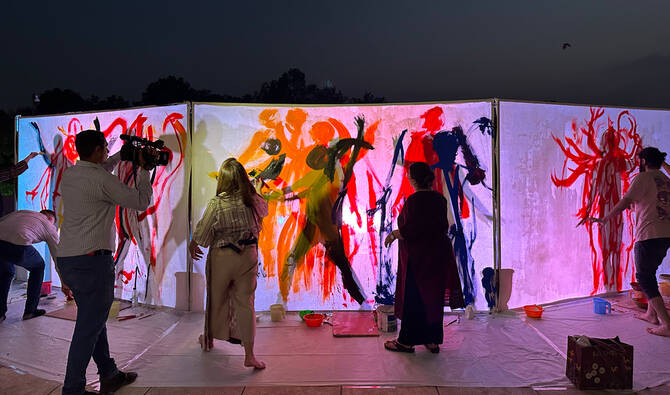
Pakistani artists paint during a live performance in solidarity with the people of Gaza, at the Silk Road Culture Center in Islamabad on May 6, 2025. (AN Photo)
Short Url
Updated 09 May 2025
Follow

Pakistani artists unite in powerful show of solidarity to raise funds for Gaza

  • The participants reflection on the Palestinian cause through dialogue, paintings, sculptures, theater, music and film
  • Proceeds of the artworks sold at the humanitarian art camp and others up for auction will go to the Palestinian embassy

ISLAMABAD: Around 150 Pakistani artists gathered in the Pakistani capital of Islamabad to participate in a eight-day humanitarian art camp to raise funds for people affected by Israeli military offensive in Gaza, the head of Silk Road Culture Center said this week, in a remarkable show of solidarity with the Palestinians.

The camp, “Art for Life – Art for Gaza,” brought together musicians, writers and performers from across Pakistan who presented series of multidisciplinary performances and visual art displays to raise funds for the war-torn people of Gaza.

The event began on April 30 and ended on May 7, amid renewed Israeli strikes on the Palestinian enclave. Israeli’s 18-month war against Hamas has killed more than 52,000 Palestinians, many of them women and children, Palestinian officials say.

“The idea [behind the event] was to empathize with the suffering people of Palestine,” Jamal Shah, chairman of the Silk Road Culture Center, told Arab News on Wednesday, without sharing details of the total funds raised.
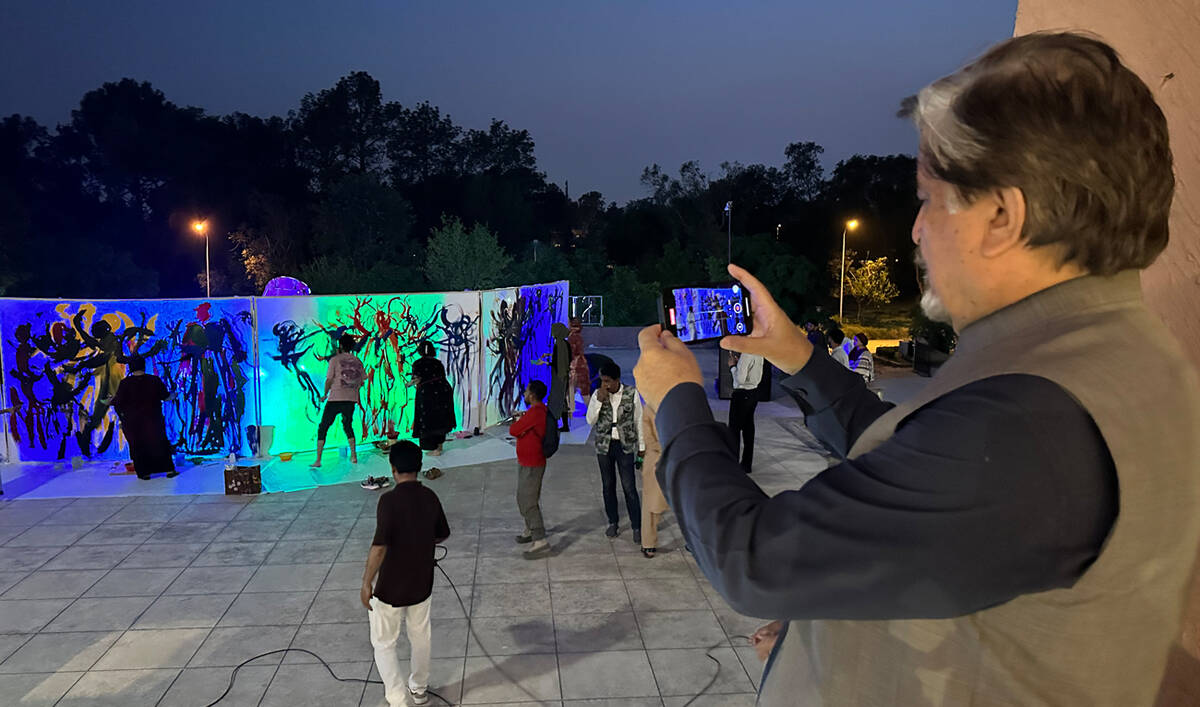


Jamal Shah, Pakistani artist and chairman of Silk Road Culture Center, records live art performance to express solidarity with Gaza, in Islamabad on May 6, 2025. (AN Photo)

A wide range of artworks, including paintings, sculptures, calligraphy, origami and mixed media, were created, exhibited and sold at the event, according to Shah. Many of the pieces are still up for auction, with proceeds pledged to the Palestinian embassy in Pakistan to support humanitarian aid efforts in Gaza.

The participating artists engaged in dialogue around the Palestinian cause and expressed their reflections through paintings, sculptures, theater, music and film at the event.

“My depiction shows their flag and different elements. The golden color represents pain and the Al-Aqsa Mosque,” said Atif Ayub, a contemprary artist from Lahore, describing his installation that combined symbolic imagery focusing on the year 1988 that marked the establishment of the State of Palestine.

“It’s all about shared humanity and emotion.”
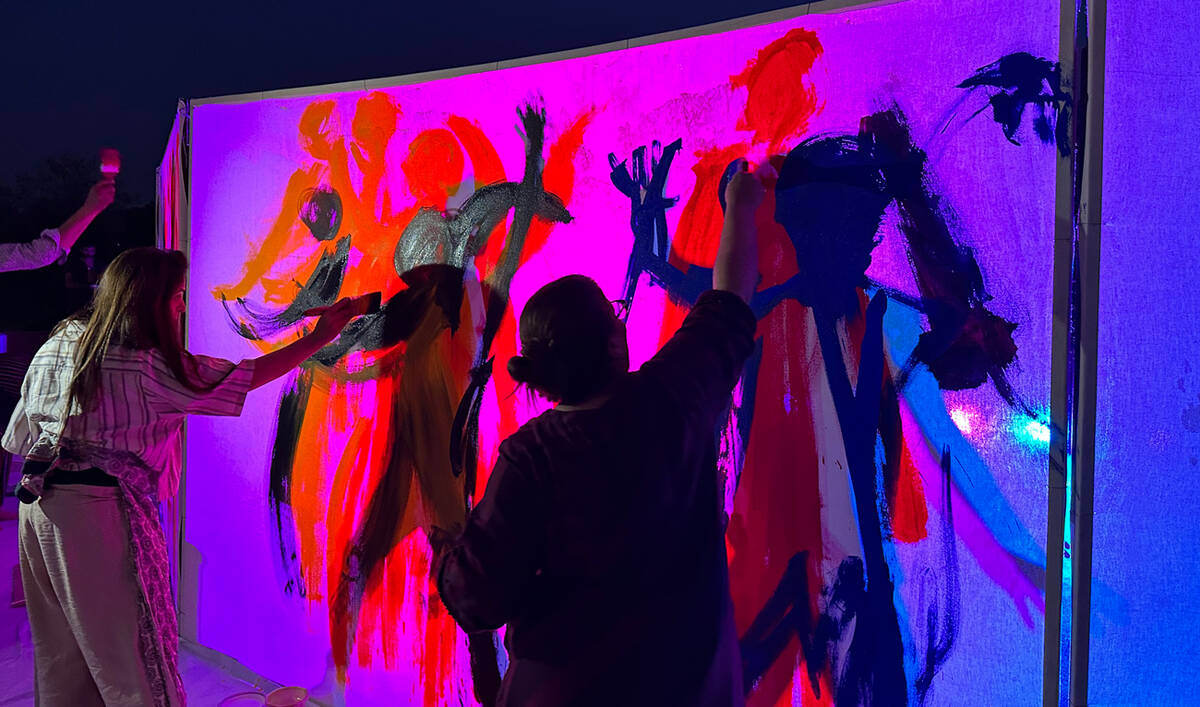


Pakistani artists paint during a live performance in solidarity with the people of Gaza, at the Silk Road Culture Center in Islamabad on May 6, 2025. (AN Photo)

The final two days featured live painting sessions, with artists painting silhouettes of performers in real time. These sessions were accompanied by musical performances, skits and poetry readings.

Pakistani singers and musicians such as Arieb, 360 Degrees, Maddy and Sam performed original pieces dedicated to Palestine, contributing to the emotional tone of the event.

Zeeshan Usman Khattak, a filmmaker from the northwestern city of Peshawar, said their collaborative work was a visual metaphor for the crisis in Gaza.

“There was a live performance behind the canvas and we were capturing the shadows,” Khattak said of their live performance. “Those movements reflected the dance of life and death, the aggression, the loss.”
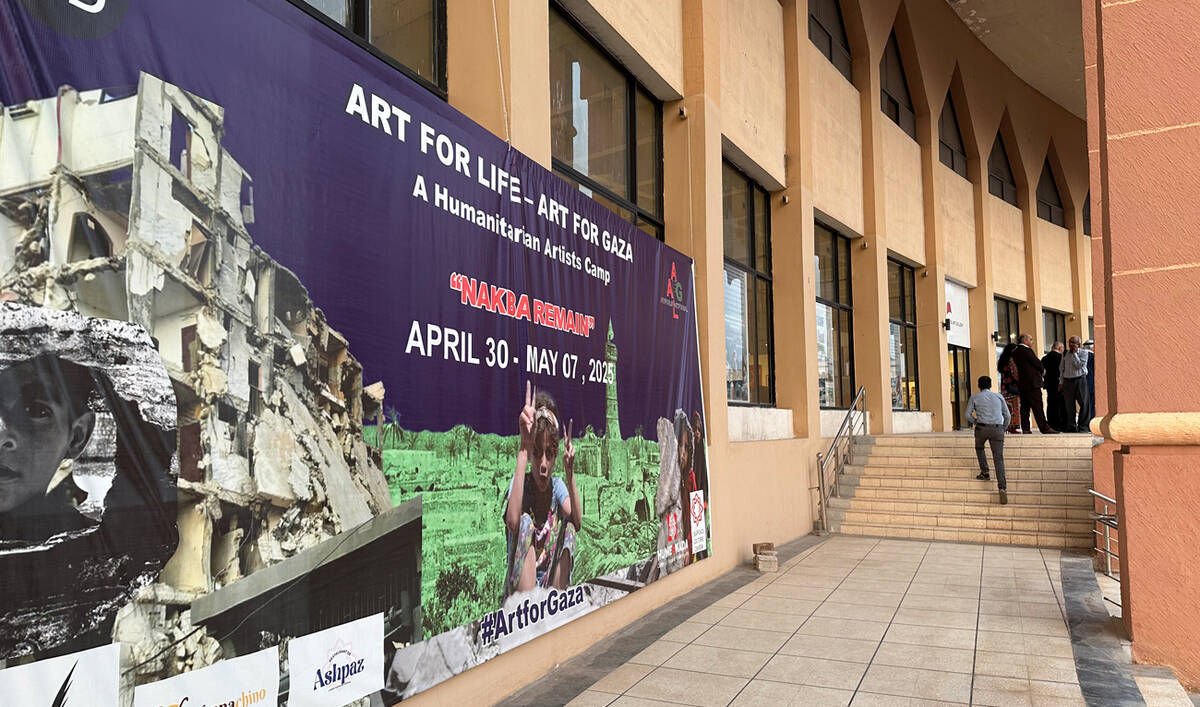


Visitors attend the eight-day art workshop to express solidarity with the people of Gaza, at the Silk Road Culture Center in Islamabad on May 6, 2025. (AN Photo)

Wednesday’s closing ceremony was attended by ambassadors from Palestine, Iraq, Iran, Sudan, Jordan, Lebanon, Morocco, Yemen, Qatar, Syria and Romania, along with cultural attachés from China and Iran as well as representatives from the French film community.

Summera Jawad, a professor who teaches fine arts at Lahore’s Punjab University, highlighted the community-driven nature of the initiative.

“Artists are not just performing or creating here, they’re also contributing to the exhibition and donating their artworks for the cause,” she said.


Abu Dhabi Royal Equestrian Arts Library taps into deep-rooted Arabian heritage of horsemanship

Updated 30 sec ago
Follow

Abu Dhabi Royal Equestrian Arts Library taps into deep-rooted Arabian heritage of horsemanship

DUBAI: Inside Abu Dhabi Royal Equestrian Arts, a new institution brings together centuries of horsemanship and the written word. The ADREA Library, the Middle East and North Africa region’s first all-equestrian library, has been carefully curated by Isobel Abulhoul, whose influence on the UAE’s literary landscape spans more than five decades.

“The ADREA Library is infused with the spirit of horses,” said Abulhoul in an interview with Arab News. Its shelves hold more than 14,000 titles dedicated entirely to equestrianism, encompassing “every aspect” of the field — from equine history and breeding to veterinary health, polo, racing, dressage, show jumping, training and saddlery. The result is a collection as comprehensive as it is specialized, designed to serve scholars, riders and enthusiasts alike.

Its shelves hold more than 14,000 titles dedicated entirely to equestrianism, encompassing “every aspect” of the field. (Supplied)

Beyond its scope, Abulhoul believes the library’s emotional resonance sets it apart. “It is a space that speaks across centuries, with a sense of legacy,” she said, pointing to stories of famous horses through history.

In the region, where the horse occupies a cherished cultural position, the library taps into a deep-rooted heritage. Arab horses, bred for centuries for “their loyalty, their speed and their beauty,” are central to that narrative. Visitors, she hopes, will be drawn into the collection and intrigued to learn more as they browse.

For Abulhoul, the project unites two lifelong passions. Since arriving in the UAE in 1968, she has played a defining role in shaping its reading culture, from co-founding Magrudy’s Bookshop in 1975 to founding the annual Emirates Airline Festival of Literature.

Beyond its scope, Abulhoul believes the library’s emotional resonance sets it apart. (Supplied)

But horses have always run alongside books in her life. She recalls helping to establish the Dubai Equestrian Centre in the 1980s, importing pure-bred Arabian horses and riding with her children through the desert. “Horses always can find their way home,” she said.

Being asked to curate the ADREA Library, she added, “was a dream come true.”

She sees strong parallels between fostering a literary community and nurturing equestrian excellence. “Humanity’s connection with horses is so special,” she said, describing them as noble creatures that respond to “gentleness and kindness.”

The ADREA Library has been carefully curated by Isobel Abulhoul. (Supplied)

Books, too, are teachers. “Both books and horses can nurture our creativity and empathy,” she said. “We can learn much about ourselves when we ride and when we read.”

That philosophy shapes the library’s role in preserving Emirati heritage. Abulhoul references Sheikh Zayed bin Sultan Al-Nahyan’s words: “A nation without a past is a nation without a present or a future,” and his declaration of a love for horses “rooted deeply in the history of our people.”

A dedicated children’s and youth section aims to spark both an interest in horses and “a love of reading for pleasure” among younger generations.

Assembling the collection took over a year of research into equestrian publishing worldwide. The final selection spans Arabic and English titles, with additional works in Spanish and Portuguese, including books on the Spanish Riding School. Rare and out-of-print volumes were sourced globally, and the collection is fully catalogued using the Dewey system, supported by specialist software that allows members to borrow titles.

Looking ahead, Abulhoul envisions steady growth, guided by community needs and borrowing patterns. Over time, the ADREA Library will continue to expand — organically and always with horses at its heart.