Dozens of former Eurovision contestants call for Israel ban from contest

Despite growing criticism, the EBU has said that Israel’s entry complies with competition rules and will proceed as planned. (AFP/File)
Short Url
Updated 06 May 2025
Follow

Dozens of former Eurovision contestants call for Israel ban from contest

  • 72 artists accused the EBU of double standards, ‘normalizing and whitewashing’ alleged Israeli war crimes
  • Open letter criticizes organizers for last year’s ‘disastrous’ contest

LONDON: A group of 72 former Eurovision contestants has called on the European Broadcasting Union to ban Israel and its national broadcaster, KAN, from this year’s song contest, citing the country’s war in Gaza.

In an open letter published Tuesday, the artists accused the EBU of “normalizing and whitewashing” alleged Israeli war crimes by allowing the country’s participation.

“By continuing to platform the representation of the Israeli state, the EBU is normalizing and whitewashing its crimes,” the letter said, adding that the organization’s handling of last year’s contest in Sweden was “disastrous,” resulting in “the most politicized, chaotic and unpleasant edition in the competition’s history.

“Last year, we were appalled that the EBU allowed Israel to participate while it continued its genocide in Gaza broadcast live for the world to see,” it said.

“Rather than acknowledging the widespread criticism and reflecting on its own failures, the EBU responded by doubling down — granting total impunity to the Israeli delegation while repressing other artists and delegations.”

Among those signing the letter are the UK’s 2023 entrant Mae Muller, Ireland’s 1994 Eurovision winner Charlie McGettigan, Finnish singer Kaija Karkinen and Portuguese performer Fernando Tordo.

Controversy surrounding Israel’s participation has grown since last year, when the EBU resisted mounting pressure to ban the country despite its military campaign in Gaza.

Critics accused the EBU of double standards, citing Russia’s exclusion from the contest in 2022 following its invasion of Ukraine.

“Silence is not an option,” the letter said. “The EBU has already demonstrated that it is capable of taking measures, as in 2022, when it expelled Russia from the competition. We don’t accept this double standard regarding Israel.”

The appeal comes amid increasing scrutiny over Israel’s inclusion in this year’s contest, which will take place in Basel, Switzerland, from May 13-17.

Last week, the EBU lifted a ban on Palestinian flags in the audience, reversing a longstanding policy that prohibited symbols from non-competing countries or territories.

Officials in several countries — including Spain, Iceland and Slovenia — have also voiced objections. Slovenia publicly protested Israel’s inclusion earlier this month.

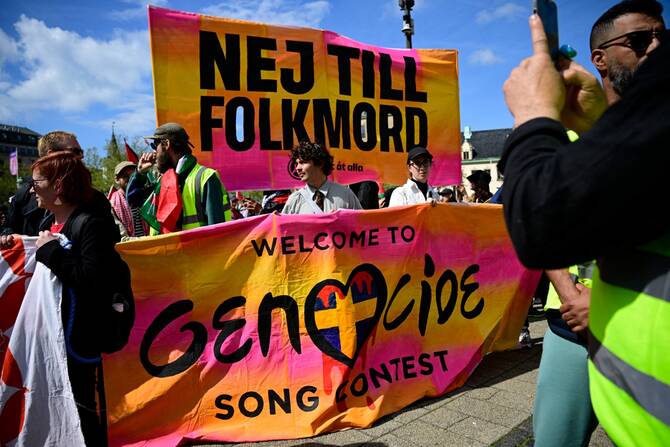
Despite growing criticism, the EBU has said that Israel’s entry complies with competition rules and will proceed as planned. Large-scale protests are expected during the event.

This year, Israel will be represented by Yuval Raphael, a survivor of the Oct. 7 Hamas-led attack, performing a song titled “New Day Will Rise.”


China’s national security agency in Hong Kong summons international media representatives

Updated 06 December 2025
Follow

China’s national security agency in Hong Kong summons international media representatives

HONG KONG: China’s national security agency in Hong Kong summoned international media representatives for a “regulatory talk” on Saturday, saying some had spread false information and smeared the government in recent reports on a deadly fire and upcoming legislative elections.
Senior journalists from several major outlets operating in the city, including AFP, were summoned to the meeting by the Office for Safeguarding National Security (OSNS), which was opened in 2020 following Beijing’s imposition of a wide-ranging national security law on the city.
Through the OSNS, Beijing’s security agents operate openly in Hong Kong, with powers to investigate and prosecute national security crimes.
“Recently, some foreign media reports on Hong Kong have disregarded facts, spread false information, distorted and smeared the government’s disaster relief and aftermath work, attacked and interfered with the Legislative Council election, (and) provoked social division and confrontation,” an OSNS statement posted online shortly after the meeting said.
At the meeting, an official who did not give his name read out a similar statement to media representatives.
He did not give specific examples of coverage that the OSNS had taken issue with, and did not take questions.
The online OSNS statement urged journalists to “not cross the legal red line.”
“The Office will not tolerate the actions of all anti-China and trouble-making elements in Hong Kong, and ‘don’t say we didn’t warn you’,” it read.
For the past week and a half, news coverage in Hong Kong has been dominated by a deadly blaze on a residential estate which killed at least 159 people.
Authorities have warned against crimes that “exploit the tragedy” and have reportedly arrested at least three people for sedition in the fire’s aftermath.
Dissent in Hong Kong has been all but quashed since Beijing brought in the national security law, after huge and sometimes violent protests in 2019.
Hong Kong’s electoral system was revamped in 2021 to ensure that only “patriots” could hold office, and the upcoming poll on Sunday will select a second batch of lawmakers under those rules.