

Drone strikes spark civilian exodus from army-controlled Sudan aid hub

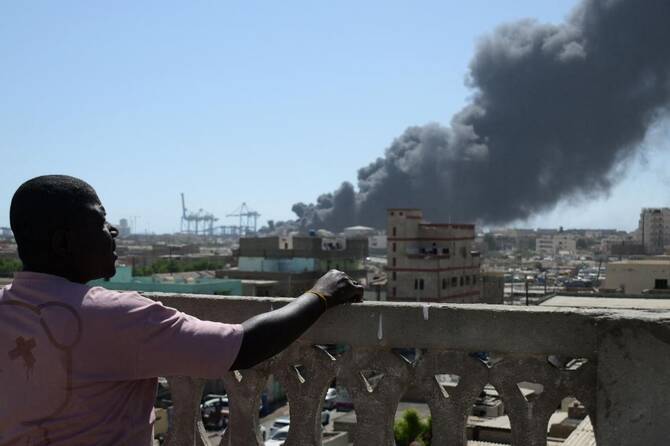
A man watches as smoke billows after a drone strike on the port of Port Sudan on May 6, 2025. (File/AFP)
Short Url
Updated 08 May 2025
Follow

Drone strikes spark civilian exodus from army-controlled Sudan aid hub

  • Port Sudan on the Red Sea coast had been regarded as a safe haven, hosting United Nations offices and hundreds of thousands of displaced people
  • RSF drone strikes on Port Sudan this week hit key facilities including the country’s last functioning international airport

PORT SUDAN: Paramilitary drones struck army-held areas of eastern and southern Sudan for a fifth straight day Thursday, army sources said, prompting an exodus of civilians from Port Sudan, seat of the army-backed government.

Attacks targeted the country’s main naval base outside Port Sudan, as well as fuel depots in the southern city of Kosti, two sources said, speaking on condition of anonymity.

“The militia launched another drone attack on the Flamingo Naval Base north of Port Sudan,” one source told AFP on condition of anonymity, referring to the paramilitary Rapid Support Forces (RSF), at war with the regular army since April 2023.

Explosions were heard across the city, an AFP correspondent reported.

Port Sudan on the Red Sea coast had been regarded as a safe haven, hosting United Nations offices and hundreds of thousands of displaced people, until drone strikes blamed on the RSF began on Sunday.

The port city is the main entry point for humanitarian aid into Sudan, and UN chief Antonio Guterres warned the attacks “threaten to increase humanitarian needs and further complicate aid operations in the country,” his spokesman Stephane Dujarric said.

Nearly 1,100 kilometers (some 680 miles) to the southwest, in the army-controlled city of Kosti in White Nile state, RSF drones struck fuel depots, setting off massive fires, a military source said.

“The militia targeted the fuel depots that supply the state with three drones, causing fires to break out,” the source told AFP on condition of anonymity.

There were no immediate reports of any casualties.

More than two years of war have killed tens of thousands of people and uprooted 13 million, according to UN figures.

RSF drone strikes on Port Sudan this week hit key facilities including the country’s last functioning international airport, its largest working fuel depot and the city’s main power station.

An army source said air defenses had shot down 15 drones over the city overnight.

At Port Sudan’s bustling main bus station, civilians were scrambling to leave.

“You can’t get a ticket without booking over a day in advance now, all the buses are booked,” said bus company employee Mahmoud Hussein.

Among those fleeing was Haidar Ibrahim, preparing to travel south with his family.

“The smoke is everywhere and my wife suffers from asthma,” he told AFP. “We have no choice but to leave.”

Many of those who had sought refuge in Port Sudan have been displaced multiple times before, fleeing each time the front line closed in.

Transport costs have nearly doubled as a result of fuel shortages triggered by the attacks.

“Now, we have to buy fuel on the black market,” said tuk-tuk driver Abdel-Meguid Babiker.

On Wednesday evening, drones were also seen over the army-held eastern city of Kassala and northern city of Merowe, prompting anti-aircraft fire.

Eight-country east African bloc, the Intergovernmental Authority on Development (IGAD), called the attacks on civilian infrastructure in Port Sudan “unacceptable” and demanded an “immediate end.”

“Any assault on this critical hub further compounds human suffering and impedes the delivery of urgently needed assistance,” IGAD executive secretary Workneh Gebeyehu said in a statement.

The RSF has not commented on the drone strikes, which have hit targets hundreds of kilometers away from their closest known positions on the outskirts of greater Khartoum.

The paramilitaries have ramped up their drone campaign since losing control of nearly all of greater Khartoum to the army in March.

The paramilitaries and their allies have moved to establish a rival administration in areas under their control.

The war has effectively split the country in two, with the army holding the north, east and center, and the RSF in control of most of Darfur and parts of the south.


Japan, UNOPS sign $4.6m project to restore customs capacity at major Yemeni ports

Updated 9 sec ago
Follow

Japan, UNOPS sign $4.6m project to restore customs capacity at major Yemeni ports

  • The notes for the project were signed and exchanged in Riyadh on Thursday

RIYADH: Japan and the United Nations Office for Project Services have signed an agreement for a new grant aid project aimed at improving customs functions at key ports in Yemen.

The notes for the project were signed and exchanged in Riyadh on Thursday by Yoichi Nakashima, Japan’s ambassador to Yemen, and Muhammad Usman Akram, representative and director of the UNOPS Operational Hub in Amman. The grant amounts to 732 million yen (approximately $4.6 million).

The initiative, titled “The Project for the Improvement of Customs Functions at Major Ports,” seeks to address mounting operational challenges facing Yemen’s customs authorities after years of conflict.

Officials said damage to cargo inspection infrastructure, particularly X-ray screening systems, has significantly reduced inspection capacity at customs facilities. As a result, only about 20 percent of cargo entering through affected ports can be scanned, while the remaining shipments are subject to manual inspection.

This imbalance has contributed to prolonged clearance times and increased risks, including the potential smuggling of weapons, narcotics and other prohibited goods, according to statements delivered at the ceremony.

The project will focus on three major entry points: Aden Sea Port in Aden Governorate, Al-Shihn Land Port in Al-Mahra, and Al-Wadiah Land Port in Hadramout.

Under the agreement, Japan will fund the rehabilitation of X-ray inspection systems and the provision of modern detection equipment. The program also includes capacity development measures, including specialized training for Yemeni customs officials.

Speaking at the event, Nakashima said the project was designed to strengthen the operational capabilities of the Yemeni Customs Authority over an 18-month period. Improving inspection efficiency would help accelerate procedures while reducing reliance on manual checks.

Strengthening customs systems was expected to facilitate smoother trade flows and improve the handling of humanitarian shipments, which remain critical amid Yemen’s ongoing humanitarian crisis, he added.

UNOPS representative Akram described the agreement as a significant step forward in supporting Yemen’s customs authorities through Japanese funding.

“Today marks a significant step forward in strengthening the Yemeni Customs Authority through vital and much appreciated funding from our longstanding partner, the Government of Japan,” he said during the ceremony.

He added the project aimed to address key operational challenges facing the Yemen Customs Authority and enhance efficiency by strengthening institutional capacity in cargo inspection and clearance procedures.

According to Akram, the initiative is expected to reduce the time and costs associated with importing goods into Yemen, including humanitarian assistance.

To achieve these objectives, UNOPS will draw on its procurement expertise to acquire cargo inspection devices and critical spare parts required to restore existing vehicle and container scanners, alongside other necessary equipment.

Akram added that the program will also include capacity-building and training components to support effective operationalization of the upgraded systems.

He said Yemen had a historical role as a major trading crossroads linking the Red Sea and the Gulf of Aden, describing the measures under the project as an important step toward revitalizing and modernizing the country’s customs infrastructure.

The improvements, he said, were expected to facilitate trade, strengthen revenue collection and support the Yemeni government’s broader reconstruction and development priorities.

Akram also expressed appreciation to the Government of Japan for its continued partnership, as well as to Yemeni authorities for their cooperation in facilitating operational and logistical processes related to UNOPS projects.

“UNOPS remains committed to supporting the efforts of the Government of Yemen towards reconstruction and sustainable development with the valuable support of the international community,” he said.

Yemen’s Deputy Finance Minister Hani Wahab welcomed the agreement, describing the project as a major step in improving customs infrastructure and operational efficiency.

Speaking during the ceremony, he said the initiative would contribute to modernizing automated inspection systems, providing spare parts for equipment and supporting personnel training. He added improved customs capacity would help facilitate trade, strengthen revenue collection and combat the trafficking of illegal goods.

Nakashima also highlighted Japan’s broader development engagement with Yemen, saying the country had provided technical support in customs management through training programs implemented by JICA in recent years.

With the latest grant, total Japanese assistance to Yemen since 2015 has reached approximately $497 million. Japan said it would continue working with UN agencies and international partners to support peace and institutional resilience in Yemen.

This article also appears on Arab News Japan