Pakistani and Indian NSAs established contact after New Delhi’s missile strike — Ishaq Dar

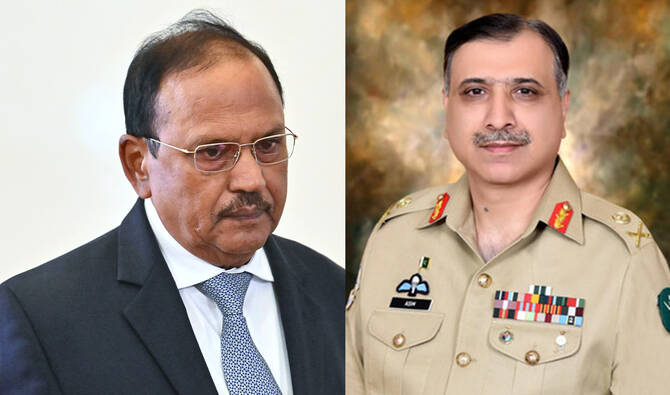
National Security advisors of India, Ajit Doval (left) and Lt. Gen. Muhammad Asim Malik's collage image. (AFP)
Short Url
Updated 08 May 2025
Follow

Pakistani and Indian NSAs established contact after New Delhi’s missile strike — Ishaq Dar

  • The Pakistani deputy PM tells a foreign news outlet India’s actions are ‘not condonable’
  • He does not disclose what the NSAs discussed, but Pakistan has vowed to avenge the attack

ISLAMABAD: Pakistani and Indian national security advisers established contact after New Delhi’s missile strikes on Pakistan killed at least 31 people, Pakistani Deputy Prime Minister Ishaq Dar said on Wednesday, marking a rare official communication between the nuclear-armed rivals.
India said it launched the strikes targeting what it described as “terrorist infrastructure” inside Pakistan following a deadly assault on tourists in Indian-administered Kashmir’s Pahalgam area, which it blamed on Pakistan despite Islamabad’s denials.
Pakistan said it shot down five Indian fighter jets and destroyed several border posts in the military clash that followed. Prime Minister Shehbaz Sharif called the Indian missile attacks a “grave mistake” and warned that New Delhi “will have to face consequences.”
In an interview with TRT World, the Pakistani deputy premier said India had done something that “is not condonable.”
“[Dar] confirmed that both a Pakistani national security adviser and Indian national security adviser spoke to each other after last night’s Indian missile strikes in Pakistan, as well as Pakistani-administered Kashmir and then Pakistan’s response, in which Pakistan said that five Indian fighter jets were shot down,” a TRT correspondent in Islamabad reported after the interview.
“However, he did not provide further details, but some people interpret that given the fact that now both sides have established contacts at the level of national security advisers, this means that some form of effort is underway to de-escalate tensions,” he added.
Pakistan recently named Lt. Gen. Muhammad Asim Malik, the head of the Inter-Services Intelligence (ISI), as its National Security Adviser, while his Indian counterpart is Ajit Doval.
The two countries have rarely maintained high-level official contacts in recent years. Pakistan downgraded diplomatic ties after India revoked the special constitutional status of the disputed Kashmir region in 2019 to integrate it with the rest of the Indian union.
The rivals, who have fought multiple wars over the Himalayan region they both claim in full but control in parts, also expelled each other’s diplomats following the recent Pahalgam attack.
It is not clear what the two NSAs discussed during their call, but Pakistan has vowed to retaliate after the missile strikes.


Pakistan stocks close at record high over current account surplus, falling bond yields

Updated 18 December 2025
Follow

Pakistan stocks close at record high over current account surplus, falling bond yields

  • KSE-100 index gains 1,646.79 points or 0.97% to close at new high of 171,960.64 points
  • Pakistan’s central bank posted a current account surplus of $100 million in November

KARACHI: Pakistani stocks closed at an all-time high of 171,960.4 points on Thursday, with financial analysts attributing the surge to increasing investor confidence stemming from a current account surplus reported in November and a drop in government bond yields.

The benchmark KSE-100 index gained 1,646.79 points or 0.97% to close at an all-time high of 171,960.64 points on Thursday. The previous day, Pakistani stocks surged to 170,313.85 points at close of business. 

Ahsan Mehanti, chief executive officer at Arif Habib Commodities, said the optimistic mood at the stock exchange was fueled by the $100 million current account surplus reported by the central bank in November.

“Speculations ahead of year-end close and fall in government bond yields up to 70 basis points after the SBP (State Bank of Pakistan) policy easing played the catalyst role in bullish activity at PSX,” Mehanti told Arab News. 

The surplus was a welcome development for Islamabad as Pakistan’s central bank reported a $291 million deficit in October.

Topline Securities, a Pakistani brokerage firm, said in its daily market review that strong buying by local funds followed a drop in Pakistan Investment Bond (PIB) yields, which boosted investor confidence.

PIB yields are the returns on bonds or government-backed securities that pay fixed semi-annual interest, with rates influenced by market demand and SBP auctions.

“Strength in ENGRO (Engro Corporation), FFC (Fauji Fertilizer Company), UBL (United Bank Limited), LUCK (Lucky Cement) and BAHL (Bank AL Habib) underpinned positive momentum, collectively contributing 1,504 points to the index,” the brokerage firm wrote on X. 

“This upside was partly offset by declines in PIOC (Pakistan International Oil Company), DHPL (D.H. Corporation Limited) and MLCF (Millat Tractor Limited), which together subtracted 176 points.”

The sustained rise in equities comes amid improving liquidity conditions and continued investor participation, with market participants focusing on corporate earnings, sector-specific developments and broader macroeconomic signals.

Earlier on Monday, Pakistan’s central bank cut its key policy interest rate by 50 basis points to 10.5%, a move that surprised analysts and followed four consecutive policy meetings where rates were held unchanged.

The cut came despite an International Monetary Fund staff report earlier this month cautioning against premature monetary easing.

Inflation eased to 6.1% in November, remaining within the SBP’s target band, though analysts have warned that price pressures could resurface later in the fiscal year as base effects fade and food and transport costs remain volatile.