Bill Gates says AI key for health, education innovation

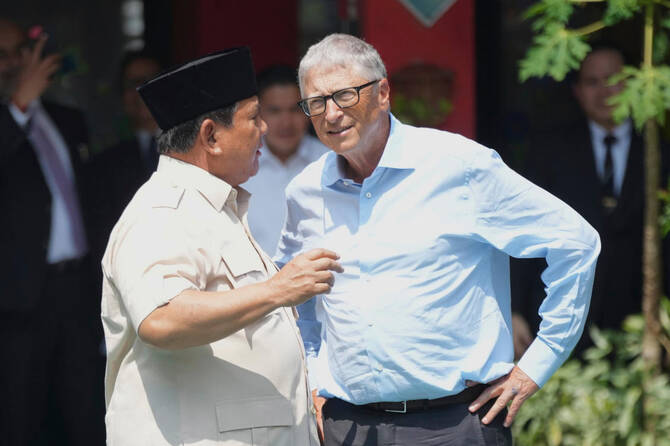
Microsoft co-founder Bill Gates said artificial intelligence will play a key role in unlocking new tools for health, education and agriculture at a meeting with Indonesia’s president on Wednesday. (AP)
Short Url
Updated 07 May 2025
Follow

Bill Gates says AI key for health, education innovation

  • Microsoft co-founder Bill Gates said artificial intelligence will play a key role in unlocking new tools for health, education and agriculture at a meeting with Indonesia's president on Wednesday

JAKARTA: Microsoft co-founder Bill Gates said artificial intelligence will play a key role in unlocking new tools for health, education and agriculture at a meeting with Indonesia's president on Wednesday.
Indonesia is Southeast Asia's biggest economy and has a population of around 280 million across its sprawling archipelago, with a growing demand for data centres and AI tech in the region.
Gates visited President Prabowo Subianto and Indonesian philanthropists in the capital Jakarta, where he spoke about his optimism that AI-driven innovation will help tackle global challenges.
"AI is going to help us discover new tools. And even in the delivery of health and education and agriculture advice, we'll be using AI," he told a meeting.
"Once we finish (eradicting) polio, we'd like to try and eradicate measles and malaria as well. We have some new tools for that. And of course, part of my optimism about the innovation is because we have now artificial intelligence."
UN agencies have been campaigning for four decades to eradicate polio, most often spread through sewage and contaminated water.
The billionaire philanthropist has donated more than $159 million to Indonesia since 2009, mostly to the health sector including to fund vaccines, Prabowo said.
Gates later visited an elementary school in Jakarta alongside Prabowo to see students having free meals as part of a programme launched by the Indonesian leader.
Prabowo also announced plans to give Gates Indonesia's highest civilian award for his "contribution to the Indonesian people and the world".
Microsoft chief executive officer Satya Nadella last year pledged a $1.7 billion investment in AI and cloud computing to help develop Indonesia's AI infrastructure.


Saudi gaming industry has promising future, says Qiddiya executive

Updated 48 min 29 sec ago
Follow

Saudi gaming industry has promising future, says Qiddiya executive

  • Mike Milanov said that the industry had surpassed the combined industries of film, television, music and sports worldwide
  • Milanov added that Saudi Arabia had talented teams with strong skills in esports and game development

RIYADH: Saudi Arabia is uniquely positioned for a highly promising future in the gaming sector, which is valued at $323 billion globally, according to the head of gaming at Saudi entertainment megaproject Qiddiya.

Mike Milanov, the company’s head of gaming and esports, spoke during the session “The Global Era of Gaming: How It Became the New Frontier for Media and Entertainment” at the Saudi Media Forum 2026 in Riyadh.

The industry, he said, had surpassed the combined industries of film, television, music and sports worldwide and was growing globally at an annual rate of 3 percent to 9 percent, expected to reach about $623 billion by 2035

He added that future generations held different perspectives and levels of engagement, as gaming represented a form of digital advancement and a powerful tool for connection.

Milanov also highlighted how Saudi Arabia had talented teams with strong skills in esports and game development, along with significant creative and innovative energy that supported building relationships both locally and globally.

He further noted that Qiddiya City spanned nearly 330 sq. km, and that more than 86 percent of Saudis identified themselves as gamers, reinforcing the Kingdom’s position as one of the world’s largest gaming and esports markets.

Karen Starr, vice president of marketing, branding and creative at Activision Publishing, also spoke during the panel and emphasized the major role gaming played across social media platforms.

She described this influence as positive for brand building, especially given the young audiences that followed gaming brands.

Starr added that the sustainability of major gaming brands depended on continuous engagement, community-building, and adapting content locally to maintain cultural relevance.

She explained that gaming had evolved into an ongoing media experience based on constant interaction and long-term audience connection.

She also said that gaming today had become a global media force that had surpassed traditional channels, shaping culture, content and audience engagement over time.

Meanwhile, Shelley Williams, executive vice president of sales at F1 Arcade Simulation, spoke about how gaming experiences were built on a sense of belonging and participation, which helped to create stronger infrastructure and extended media experiences.

She said that shared audience experiences opened the door to new ecosystems and further game development, supporting long-term content sustainability.