

India strikes Pakistan over tourist killings, Pakistan says Indian jets downed

1 / 4
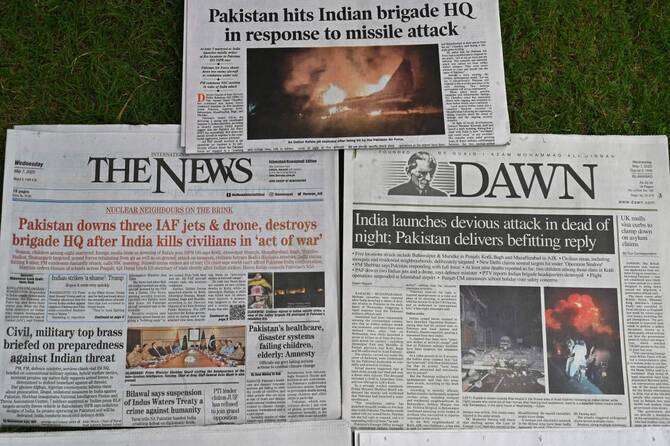
Newspapers are pictured at a stall following border tensions, in Islamabad on May 7, 2025.(AFP)
2 / 4
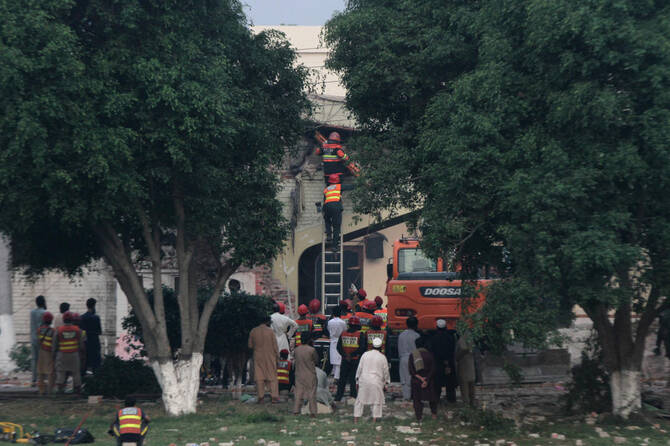
Rescuers search for survivors in a damaged building after it was hit by an Indian strike in Muridke near Lahore, Pakistan, May 7, 2025. (Reuters)
3 / 4
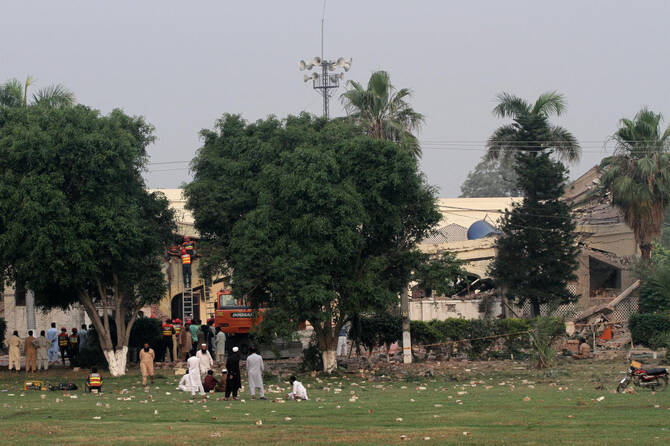
Rescuers search for survivors in a damaged building after it was hit by an Indian strike in Muridke near Lahore, Pakistan, May 7, 2025. (Reuters)
4 / 4
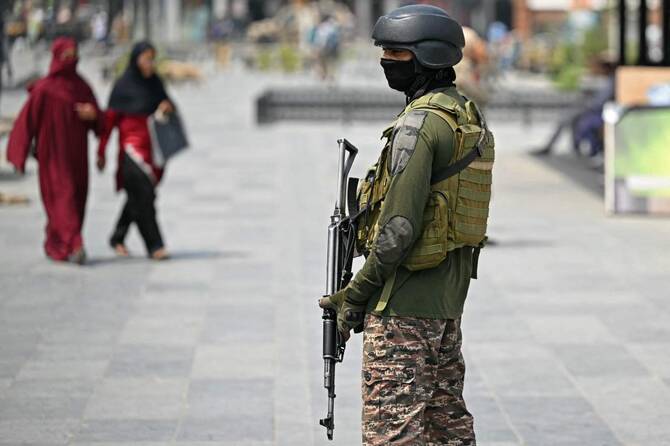
An Indian paramilitary personnel stands guard along a road in Srinagar on May 7, 2025, following border tensions.(AFP)
Short Url
Updated 07 May 2025
Follow

India strikes Pakistan over tourist killings, Pakistan says Indian jets downed

  • India fired missiles into Pakistani-controlled territory in several locations early Wednesday, killing at least 26 people including a child
  • India says it struck terrorist sites in Pakistan
  • Pakistan says mosques, civilians hit, vows to respond

MUZAFFARABAD/NEW DELHI: India attacked Pakistan and Pakistani Kashmir on Wednesday and Pakistan said it had shot down five Indian fighter jets in the worst fighting in more than two decades between the nuclear-armed enemies.

India said it struck nine Pakistani “terrorist infrastructure” sites, some of them linked to an attack by Islamist militants on Hindu tourists that killed 26 people in Indian Kashmir last month.

Islamabad said six Pakistani locations were targeted, and that none of them were militant camps. At least 26 civilians were killed and 46 injured, a Pakistan military spokesperson said.

Indian forces attacked the headquarters of Islamist militant groups Jaish-e-Mohammed and Lashkar-e-Taiba, an Indian defense source told Reuters.

“India has demonstrated considerable restraint in selection of targets and method of execution,” the Indian defense ministry said in a statement.

Pakistan said Indian missiles hit three sites and a military spokesperson told Reuters five Indian aircraft had been shot down, a claim not confirmed by India.

However, four local government sources in Indian Kashmir told Reuters that three fighter jets had crashed in separate areas of the Himalayan region during the night.

All three pilots had been hospitalized, the sources added. Indian defense ministry officials were not immediately available to confirm the report.

Images circulating on local media showed a large, damaged cylindrical chunk of silver-colored metal lying in a field at one of the crash sites. Reuters could not immediately verify the authenticity of the image.

Islamabad called the assault a “blatant act of war” and said it had informed the UN Security Council that Pakistan reserved the right to respond appropriately to Indian aggression.

“All of these engagements have been done as a defensive measure,” Pakistan military spokesperson Ahmed Sharif Chaudhry said. “Pakistan remains a very responsible state. However, we will take all the steps necessary for defending the honor, integrity and sovereignty of Pakistan, at all cost.”

The South Asian neighbors also exchanged intense shelling and heavy gunfire across much of their de facto border in the Himalayan region of Kashmir, police and witnesses told Reuters.

Hindu-majority India and Islamic Pakistan have fought two of their three wars since independence in 1947 over Muslim-majority Kashmir, which both sides claim in full and control in part.


’OPERATION SINDOOR’

Since a 2003 ceasefire, to which both countries recommitted in 2021, targeted strikes between the neighbors are extremely rare, especially Indian strikes on Pakistani areas outside Pakistani Kashmir.

But analysts said the risk of escalation is higher than in the recent past due to the severity of India’s attack, which New Delhi called “Operation Sindoor.” Sindoor is the Hindi language word for vermilion, a red powder that Hindu women put on the forehead or parting of their hair as a sign of marriage.

US President Donald Trump called the fighting “a shame” and added, “I hope it ends quickly.” The State Department said Secretary of State Marco Rubio spoke to the national security advisers of both nations, urging “both to keep lines of communication open and avoid escalation.”

UN Secretary-General Antonio Guterres called for maximum military restraint from both countries, a spokesperson said. China, which neighbors both India and Pakistan, also called for restraint.

The Pakistani army’s shelling across the frontier in Kashmir killed seven civilians and injured 35 in the Indian sector of the region, police there said.

Indian TV channels showed videos of explosions, fire, large plumes of smoke in the night sky and people fleeing in several places in Pakistan and Pakistani Kashmir. Reuters could not independently verify the footage.

In Muzaffarabad, the capital of Pakistani Kashmir, damage from the Indian strike was visible at sunrise. Security forces surrounded a small mosque in a hill-side residential neighborhood which had been hit, with its minaret collapsed.

All schools in Pakistani Kashmir, the national capital Islamabad, and much of Indian Kashmir and the populous Pakistani province of Punjab were ordered closed on Wednesday in the aftermath of the strikes.

Imran Shaheen, a district official in Pakistani Kashmir, said two mortars landed on a house in the town of Forward Kahuta, killing two men and injuring several women and children. In another village, a resident had been killed in firing, Shaheen said.

Pakistani Prime Minister Shehbaz Sharif said Islamabad was responding to the Indian attacks but did not provide details. Pakistan’s populous province of Punjab declared an emergency, its chief minister said, and hospitals and emergency services were on high alert.

A Pakistani military spokesperson told broadcaster Geo that two mosques were among the sites hit by India. The Pakistani defense minister told Geo that all the sites were civilian and not militant camps.

He said India’s claim of targeting “camps of terrorists is false.”

After India’s strikes, the Indian army said in a post on X on Wednesday: “Justice is served.”

STOCK FUTURES, AIRLINES IMPACTED

A spokesperson for the Indian Embassy in Washington told Reuters that evidence pointed “toward the clear involvement of Pakistan-based terrorists in this terror attack,” referring to the April tourist killings.

India said two of three suspects in that attack were Pakistani nationals but had not detailed its evidence. Pakistan denied that it had anything to do with the April killings.

News of the strikes impacted Indian stock futures mildly, with the GIFT NIFTY at 24,311, 0.3 percent below the NIFTY 50’s last close of 24,379.6 on Tuesday.

Several airlines including India’s largest airline, IndiGo , Air India and Qatar Airways canceled flights in areas of India and Pakistan due to closures of airports and airspace. Indian National Security Adviser Ajit Doval spoke to US Secretary of State Marco Rubio and other senior Indian officials briefed counterparts in Britain, Russia, Saudi Arabia and the United Arab Emirates, an Indian source told Reuters.

The Indian strike goes far beyond New Delhi’s response to previous attacks in Kashmir blamed on Pakistan. Those include India’s 2019 air strike on Pakistan after 40 Indian paramilitary police were killed in Kashmir and India’s retaliation for the deaths of 18 soldiers in 2016.

“Given the scale of the Indian strike, which was far greater than what we saw in 2019, we can expect a sizable Pakistani response,” said Michael Kugelman, a Washington-based South Asia analyst and writer for the Foreign Policy magazine.

“All eyes will be on India’s next move. We’ve had a strike and a counter-strike, and what comes next will be the strongest indication of just how serious a crisis this could become,” he said.


In an increasingly hostile world, migrants are hopeful as Spain moves to integrate them

Updated 5 sec ago
Follow

In an increasingly hostile world, migrants are hopeful as Spain moves to integrate them

  • The “sin papeles” (Spanish for “without papers”) are often exploited, marginalized and invisible
  • Sánchez said the country was opening a legal path for “people who have, together with us, built progress in this country”

BARCELONA: More than half a million immigrants are believed to live in Spain without legal permission.
They work jobs that few Spaniards want: picking fruits and vegetables in the fields, caring for children and the elderly, cleaning homes and hotel rooms. Some wind up homeless.
The “sin papeles” (Spanish for “without papers”) are often exploited, marginalized and invisible.
Now, Spain wants to integrate them. Earlier this week, the government announced it would grant residency and work permits to all foreigners who arrived in the country before Dec. 31, 2025, have lived in Spain for at least five months, and have no criminal record.
Pedro Sánchez, Spain’s socialist prime minister, said the country was opening a legal path for “people who have, together with us, built progress in this country” in a video posted to social media Friday.
The unexpected move contrasted with harsh rhetoric and deportation efforts ramping up in the United States and other European Union countries.
Here are three people who are hoping to get their residency and work permits under Spain’s new policy.
A Colombian asylum-seeker
“A week ago, I was living with constant anxiety,” said Ale Castañeda, an asylum-seeker from Colombia whose temporary permit was about to expire in February. “I didn’t know what would happen to me, if I would be able to stay or not, if I would have to start from scratch again.”
Now, if his asylum case gets rejected, Castañeda has another legal pathway to remain in Spain. He just wants to be able to work and get access to “basic things,” like opening a bank account. One thing he wants to make clear is that he doesn’t plan to rely on public benefits.
Castañeda says he’s found odd jobs when he can but is currently out of work.
Like many of the Latin Americans who make up the majority of immigrants in Spain, Castañeda arrived legally on a tourist visa and decided to stay. A queer man, he fled discrimination in Colombia to more progressive, gay-friendly Argentina. But after right-wing, anti-woke Javier Milei was elected, the mood in the country changed and Castañeda was brutally attacked. “I just had to leave,” he said.
In Spain, he finally felt safe.
While Castañeda celebrated Spain’s immigration opening — “It’s the best news of 2026!” — he and other foreigners know that the devil is in the details. The government has shared the basic requirements but the fine print has yet to be published in the official state bulletin.
Castañeda knows how lengthy immigration procedures can be. Even the most basic step, getting an appointment at the immigration office, is such an impossible task that criminal groups are selling them for 50 euros ($60). He wonders how the government will process hundreds of thousands of applications in only a few months.
Spain’s Minister of Migration Elma Saiz vowed that her ministry will dedicate additional resources to make sure things run smoothly. “We want this to be a success,” she said.
A former architect from Chile
Paulina Valenzuela still can’t believe the news. “I still can’t stop smiling,” she told The Associated Press by phone.
A former architect, Valenzuela moved to Spain after losing her job in Chile. She’s struggled to legalize her status for the past three years, falling for costly scams and getting her immigration applications rejected twice without understanding why.
Like many educated Latinas who have moved to Spain, Valenzuela has taken up cleaning jobs to make a living. “I’ll work in anything,” she said. At one point, she was responsible for cleaning 40 apartments listed on Airbnb, an intense and stressful job that paid little, she said.
The booming tourism sector depends heavily on cheap and informal immigrant labor. A record 97 million tourists visited Spain last year and spent more than 130 billion euros. Immigrants see only a tiny fraction of that revenue.
Physically and emotionally drained, Valenzuela quit in November and has resorted to social services to get food on the table.
She’s hoping the new residency permits will lift her out of poverty. Valenzuela can’t help but be suspicious of things that seem too good to be true.
“There’s always an obstacle at the last minute,” she said. “But at least I have hope I didn’t have before.”
A struggling man from Pakistan
Hussain Dar, 30, has been in Spain for almost a year and is struggling without papers.
He left his native Pakistan, where jobs are scarce, to pursue a master’s degree in the United Kingdom.
But he was unable to stay in the UK due to its harsher immigration laws and headed to Spain. Still unable to work legally, he’s used up all his savings, sold his computer, and is now thinking of selling his phone. Late on his rent payment, he’s spent several nights sleeping on the streets.
“It’s been tough,” he told AP as he stood in an eight-hour line outside the Pakistani consulate in Barcelona this week.
Dar is among some 15,000 Pakistani citizens living in the northeastern region of Catalonia without permission, according to Murad Ali Wazir, Pakistan’s consul general in Barcelona.
One of the requirements — a certificate of clear criminal record — has swamped the consulate. The window to apply for legal residency in Spain will be short: from April and to the end of June only, Spanish officials say. To help its citizens get the required documents in time, the consulate announced it will even open on weekends.
“I didn’t expect that this country was going to be so good, the weather, the people, the culture,” Dar said. With permits, he and others will be able to work and pay Spanish taxes, contributing to the Spanish economy, he said. They’ll also be allowed to visit family back home that they haven’t seen in years, Dar said with a smile.
“Viva España! Viva Pedro Sánchez! We love that guy,” he exclaimed.