

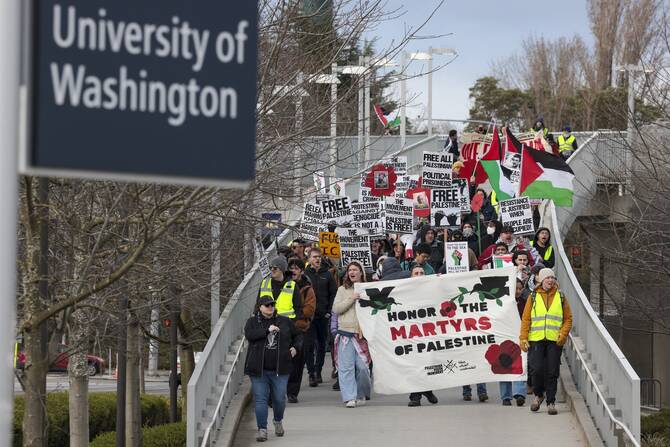
Pro-Palestinian protesters arrested after occupying University of Washington building

People protest the arrest of former Columbia University student activist Mahmoud Khalil and show support for Palestinians at the University of Washington campus in Seattle, Mar. 15, 2025. (AFP)
Short Url
Updated 06 May 2025
Follow

Pro-Palestinian protesters arrested after occupying University of Washington building

  • Students demanded that the university sever all ties with Boeing, including returning any Boeing donations and barring the company’s employees from teaching
  • The arrests come amid a Trump administration crackdown on international students who took part in pro-Palestinian protests at US colleges and universities

SEATTLE: Police arrested about 30 pro-Palestinian protesters who occupied a University of Washington engineering building and demanded the school break ties with Boeing.
Students from the group Super UW moved into the Interdisciplinary Engineering Building in Seattle on Monday evening and unofficially renamed it after Shaban Al-Dalou, a teenage engineering student who was killed along with his mother after an Israeli airstrike caused an inferno outside of a Gaza hospital.
The students demanded that the university sever all ties with Boeing, including returning any Boeing donations and barring the company’s employees from teaching at or otherwise influencing the school. Boeing has a factory in nearby Renton that makes commercial and military aircraft, according to its website.
“We’re hoping to remove the influence of Boeing and other manufacturing companies from our educational space, period, and we’re hoping to expose the repressive tactics of the university,” Super UW spokesperson Eric Horford told KOMO News.
Another group dressed in black blocked the front of the building with furniture and used dumpsters to block nearby Jefferson Road.
UW police worked with Seattle police to clear the building at around 10:30 p.m., UW spokesperson Victor Balta said in a statement. About 30 people were taken into custody and charged with trespassing, property destruction and disorderly conduct, he said. Their cases will be referred to the King County prosecutors.
Any students identified will be referred to the Student Conduct Office, Balta said.
The arrests come amid a Trump administration crackdown on international students who took part in pro-Palestinian protests at US colleges and universities.

More than 1,000 students at 160 colleges, universities and university systems have had their visas revoked or their legal status terminated since late March, according to an Associated Press review of university statements, correspondence with school officials and court records.



Philippines builds defense partnerships amid growing China aggression

Updated 4 sec ago
Follow

Philippines builds defense partnerships amid growing China aggression

  • Island country forged new pacts with Japan, the UAE, Canada, Germany in past year
  • Manila sees China’s maritime expansion as ‘quintessential security threat,’ expert says

MANILA: The Philippines and Japan have signed a new defense pact, adding to a growing list of security cooperation Manila has been forging with partner countries as it faces a growing Chinese presence in the disputed South China Sea.

Philippine-Japan security ties have strengthened in recent years over shared concerns in the region, with the two countries signing a landmark military pact in 2024, allowing the deployment of their forces on each other’s soil for joint military drills. It was Japan’s first such pact in Asia.

The new defense agreement — signed by Philippine Foreign Secretary Theresa Lazaro and Japanese Foreign Minister Toshimitsu Motegi in Manila on Thursday — is a follow-up to their 2024 pact, and would allow tax-free, reciprocal provision of ammunition, fuel, food and other necessities when their forces conduct joint training and disaster relief operations.

The security partnership is aimed at boosting deterrence against China, experts say.

“The latest defense pact with Japan is not only significant but also existential (as) a strong deterrence to China’s growing military size and ambition in the string of islands of the first island chain that includes Japan and the Philippines,” Chester Cabalza, founding president of the International Development and Security Cooperation think tank, told Arab News.

The Philippines, China and several other countries have overlapping claims in the disputed South China Sea, a strategic waterway through which billions of dollars worth of goods pass each year.

Beijing has maintained its expansive claims of the area, despite a 2016 international tribunal ruling that China’s historical assertion to it had no basis.

Japan has a longstanding territorial dispute with China over islands in the East China Sea, while Chinese and Philippine coast guard and navy ships have been involved in a series of tense incidents in the South China Sea in recent years.

“The imminent threat to maintain a status quo of peaceful co-existence in the region brings a shared responsibility for Manila and Tokyo to elevate strategic partnership to achieve this strategic equilibrium,” he said.

Motegi said he and Lazaro “concurred on continuing to oppose unilateral attempts to change the status quo by force or coercion in the East and South China seas,” in a clear rebuke of Beijing’s increasing assertiveness, without naming China.

The Philippines sees China’s maritime expansion as “the quintessential security threat,” said international studies expert Prof. Renato De Castro.

“So, of course, we rely on our efforts to build up our armed forces in terms of the comprehensive archipelagic defense operation,” he told Arab News.

The Philippines has a mutual defense treaty with the US, which the allies signed in 1951. While both governments have continued to deepen defense cooperation in recent years, Manila has also been building security partnerships with other countries.

The Philippines has signed two defense deals this month alone, including a Memorandum of Understanding on Defense Cooperation with the UAE, its first such deal with a Gulf country.

Last year, Manila signed military pacts with New Zealand and Canada, which sets the legal framework to allow military engagements, including joint drills, in each other’s territory. Both agreements still need to be ratified by the Philippine Senate to take effect.

The Philippines also signed a defense cooperation arrangement with Germany in May, aimed at boosting joint activities.