

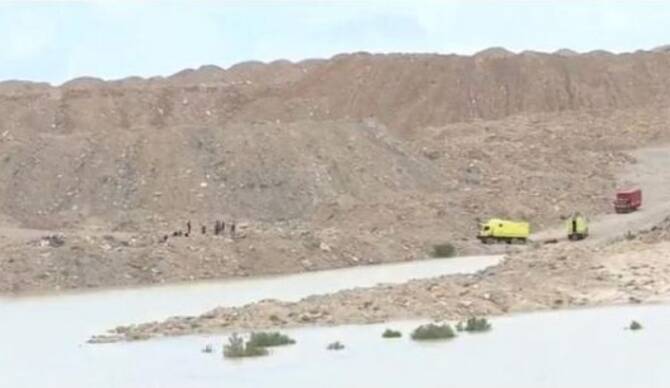
The bodies of a Belgian mother and her son were recovered in southern Jordan after flash flooding

Search and rescue teams recovered the bodies of a Belgian mother and her son on Monday in Jordan, police said a day after the woman and her three children were reported missing in flash flooding. (X/@Jomomoment)
Short Url
Updated 06 May 2025
Follow

The bodies of a Belgian mother and her son were recovered in southern Jordan after flash flooding

  • The mother and children had been part of a group of 18 tourists
  • Fourteen tourists, all Czechs, were rescued on Sunday

AMMAN: Search and rescue teams recovered the bodies of a Belgian mother and her son on Monday in Jordan, police said a day after the woman and her three children were reported missing in flash flooding. The other two children were found alive.
Sunday’s flooding in southern Jordan also led to the evacuation of hundreds of tourists from the Petra archaeological site, the country’s main tourist attraction.

The mother and children had been part of a group of 18 tourists who had been on an adventure trip in Wadi Al-Nakhil when they were caught up in the flash flood, Ma’an district local governor Hassan Al-Jabour told state media broadcaster Al-Mamlaka TV.
Fourteen tourists, all Czechs, were rescued on Sunday. Rescue crews located two of the children alive late Sunday, Al-Jabour said. The search and rescue operation was suspended at about 2 a.m. because of the complicated weather conditions and terrain. The bodies of the woman and her son were found Monday morning after the search resumed, he said.
Further details about the family and the ages of the children weren’t immediately available.
Jordan often experiences flash flooding as heavy seasonal rains send torrents of water through dry desert valleys. At least three people died in 2021 when floodwaters swept away their car, while more than 30 people in the Dead Sea region and other parts of Jordan were killed in flash flooding in 2018.


The art of war: fears for masterpieces on loan to Louvre Abu Dhabi

Updated 13 March 2026
Follow

The art of war: fears for masterpieces on loan to Louvre Abu Dhabi

  • UAE paid more than €1 billion to borrow priceless works, but experts in France want them back

PARIS: The Middle East war has raised fears for the safety of priceless masterpieces on loan from France to the Louvre Abu Dhabi, the museum’s only foreign branch.
The Abu Dhabi museum, which opened in 2017, has so far escaped damage from nearly 1,800 Iranian drone and missile strikes launched since the conflict erupted on Feb. 28.
However, concerns are mounting in France. “The works must be removed,” said Didier Selles, who helped broker the original agreement between France and the UAE.
French journal La Tribune de l’Art echoed that alarm. “The Louvre’s works in Abu Dhabi must be secured!” it said.
France’s culture ministry said French authorities were “in close and regular contact with the authorities of the UAE to ensure the protection of the works loaned by France.”
Under the agreement with the UAE, France agreed to provide expertise, lend works of art and organize exhibitions, in return for €1 billion, including €400 million for licensing the use of the Louvre name. The deal was extended in 2021 to 2047 for an additional €165 million.
Works on loan include paintings by Rembrandt and Chardin, Classical statues of Isis, Roman sarcophagi and Islamic masterpieces: such as the Pyxis of Al-Mughira.

A Louvre Abu Dhabi source said the museum was designed to protect collections from both security threats and natural disasters.