Fear and uncertainty grip Azad Kashmir’s tourism sector as India-Pakistan tensions soar

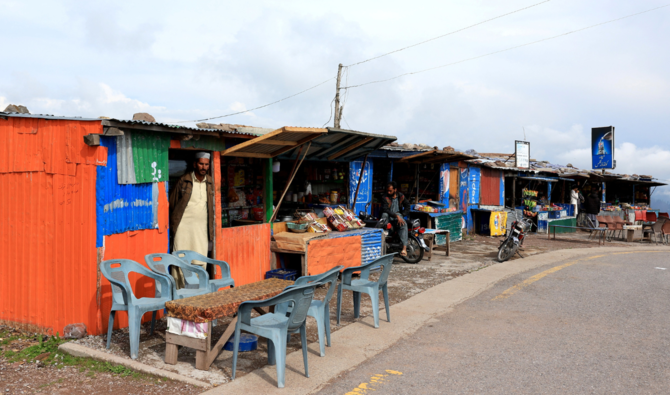
Musaddiq Hussain stands at his empty roadside restaurant at Pir Chinasi, a tourist attraction in Pakistan-administered Kashmir, May 4, 2025. (Reuters)
Short Url
Updated 06 May 2025
Follow

Fear and uncertainty grip Azad Kashmir’s tourism sector as India-Pakistan tensions soar

  • Guesthouses in Azad Kashmir experiencing “zero occupancy” due to safety concerns and restrictions, says hotel association
  • Tensions between Delhi, Islamabad have surged since last month when militant attack killed 26 in Indian-administered Kashmir

PIR CHANASI, Muzaffarabad: Tensions between India and Pakistan have impacted tourism in Pakistan-administered Kashmir, with local business owners reporting a sharp decline in visitor arrivals on Sunday (May 4) due to safety concerns and restrictions on movement enforced by Pakistani authorities.
The latest crisis between the nuclear-armed neighbors was sparked by a deadly attack on tourists in the disputed Kashmir region last week that saw suspected militants kill at least 26 people. India has accused Pakistan of involvement in the attack, which Islamabad denies. Pakistan has said it has “credible intelligence” that India intends to launch military action.
The Pir Chinasi area in Muzaffarabad district, a popular hilltop tourist destination not far from the border with India-administered Kashmir, has seen a dramatic drop in footfall, leaving hotels empty and businesses struggling.
“Due to tensions between India and Pakistan, the roads have been closed here since the border is nearby,” Mohammad Saghir, a local restaurant owner, said. “Because of this, only a few tourists are coming here.”
However, Syed Yasir Ali, a tourist from Islamabad, said he believes the area is still “a safe place” and “very peaceful.”
Despite Ali’s positive reassurances, Abrar Ahmed Butt, a spokesperson for the All Kashmir Hotel Association, local hotels and guesthouses have experienced “zero occupancy” over the past eight days due to road closures and restrictions on movement being enforced by local authorities. With no end in sight for the current hostilities, Butt said he is “hoping for the best”, but very supportive of Pakistani authorities, even if it means preventing tourists from traveling to the Muzaffarabad area.
“National security is our top priority. As patriots, we love our country. When our country is secure, business and other aspects will follow suit. With faith, we trust things will improve,” said Butt.


Pakistan to promote mineral sector at Saudi forum this month with 13 companies

Updated 5 sec ago
Follow

Pakistan to promote mineral sector at Saudi forum this month with 13 companies

  • Delegation will take part in the Future Minerals Forum in Riyadh from Jan. 13-15
  • Petroleum minister will lead Pakistan, participate in a 90-minute country session

ISLAMABAD: Around 13 Pakistani state-owned and private companies will attend the Future Minerals Forum (FMF) in Saudi Arabia from Jan. 13 to 15, an official statement said on Friday, as the country seeks to ramp up global engagement to develop its mineral resources.

The FMF is an international conference and investment platform for the mining sector, hosted by mineral-rich countries to attract global investors, companies and governments.

Petroleum Minister Ali Pervaiz Malik confirmed Pakistan’s participation in a meeting with the Saudi envoy, Nawaf bin Said Al-Malki.

Pakistan hosts one of the world’s largest copper-gold zones. The Reko Diq mine in southwestern Balochistan, with an estimated 5.9 billion tons of ore, is partly owned by Barrick Gold, which calls it one of the world’s largest underdeveloped copper-gold deposits. Its development is expected to boost Pakistan’s struggling economy.

“Upon an invitation of the Government of the Kingdom of Saudi Arabia, the Federal Minister informed the Ambassador that Pakistan will fully participate in the upcoming Future Minerals Forum (FMF), scheduled to be held in Riyadh later this month,” Pakistan’s Press Information Department (PID) said in an official statement.

The Pakistani minister will lead his country’s delegation at the FMF and take part in a 90-minute country showcase session titled “Unleashing Potential: Accelerating Pakistan’s Mineral Revolution” along with local and foreign investors.

Pakistan will also establish a dedicated pavilion to highlight the vast potential of its rich geological landscape to the global mineral community.

The Saudi envoy welcomed Pakistan’s decision to participate in the forum and discussed enhancing bilateral cooperation in the minerals and energy sectors during the meeting.

According to the statement, he highlighted the potential for cooperation between Saudi Arabia and Pakistan in the minerals and energy sectors, expressing confidence that the FMF would provide a platform to expand collaboration.
Pakistan’s mineral sector, despite its rich reserves of salt, copper, gold and coal, contributes only 3.2 percent to the country’s GDP and just 0.1 percent to global mineral exports.

However, many countries, including the United States, have shown interest in Pakistan’s underdeveloped mineral sector, particularly in copper, gold and other critical resources.

In October, Pakistan dispatched its first-ever shipment of rare earth and critical minerals to the United States, according to a Chicago-based US public relations firm’s report.