

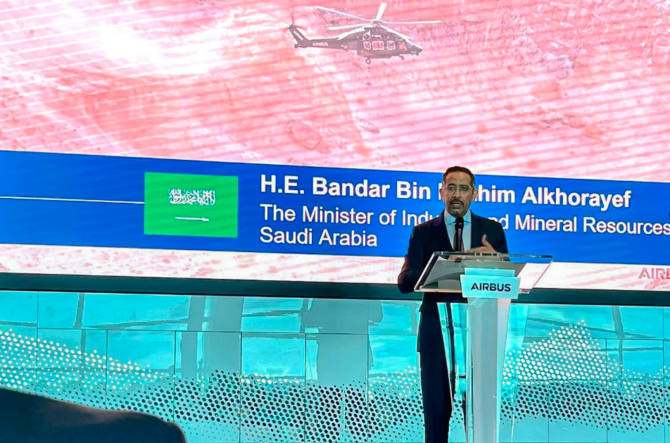

RIYADH: Saudi Arabia is exploring joint manufacturing opportunities with Airbus Helicopters as part of its broader effort to localize advanced aviation technologies and strengthen the domestic industry.
The discussions were held during the “Industrial Day” event at Airbus Helicopters’ headquarters in Marignane, France, in the presence of the Kingdom’s Minister of Industry and Mineral Resources Bandar Alkhorayef, company executives, Saudi aviation suppliers, and Airbus’s global network of partners.
The visit marks a key milestone in the Kingdom’s push to become a global hub for the aerospace industry under Vision 2030.
In a post on X, Alkhorayef said the event “emphasized the importance of localizing technology, strengthening international partnerships, and leveraging the Kingdom’s assets and mineral resources to become a pivotal hub for the aviation industry.”
During the gathering, the Saudi delegation met with Airbus Helicopters CEO Bruno Even, reviewed the company’s advanced aircraft production technologies, and explored potential areas for investment and joint manufacturing in helicopters and related sectors.
Alkhorayef emphasized the strategic importance of the aviation industry to Saudi Arabia’s industrial development plans, calling it one of the most promising advanced sectors for localizing capabilities and developing high-value technologies.
He added that Saudi Arabia is focused on building a globally competitive manufacturing base, highlighting the country’s commitment to localizing the aviation sector through industrial partnerships and foreign investment.
The minister said the Kingdom offers robust fundamentals for industrial growth, including mineral wealth, energy resources, skilled labor, and a business-friendly investment environment.
He stated that Saudi Arabia’s aerospace strategy includes the localization of helicopter production, unmanned aerial vehicles, and the development of maintenance, repair, and overhaul services.
The market for these capabilities is projected to exceed $10 billion.
By 2035, the aerospace sector is expected to contribute $88 billion to the Kingdom’s gross domestic product and support more than 377,000 jobs, according to a statement from the ministry.
During the meeting, Airbus Helicopters executives presented the company’s manufacturing capabilities and expressed interest in deepening collaboration in areas such as assembly, aviation maintenance, and innovation in rotorcraft technology.
The discussions also addressed opportunities for technology transfer and industrial training to support Saudi Arabia’s ambition of becoming a regional aerospace center.
The Saudi delegation included senior officials such as the National Industrial Development Center CEO Saleh Al-Sulomi and was part of a broader official visit to France.
The visit aimed to strengthen bilateral ties and explore strategic cooperation in mining, aviation, and industrial development. Meetings were also held with French government representatives and business leaders to discuss expanding investment flows and industrial partnerships.
Alkhorayef stressed that the Kingdom’s long-term goal is to diversify its economy by accelerating the growth of high-tech industries and integrating into global manufacturing value chains.
The nation’s unique competitive advantages — including its strategic location, mineral reserves, energy capacity, and logistics infrastructure — position it as a compelling destination for industrial investment.


