CAPE TOWN: The call came in just after 7:00 p.m. as the paramedics began the night shift: a man had been stabbed in the head with a glass bottle and was bleeding heavily.
The medical crew and their ambulance from Cape Town’s Emergency Medical Services (EMS) were only minutes away. But they could not respond until they had an armed police escort.
The Cape Flats, low-lying townships outside Cape Town, are hotspots for murder and gang violence in a country already plagued by one of the highest crime rates in the world.
The sprawling area of Philippi, where the wounded man lay bleeding in a shack, is among the most dangerous.
It is one of nine Red Zones in Cape Town where the EMS refuses to allow its medical crews to move without security cover.
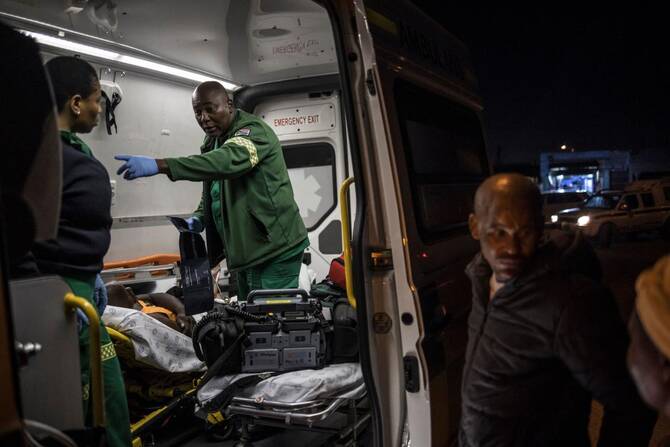
“If it was up to me, I would go straight there,” said paramedic Mawethu Ntintini, 52, pacing the sidewalk outside the Philippi police station in his green reflective uniform.
“But we have to go through the police.”
Waiting inside the ambulance was Ntintini’s partner, Ntombikayisi Joko, who has narrowly escaped ambush while on duty and was robbed in 2021 while waiting for directions to a call-out.
“Every time I’m going out, I have to pray,” the 42-year-old mother told AFP.
“If we were going there by ourselves, we would be robbed,” Ntintini admitted.
They waited another 30 minutes before a police patrol car emerged to escort the ambulance 10 minutes down the road to a small shack of corrugated iron.
Anguished family members crowded at the wounded man’s bed were relieved to see the paramedics. “Sometimes we have to wait until the morning just because we live in a wrong place,” one said.
As the team worked, the police car’s flashing lights cast a blue glow on the dark street.
The man’s injuries, a deep cut to the arm and a bump on the head, were less severe than feared. Loaded into the ambulance, he arrived at the hospital at 8:45 pm, almost two hours after the call for help.
Joko recalled a time the police, overstretched and overburdened, could only free up an escort more than an hour after an emergency was issued for a woman in labor.
It was too late.
“It was a baby boy, he was so cute. The umbilical cord was wrapped around his neck,” she said.
“I was crying, because I knew that if I was there before, I would have helped that baby.”
Four of South Africa’s top five homicide hotspots last year were in the Cape Flats, according to police figures.
The Western Cape — one of nine provinces — recorded more than 12 people murdered every day, with the national average hovering around 75 a day.
The EMS demanded security escorts in 2015 when there was more than one assault a week on paramedics operating in the Cape Flats.
Incidents peaked in 2017 when nearly 90 attacks were recorded, ranging from verbal abuse and theft to hijackings and stabbings. In 2023, the latest available figure, there were 44 incidents.
Ambulance crews are soft targets for criminals looking to steal phones, money or medical equipment, said Pastor Craven Engel, who runs a gang violence prevention organization called Ceasefire.
He linked the violence to hardships imposed under apartheid, the previous government that espoused racial segregation and forced non-whites into bleak areas like Philippi, 20 kilometers (12 miles) from the city center.
“It started with the urban displacement, uprooting people, putting them into areas where there’s no economic development, no recreation, no sustainable livelihood,” Engel said.
With high unemployment and rampant poverty, “the resources are so depleted that people are now targeting the good guys,” he told AFP at his offices in Hanover Park, another Red Zone.
Medical crews working to save lives sometimes know the criminals who threaten them and might also, one day, need their assistance, said 32-year-old paramedic Inathi Jacob.
“You get angry,” she said. “But we don’t let them get us to the core. There are a lot of people who really need the services of EMS.”
Ntintini and Joko had just dropped the bleeding man at a hospital when the second “priority one” call of their night shift came in: an elderly man, recently recovered from a stroke, was unresponsive.
Driving to his house would take only five minutes but the ambulance could only leave 40 minutes later, sirens blaring as a police car escorted them down narrow, dark alleyways.


![]()


‘I have to pray’: fear, danger for paramedics in South Africa’s crime hotspots
Short Url
https://arab.news/5483x
‘I have to pray’: fear, danger for paramedics in South Africa’s crime hotspots
- The call came in just after 7:00 p.m. as the paramedics began the night shift: a man had been stabbed in the head with a glass bottle and was bleeding heavily
- Ambulance crews are soft targets for criminals looking to steal phones, money or medical equipment


Russia’s war footing may remain after Ukraine war, Latvia spy chief warns
MUNICH: Russia will not end the militarization of its economy after fighting in Ukraine ends, the head of Latvia’s intelligence agency told AFP on the sidelines of the Munich Security Conference which ends Sunday.
“The potential aggressiveness of Russia when the Ukraine war stops will depend of many factors: How the war ends, if it’s frozen or not, and if the sanctions remain,” Egils Zviedris, director of the Latvian intelligence service SAB, told AFP.
Some observers believe that Russia has so thoroughly embraced a war economy and full military mobilization that it will be difficult for it to reverse course, and that this could push Moscow to launch further offensives against European territories.
Zviedris said that lifting current sanctions “would allow Russia to develop its military capacities” more quickly.
He acknowledged that Russia has drawn up military plans to potentially attack Latvia and its Baltic neighbors, but also said that “Russia does not pose a military threat to Latvia at the moment.”
“The fact that Russia has made plans to invade the Baltics, as they have plans for many things, does not mean Russia is going to attack,” Zviedris told AFP.
However, the country is subject to other types of threats from Moscow, particularly cyberattacks, according to the agency he leads.
The SAB recently wrote in its 2025 annual report that Russia poses the main cyber threat to Latvia, because of broader strategic goals as well as Latvia’s staunch support of Ukraine.
The threat has “considerably increased” since Moscow’s full-scale invasion of Ukraine in 2022, it said.
The agency has also warned that Russia is seeking to exploit alleged grievances of Russian-speaking minorities in the Baltics — and in Latvia in particular.
Russia’s Ministry of Foreign Affairs has repeatedly claimed to be preparing cases against Latvia, Lithuania and Estonia at the UN International Court of Justice over the rights of their Russian-speaking minorities.
“The aim of litigation: to discredit Latvia on an international level and ensure long-term international pressure on Latvia to change its policy toward Russia and the Russian-speaking population,” the report said.
In 2025, approximately 23 percent of Latvia’s 1.8 million residents identified as being of Russian ethnicity, according to the national statistics office.
Following the Russian invasion of Ukraine in 2022, Latvian authorities decided to require Russian speakers residing in the country to take an exam to assess their knowledge of the Latvian language — with those failing at potential risk of deportation.
“The potential aggressiveness of Russia when the Ukraine war stops will depend of many factors: How the war ends, if it’s frozen or not, and if the sanctions remain,” Egils Zviedris, director of the Latvian intelligence service SAB, told AFP.
Some observers believe that Russia has so thoroughly embraced a war economy and full military mobilization that it will be difficult for it to reverse course, and that this could push Moscow to launch further offensives against European territories.
Zviedris said that lifting current sanctions “would allow Russia to develop its military capacities” more quickly.
He acknowledged that Russia has drawn up military plans to potentially attack Latvia and its Baltic neighbors, but also said that “Russia does not pose a military threat to Latvia at the moment.”
“The fact that Russia has made plans to invade the Baltics, as they have plans for many things, does not mean Russia is going to attack,” Zviedris told AFP.
However, the country is subject to other types of threats from Moscow, particularly cyberattacks, according to the agency he leads.
The SAB recently wrote in its 2025 annual report that Russia poses the main cyber threat to Latvia, because of broader strategic goals as well as Latvia’s staunch support of Ukraine.
The threat has “considerably increased” since Moscow’s full-scale invasion of Ukraine in 2022, it said.
The agency has also warned that Russia is seeking to exploit alleged grievances of Russian-speaking minorities in the Baltics — and in Latvia in particular.
Russia’s Ministry of Foreign Affairs has repeatedly claimed to be preparing cases against Latvia, Lithuania and Estonia at the UN International Court of Justice over the rights of their Russian-speaking minorities.
“The aim of litigation: to discredit Latvia on an international level and ensure long-term international pressure on Latvia to change its policy toward Russia and the Russian-speaking population,” the report said.
In 2025, approximately 23 percent of Latvia’s 1.8 million residents identified as being of Russian ethnicity, according to the national statistics office.
Following the Russian invasion of Ukraine in 2022, Latvian authorities decided to require Russian speakers residing in the country to take an exam to assess their knowledge of the Latvian language — with those failing at potential risk of deportation.
Latest updates


Recommended



© 2026 SAUDI RESEARCH & PUBLISHING COMPANY, All Rights Reserved And subject to Terms of Use Agreement.