

Pakistan army chief, Iranian FM review border management, security challenges

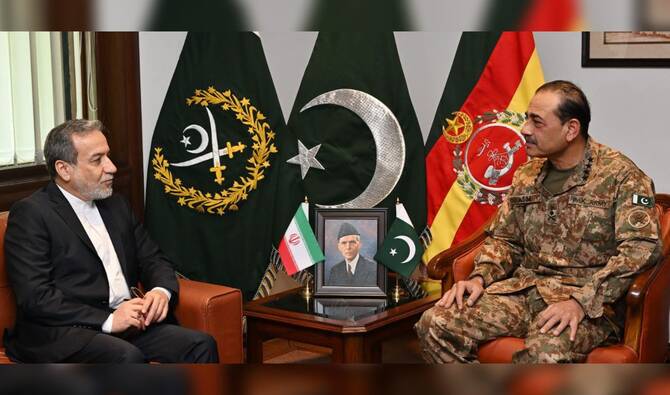
Army Chief General Syed Asim Munir (R) in a meeting with Iran’s Foreign Minister Seyyed Abbas Araghchi in Rawalpindi, on May 5, 2025. (Courtesy: Pakistan military’s media wing)
Short Url
Updated 06 May 2025
Follow

Pakistan army chief, Iranian FM review border management, security challenges

  • Pakistan and Iran have often been at odds over instability along their shared, porous border 
  • Araghchi arrived in Islamabad this week to discuss surging tensions between India and Pakistan

ISLAMABAD: Army Chief General Syed Asim Munir reviewed border management and security challenges with Iran’s Foreign Minister Seyyed Abbas Araghchi this week, the Pakistan military’s media wing said, with the two sides agreeing to enhance bilateral cooperation. 

Pakistan and Iran have often been at odds over instability along their shared, porous border and routinely trade blame for not rooting out militancy. Tensions surged in January last year when Pakistan and Iran exchanged airstrikes, with both claiming to target alleged militant hideouts in each other’s territory.

Araghchi arrived in Pakistan on Monday to hold talks with Pakistani leadership as Islamabad’s tensions with New Delhi surge. Iran has offered to mediate between the two nuclear-armed nations as the threat of war looms over the South Asian region. 

“The meeting featured constructive discussions on the geo-strategic environment, with particular focus on challenges confronted by both countries in the domain of security,” the Inter-Services Public Relations (ISPR), the military’s media wing, said on Monday. 

“The Pak-Iran border security mechanism was also reviewed as part of efforts to enhance bilateral coordination.”

The statement said both sides agreed to stay engaged for enhanced bilateral cooperation, while jointly working to assist in bringing “positive developments” in issues concerning the region.

“The Iranian FM acknowledged and appreciated Pakistan’s efforts for peace and stability in the region,” the ISPR said. 

Earlier, Araghchi met Pakistan’s Deputy Prime Minister and Foreign Minister Ishaq Dar as the two held delegation-level talks. Dar expressed appreciation for the positive momentum in Pakistan-Iran relations and emphasized the need to expand cooperation in key areas including trade, energy, border security, and regional connectivity, state-run Radio Pakistan reported.


Pakistan to begin first phase of Hajj 2026 trainings from today

Updated 31 December 2025
Follow

Pakistan to begin first phase of Hajj 2026 trainings from today

  • Training programs to be held in phases across Pakistan till February, says religion ministry
  • Saudi Arabia allocated Pakistan a total quota of 179,210 pilgrims for Hajj 2026

ISLAMABAD: Pakistan’s religious affairs ministry has said that it will begin the first phase of mandatory Hajj 2026 training for pilgrims intending to perform the pilgrimage from today, Thursday.

The one-day Hajj training programs will be held in phases across the country at the tehsil level until February. The ministry directed intending pilgrims to bring their original identity cards and the computerized receipt of their Hajj application to attend the training sessions.

“Pilgrims should attend the one-day training program according to their scheduled date,” Pakistan’s Ministry of Religious Affairs (MoRA) said in a statement.

The ministry said training schedules are being shared through the government’s Pak Hajj 2026 mobile application as well as via SMS. It added that details of the schedule are also available on its website.

According to the ministry, training programs will be held in Abbottabad on Jan. 2; Ghotki, Thatta and Kotli on Jan. 3; and Tando Muhammad Khan and Khairpur on Jan. 4.

Hajj training sessions will be held in Rawalakot, Badin and Naushahro Feroze on Jan. 5, while pilgrims in Fateh Jang, Dadu and Tharparkar will receive the training on Jan. 6.

The ministry said training programs will be conducted in Umerkot and Larkana on Jan. 7, followed by sessions in Mirpurkhas, Shahdadkot and Mansehra on Jan. 8.

Pakistan’s religious affairs ministry has previously said these trainings will be conducted by experienced trainers and scholars using multimedia.

It said the training has been made mandatory to ensure that intending pilgrims are fully aware of Hajj rituals and administrative procedures.

Saudi Arabia has allocated Pakistan a quota of 179,210 pilgrims for Hajj 2026, of which around 118,000 seats have been reserved under the government scheme, while the remainder will be allocated to private tour operators.

Under Pakistan’s Hajj scheme, the estimated cost of the government package ranges from Rs1,150,000 to Rs1,250,000 ($4,049.93 to $4,236), subject to final agreements with service providers.