

Pakistan army chief, Iranian FM review border management, security challenges

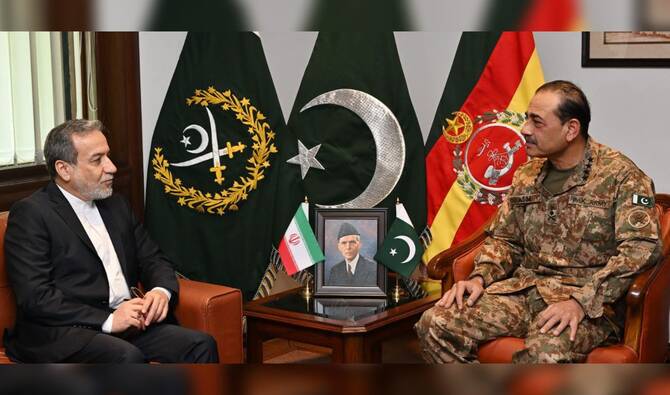
Army Chief General Syed Asim Munir (R) in a meeting with Iran’s Foreign Minister Seyyed Abbas Araghchi in Rawalpindi, on May 5, 2025. (Courtesy: Pakistan military’s media wing)
Short Url
Updated 06 May 2025
Follow

Pakistan army chief, Iranian FM review border management, security challenges

  • Pakistan and Iran have often been at odds over instability along their shared, porous border 
  • Araghchi arrived in Islamabad this week to discuss surging tensions between India and Pakistan

ISLAMABAD: Army Chief General Syed Asim Munir reviewed border management and security challenges with Iran’s Foreign Minister Seyyed Abbas Araghchi this week, the Pakistan military’s media wing said, with the two sides agreeing to enhance bilateral cooperation. 

Pakistan and Iran have often been at odds over instability along their shared, porous border and routinely trade blame for not rooting out militancy. Tensions surged in January last year when Pakistan and Iran exchanged airstrikes, with both claiming to target alleged militant hideouts in each other’s territory.

Araghchi arrived in Pakistan on Monday to hold talks with Pakistani leadership as Islamabad’s tensions with New Delhi surge. Iran has offered to mediate between the two nuclear-armed nations as the threat of war looms over the South Asian region. 

“The meeting featured constructive discussions on the geo-strategic environment, with particular focus on challenges confronted by both countries in the domain of security,” the Inter-Services Public Relations (ISPR), the military’s media wing, said on Monday. 

“The Pak-Iran border security mechanism was also reviewed as part of efforts to enhance bilateral coordination.”

The statement said both sides agreed to stay engaged for enhanced bilateral cooperation, while jointly working to assist in bringing “positive developments” in issues concerning the region.

“The Iranian FM acknowledged and appreciated Pakistan’s efforts for peace and stability in the region,” the ISPR said. 

Earlier, Araghchi met Pakistan’s Deputy Prime Minister and Foreign Minister Ishaq Dar as the two held delegation-level talks. Dar expressed appreciation for the positive momentum in Pakistan-Iran relations and emphasized the need to expand cooperation in key areas including trade, energy, border security, and regional connectivity, state-run Radio Pakistan reported.


Pakistan launches double-decker buses in Karachi after 65 years to tackle transport woes

Updated 11 sec ago
Follow

Pakistan launches double-decker buses in Karachi after 65 years to tackle transport woes

  • Karachi citizens will be able to travel in double-decker buses from Jan. 1, says Sindh government
  • City faces mounting transport challenges such as lack of buses, traffic congestion, poorly built roads

ISLAMABAD: The government in Sindh province on Wednesday launched double-decker buses in the provincial capital of Karachi after a gap of 65 years, vowing to improve public transport facilities in the metropolis. 

Double-decker buses are designed to carry more passengers than single-deck vehicles without taking up extra road space. The development takes place amid increasing criticism against the Sindh government regarding Karachi’s mounting public transport challenges and poor infrastructural problems. 

Pakistan’s largest city by population faces severe transportation challenges due to overcrowding in buses, traffic congestion and limited bus options. Commuters, as a result, rely on private vehicles or unregulated transport options that are often unsafe and expensive.

“Double-decker buses have once again been introduced for the people of Karachi after 65 years,” a statement issued by the Sindh information ministry said. 

Sindh Transportation Minister Sharjeel Inam Memon and Local Government Minister Syed Nasir Hussain Shah inaugurated the bus service. The ministry said the facility will be available to the public starting Jan. 1. 

The statement highlighted that new electric bus routes will also be launched across the entire province starting next week. It added that the aim of introducing air-conditioned buses, low-fare services, and fare subsidies is to make public transport more accessible to the people.

The ministry noted that approximately 1.5 million people travel daily in Karachi using the People’s Bus Service, while around 75,000 passengers use the Orange Line and Green Line BRT services.

“With the integration of these routes, efforts are being made to benefit up to 100,000 additional people,” the ministry said.