

Visa crackdown leads international students in the US to reconsider summer travel

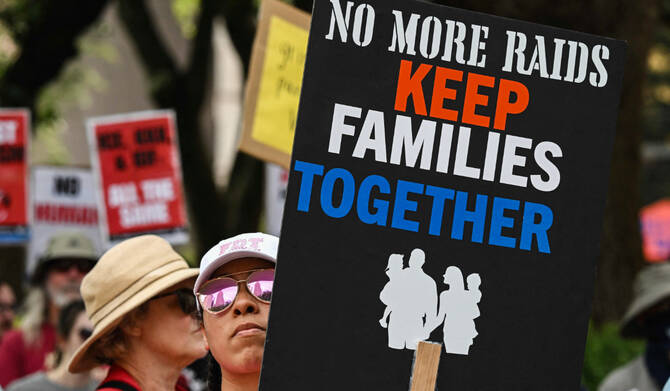
A person holds a during a May Day demonstration against US President Donald Trump and his immigration policies in Houston, Texas, on May 1, 2025. (AFP)
Short Url
Updated 04 May 2025
Follow

Visa crackdown leads international students in the US to reconsider summer travel

  • International students weighing travel to see family, take a vacation or conduct research are thinking twice because of the Trump administration’s crackdown, which has added to a sense of vulnerability

CALIFORNIA: On summer break from a PhD program, an international student at University of California, San Diego, was planning a trip with a few friends to Hawaii. But after seeing international students across the United States stripped of their legal status, the student decided against it.
Any travel, even inside the US, just didn’t seem worth the risk.
“I probably am going to skip that to ... have as few interactions with governments as possible,” said the student, who spoke on condition of anonymity out of fear of being targeted.
International students weighing travel to see family, take a vacation or conduct research are thinking twice because of the Trump administration’s crackdown, which has added to a sense of vulnerability.
Even before students suddenly began losing permission to study in the US, some colleges were encouraging international students and faculty to postpone travel, citing government efforts to deport students involved in pro-Palestinian activism. As the scale of the status terminations emerged in recent weeks, more schools have cautioned against non-essential travel abroad for international students.
University of California, Berkeley, for one, issued an advisory last week saying upcoming international travel was risky due to “strict vetting and enforcement.”
At least 1,220 students at 187 colleges, universities and university systems have had their visas revoked or legal status terminated since late March, according to an Associated Press review of university statements, correspondence with school officials and court records.


Cuba president says willing to talk to US, but ‘without pressure’

Updated 4 sec ago
Follow

Cuba president says willing to talk to US, but ‘without pressure’

  • People in the country’s east were left without electricity for hours after an electricity grid failure
  • Officials blame tight US sanctions for the crisis, which includes food and medicine shortages

HAVANA: Cuba is prepared to hold dialogue with the United States but not under pressure, President Miguel Diaz-Canel insisted Thursday after months of threats from US President Donald Trump.
“Cuba is willing to engage in dialogue with the United States, a dialogue on any topic... but without pressure or preconditions,” Diaz-Canel said in an address to the nation on state TV and radio.
He added that any talks must take place “from a position of equals, with respect for our sovereignty, our independence, and our self-determination” and without “interference in our internal affairs.”
Trump has made repeated threats against communist-run Cuba in recent months, vowing to cut off its access to oil and stating the island was “ready to fall.”
Cuba, in the grips of an economic crisis, has long relied on oil supplies from Venezuela, whose leader was ousted in a deadly US military operation last month.
Trump subsequently claimed to have control of Venezuelan oil, vowed to starve Cuba of the commodity, and threatened tariffs on any other nation stepping in to help US-sanctioned Havana.
The pressure tactics threaten to plunge Cuba into complete darkness, with its power plants already struggling to keep the lights on due to fuel shortages.
Earlier Thursday, hundreds of thousands of people in the country’s east were left without electricity for hours after an electricity grid failure.
An AFP analysis of official statistics recently found that the island generated only half the electricity it needed last year.
Officials blame tight US sanctions for the crisis, which includes food and medicine shortages. But poor economic management and a tourism collapse following the Covid-19 pandemic have contributed to the island’s woes.
Trump has repeatedly said Washington was in talks for “a deal” with Havana, which has denied any formal negotiations were underway. Trump has not specified the nature of the agreement he has floated.