NEW DELHI: New Delhi widened measures against Islamabad on Saturday, blocking access to the social media accounts of Pakistani actors and cricketers, as well as extending trade blocks and stopping postal services.
India blames Pakistan of backing the deadliest attack in years on civilians in Indian-administered Kashmir on April 22, in which 26 men were killed.
Islamabad has rejected the charge, and both countries have since exchanged gunfire across their contested de facto border in Kashmir.
Pakistan’s military said it carried out a “training launch” of a surface-to-surface missile weapons system on Saturday, further heightening tensions.
On Saturday, India’s communications ministry issued a statement saying it had “decided to suspend the exchange of all categories of inbound mail and parcels from Pakistan through air and surface routes.”
The arch-rivals had already expelled each other’s citizens and closed the main border crossing, and barred aircraft from each other’s airspace.
Indian media on Saturday, citing a Directorate General of Shipping (DGS) order, said that Pakistani-flagged ships are barred from any Indian port — and Indian ships are banned from Pakistan.
The move, however, is seen as largely symbolic, as regular diplomatic flare-ups between the neighbors over decades have prevented close economic ties.
But cultural ties remain far stronger. The nations were only divided by the 1947 colonial creation at the violent end of British rule, partitioning the sub-continent into Hindu-majority India and Muslim-majority Pakistan.
On social media, India banned on April 28 more than a dozen Pakistani YouTube channels for allegedly spreading “provocative” content, including Pakistani news outlets.
On Saturday, further restrictions blocked access in India to the Instagram account of Pakistan’s ex-prime minister and cricket captain Imran Khan.
Bollywood movie regulars Fawad Khan and Atif Aslam were also off limits, as well as a wide range of cricketers — including star batters Babar Azam and Mohammad Rizwan and retired players Shahid Afridi and Wasim Akram.
Olympic gold medallist Arshad Nadeem’s Instagram account was also no longer accessible to Indian users, reflecting the broad scope of the clampdown beyond just cricket.
Users in India attempting to access these accounts are shown a message indicating that they are unavailable due to compliance with a legal request.


India blocks Pakistani celebrities on social media

https://arab.news/2c7nm
India blocks Pakistani celebrities on social media

- Last month, India banned more than a dozen Pakistani YouTube channels for spreading ‘provocative’ content
- Fawad Khan, Babar Azam, and Arshad Nadeem among celebrities whose accounts have been blocked
India’s Bollywood bets big on ‘event cinema’
- Films centered on geopolitical conflict, internal enemies, masculinity now dominate mainstream Hindi cinema
- Critics argue Bollywood is using cinema’s unrivalled mass reach to shape the public sentiment in India
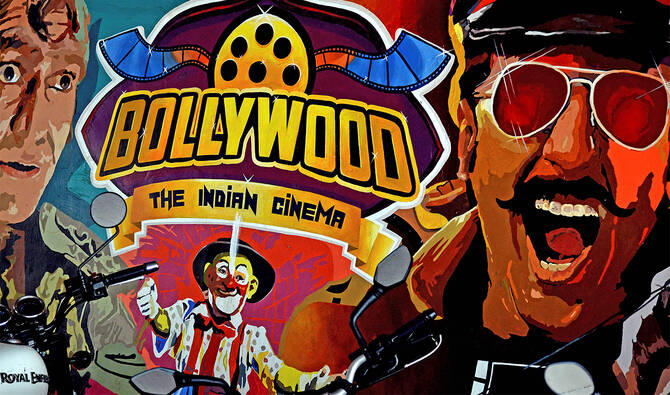
MUMBAI: India’s Bollywood is moving decisively toward a cinema of scale and confrontation — where patriotism, spectacle, and ideological clarity increasingly trump nuance and narrative risk, industry insiders say.
The shift has fueled what experts describe as “event cinema,” as studios rely on big-budget spectacles and top-tier stars to lure audiences — especially smartphone-loving Gen Z viewers — back into theaters.
That strategy appears to be working. Akshaye Rathi, a prominent film exhibitor, predicted a 45-50 percent rise in net Hindi box-office collections and a 25 percent increase in young theater-goers this year.
“The year looks poised for historic numbers,” Rathi told AFP.
The industry’s financial model was shaken during the Covid-19 pandemic, which coincided with the rapid rise of streaming platforms and a shift to home viewing.
But its 2026 upcoming slate, packed with patriotic war dramas, spy thrillers, mythological epics and nationalist narratives — reflects not just a commercial recalibration, analysts say, but a broader change in creative priorities.
‘PROPAGANDA’
Critics argue Bollywood is increasingly producing polarizing films aligned with the ideology of Prime Minister Narendra Modi’s Hindu-nationalist government, using cinema’s unrivalled mass reach to shape public sentiment.
“These days film themes also depend upon who is ruling at the center — Hindu wave, propaganda... all these are big factors that filmmakers cash in on,” said movie business analyst Atul Mohan, editor of film trade magazine Complete Cinema. “But only one or two films work, not all 10 or 15.”
He cited the success of 2022 blockbuster “The Kashmir Files,” depicting in harrowing detail how several hundred thousand Hindus fled Muslim militants in Indian-administered Kashmir in 1989-90.
And he compared that with the 2025 film “The Bengal Files,” on alleged political violence in eastern India, which he described as a commercial “disaster.”
Films centered on geopolitical conflict, internal enemies, and heroic masculinity now dominate mainstream Hindi cinema, reflecting both the political mood and the economics of theatrical survival.
Last year’s gory action thriller “Dhurandhar,” meaning “formidable,” leaned heavily on hyper-nationalist tropes of Indian agents confronting Pakistan-linked foes, and became one of 2025’s highest-grossing films — following a real-life four-day border clash with Pakistan.
Its sequel, “Dhurandhar 2,” again starring Ranveer Singh, is set for release in March.
‘GRATUITIOUS VIOLENCE’
Veteran Delhi-based film critic Arnab Banerjee said political messaging now outweighs craftsmanship.
“It is not the quality of the film that matters today, it is propaganda films that are working,” said Banerjee.
“The mood of the nation is such that people are lapping up these subjects. Pakistan-bashing and references to enemy countries are being accepted without questioning.”
Banerjee also criticized what he called an excess of “gratuitous violence,” arguing that “it is social media hype that is deciding the film’s fate.”
He pointed to “Ikkis,” a film on the 1971 India-Pakistan war released in January, which struggled commercially despite positive reviews.
“It is a well-made film, but it didn’t work,” he said. “Perhaps because Pakistan is not shown as the enemy.”
Director Ahmed Khan, however, said quality still ultimately determines success, citing his upcoming action-comedy “Welcome to the Jungle,” starring Akshay Kumar.
“Whatever the genre — action, drama, comedy or horror — it depends on how well you’ve made it,” Khan said.
He pointed to the 2025 successes of the contrasting romantic drama “Saiyaara” as well as high-octane “Dhurandhar.”
“Both, poles apart in genre, did great business,” he said. “People’s mood can change any time.”


