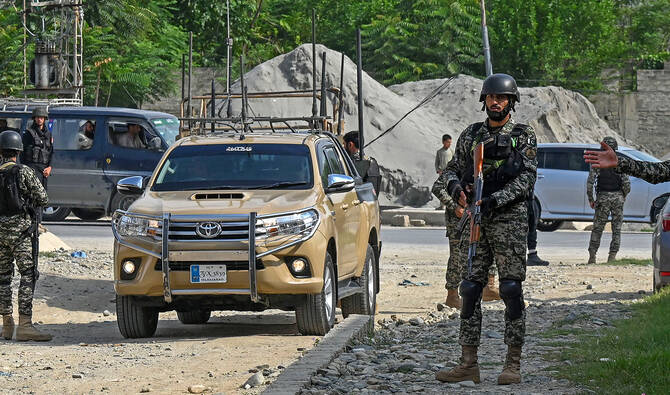
ISLAMABAD: Five militants, belonging to the Tehreek-e-Taliban Pakistan (TTP), were killed and two others were apprehended in three separate operations in Pakistan’s northwestern Khyber Pakhtunkhwa (KP) province, the Pakistani military said on Saturday.
Pakistani security forces killed three militants, including a high-value target, in an intelligence-based operation in KP’s Bajaur district, according to the Inter-Services Public Relations (ISPR), the military’s media wing.
Two TTP militants were killed in the second operation in the North Waziristan district, while security forces busted a TTP hideout in the Mohmand district and arrested two members of the outlawed group.
“Weapons, ammunition and explosives were also recovered from these khwarij (TTP militants), who remained actively involved in numerous terrorist activities,” the ISPR said in a statement.
“Sanitization operations are being conducted to eliminate any other kharji found in the area.”
Pakistan has struggled to contain surging militancy in KP in recent years, where the Pakistani Taliban, or the TTP, have mounted their attacks against security forces and police since their fragile, months-long truce with Islamabad broke down in late 2022.
Late last month, the Pakistani military said it had killed 71 militants in three days of operations in the North Waziristan district that borders Afghanistan.
The number was usually high in Pakistan’s battle against militancy and instability along its border with Afghanistan during the nearly four years since the United States withdrew its military support from the country and the Taliban took over Kabul.
Islamabad has frequently accused Afghanistan of supporting the Pakistani Taliban and other militant groups, an allegation denied by Kabul.
Pakistan is also facing an intensifying separatist insurgency in the southwestern Balochistan province.
On Friday, a Levies paramilitary troop was killed in an attack on a check-post in Balochistan’s Kalat district, while there were reports of militant attacks on government buildings in Mangochar city, according to a Levies official.
“One Levies soldier was killed after gunmen targeted a Levies check-post in Kot Langove, an area of Kalat district,” Levies official Muhammad Ramzan told Arab News.
“Many armed militants obstructed the Quetta-Karachi highway in Mangochar and there are reports that many government buildings were torched in Mangochar Bazaar.”
The official said they were gathering more details about the incidents.
In another attack, armed men targeted a passenger bus heading to Karachi from Quetta in Khad Kocha area near Mastung.
“Six passengers were injured in the attack who were later shifted to Nawab Ghosh Bukhsh Memorial Hospital,” Mastung Deputy Commissioner Raja Atthar Abbas told Arab News.
“They were the same militants who attempted to take control of the highway in Kalat, but couldn’t succeed in blocking the road.”
No group immediately claimed responsibility for the attacks, but suspicions are likely to fall on Baloch separatists.
In March, fighters from the Baloch Liberation Army (BLA) separatist group hijacked the Jaffar Express train in Balochistan’s Bolan region, holding hundreds of passengers hostage.
The military launched a rescue operation in which 354 passengers were freed and 33 militants were killed. Officials said the hijacking killed 31 soldiers, railway staff and civilians.


![]()

Five militants killed, two apprehended in separate operations in Pakistan’s northwest
Short Url
https://arab.news/zsz4v
Five militants killed, two apprehended in separate operations in Pakistan’s northwest
- A paramilitary troop was killed in Balochistan amid reports of attacks on a passenger bus and government buildings in the province
- Pakistan has been battling twin insurgencies in its western provinces of Khyber Pakhtunkhwa and Balochistan that border Afghanistan
Latest updates


© 2026 SAUDI RESEARCH & PUBLISHING COMPANY, All Rights Reserved And subject to Terms of Use Agreement.