Lives on hold in India’s border villages with Pakistan

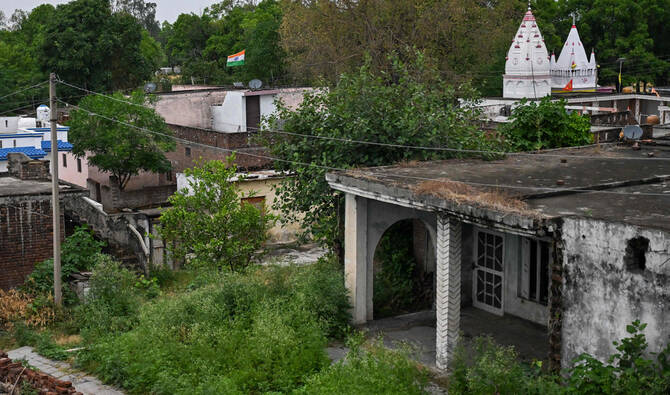
The Indian national flag is seen on a house in Sainth, the last village near the Line of Control (LOC), in Jammu district on May 2, 2025. (AFP)
Short Url
Updated 03 May 2025
Follow

Lives on hold in India’s border villages with Pakistan

  • Relations between the neighbors have plummeted after India accused Pakistan of backing an attack in disputed Kashmir region
  • Islamabad has rejected the charge of aiding gunmen who killed 26 people, with both countries since exchanging diplomatic barbs

SAINTH: On India’s heavily fortified border with arch-rival Pakistan, residents of farming villages have sent families back from the frontier, recalling the terror of the last major conflict between the rival armies.
Those who remain in the farming settlement of Sainth, home to some 1,500 people along the banks of the broad Chenab river, stare across the natural division between the nuclear-armed rivals fearing the future.
“Our people can’t plan too far ahead,” said Sukhdev Kumar, 60, the village’s elected headman.
“Most villagers here don’t invest beyond a very basic house,” he added.
“For who knows when a misdirected shell may fall from the other side and ruin everything?”
Relations between the nuclear-armed neighbors have plummeted after India accused Pakistan of backing the worst attack on civilians in Indian-administered Kashmir in years.
Indian police have issued wanted posters for three men accused of carrying out the April 22 attack at Pahalgam — two Pakistanis and an Indian — who they say are members of the Pakistan-based Lashkar-e-Taiba group, a UN-designated terrorist organization.
Islamabad has rejected the charge of aiding gunmen who killed 26 people, with both countries since exchanging diplomatic barbs including expelling each other’s citizens.
India’s army said Saturday its troops had exchanged gunfire with Pakistani soldiers overnight along the de facto border with contested Kashmir — which it says has taken place every night since April 24.
Muslim-majority Kashmir has been divided between India and Pakistan since their independence from British rule in 1947, with both governing part of the disputed territory separately and claiming it in its entirety.
Sainth, with its open and lush green fields, is in the Hindu-majority part of Indian-run Jammu and Kashmir.
Security is omnipresent.
Large military camps dot the main road, with watchtowers among thick bushes.
Kumar said most families had saved up for a home “elsewhere as a backup,” saying that only around a third of those with fields remained in the village.
“Most others have moved,” he said.
The region was hit hard during the last major conflict with Pakistan, when the two sides clashed in 1999 in the high-altitude Himalayan mountains further north at Kargil.
Vikram Singh, 40, who runs a local school, was a teenager at the time.
He remembers the “intense mortar shelling” that flew over their heads in the village — with some exploding close by.
“It was tense then, and it is tense now,” Singh told AFP.
“There is a lot to worry since the attack at Pahalgam... The children are scared, the elderly are scared — everyone is living in fear.”
International pressure has been piled on both New Delhi and Islamabad to settle their differences through talks.
The United States has called for leaders to “de-escalate tensions,” neighboring China urged “restraint,” with the European Union warning Friday that the situation was “alarming.
On the ground, Singh seemed resigned that there would be some fighting.
“At times, we feel that war must break out now because, for us, it is already an everyday reality,” he said.
“We anyways live under the constant threat of shelling, so, maybe if it happens, we’d get to live peacefully for a decade or two afterwards.”
There has been a flurry of activity in Trewa, another small frontier village in Jammu.
“So far, the situation is calm — the last cross-border firing episode was in 2023,” said Balbir Kaur, 36, the former village head.
But the villagers are preparing, clearing out concrete shelters ready for use, just in case.
“There were several casualties due to mortar shelling from Pakistan in the past,” she said.
“We’ve spent the last few days checking our bunkers, conducting drills, and going over our emergency protocols, in case the situation worsens,” she added.
Kaur said she backed New Delhi’s stand, with Prime Minister Narendra Modi vowing “to punish every terrorist and their backer” and to “pursue them to the ends of the Earth.”
Dwarka Das, 65, a farmer and the head of a seven-member family, has lived through multiple India-Pakistan conflicts.
“We’re used to such a situation,” Das said.
“During the earlier conflicts, we fled to school shelters and nearby cities. It won’t be any different for us now.”


Trump says Iran ‘want to negotiate’ after reports of hundreds killed in protests

Updated 57 min 24 sec ago
Follow

Trump says Iran ‘want to negotiate’ after reports of hundreds killed in protests

  • US President Donald Trump said Sunday that Iran’s leadership had called him seeking “to negotiate” after he repeatedly threatened to intervene militarily if Tehran killed protesters

WASHINGTON: US President Donald Trump said Sunday that Iran’s leadership had called him seeking “to negotiate” after he repeatedly threatened to intervene militarily if Tehran killed protesters.
For two weeks, Iran has been rocked by a protest movement that has swelled in spite of a crackdown rights groups warn has become a “massacre.”
Initially sparked by anger over the rising cost of living, the demonstrations have evolved into a serious challenge of the theocratic system in place since the 1979 revolution.
Information has continued to trickle out of Iran despite a days-long Internet shutdown, with videos filtering out of capital Tehran and other cities over the past three nights showing large demonstrations.
As reports emerge of a growing protest death toll, and images show bodies piled outside a morgue, Trump said Tehran indicated its willingness to talk.
“The leaders of Iran called” yesterday, Trump told reporters aboard Air Force One, adding that “a meeting is being set up... They want to negotiate.”
He added, however, that “we may have to act before a meeting.”
The US-based Center for Human Rights in Iran (CHRI) said it had received “eyewitness accounts and credible reports indicating that hundreds of protesters have been killed across Iran during the current Internet shutdown.”
“A massacre is unfolding,” it said.
The Norway-based NGO Iran Human Rights (IHR) said it confirmed the killing of at least 192 protesters but that the actual toll could be much higher.
“Unverified reports indicate that at least several hundreds, and according to some sources, more than 2,000 people may have been killed,” said IHR.
More than 2,600 protesters have been arrested, IHR estimates.
A video circulating on Sunday showed dozens of bodies accumulating outside a morgue south of Tehran.
The footage, geolocated by AFP to Kahrizak, showed bodies wrapped in black bags, with what appeared to be grieving relatives searching for loved ones.
Near paralysis
In Tehran, an AFP journalist described a city in a state of near paralysis.
The price of meat has nearly doubled since the start of the protests, and many shops are closed. Those that do open must close at around 4:00 or 5:00 pm, when security forces deploy en masse.
There were fewer videos showing protests on social media Sunday, but it was not clear to what extent that was due to the Internet shutdown.
One widely shared video showed protesters again gathering in the Pounak district of Tehran shouting slogans in favor of the ousted monarchy.
The protests have become one of the biggest challenges to the rule of supreme leader Ayatollah Ali Khamenei, 86, coming in the wake of Israel’s 12-day war against the Islamic republic in June, which was backed by the United States.
State TV has aired images of burning buildings, including a mosque, as well as funeral processions for security personnel.
But after three days of mass actions, state outlets were at pains to present a picture of calm returning, broadcasting images of smooth-flowing traffic on Sunday. Tehran Governor Mohammad-Sadegh Motamedian insisted in televised comments that “the number of protests is decreasing.”
The Iranian government on Sunday declared three days of national mourning for “martyrs” including members of the security forces killed.
President Masoud Pezeshkian also urged Iranians to join a “national resistance march” Monday to denounce the violence.
In response to Trump’s repeated threats to intervene, Iran’s parliament speaker Mohammad Bagher Ghalibaf said Iran would hit back, calling US military and shipping “legitimate targets” in comments broadcast by state TV.
‘Stand with the people’
Reza Pahlavi, the US-based son of Iran’s ousted shah, who has emerged as an anti-government figurehead, said he was prepared to return to the country and lead a democratic transition.
“I’m already planning on that,” he told Fox News on Sunday.
He later urged Iran’s security forces and government workers to join the demonstrators.
“Employees of state institutions, as well as members of the armed and security forces, have a choice: stand with the people and become allies of the nation, or choose complicity with the murderers of the people,” he said in a social media post.
He also urged protesters to replace the flags outside of Iranian embassies.
“The time has come for them to be adorned with Iran’s national flag,” he said.
The ceremonial, pre-revolution flag has become an emblem of the global rallies that have mushroomed in support of Iran’s demonstrators.
In London, protesters managed over the weekend to swap out the Iranian embassy flag, hoisting in its place the tri-colored banner used under the last shah.