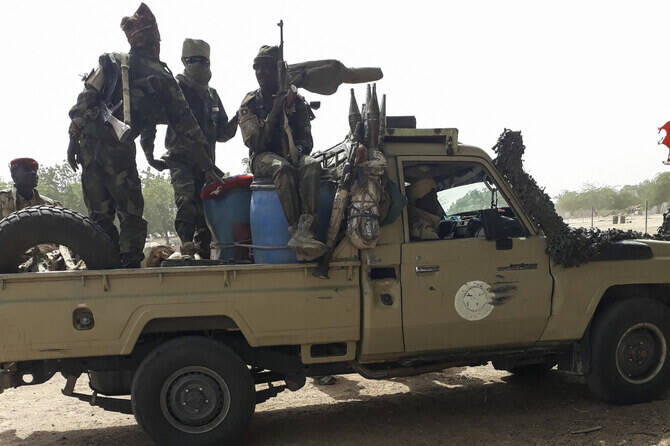

LAGOS: Nigeria’s northeast is facing a brutal resurgence of militant attacks, which have killed at least 100 people in April.
The state of Borno in particular, where the Boko Haram militant group emerged 16 years ago, remains the epicenter of a conflict that has killed more than 40,000 and displaced some two million people in Africa’s most populous country.
The Lake Chad basin serves as a crucial strategic corridor for militant groups, said Kabir Adamu, director of the Nigerian consulting firm Beacon Consulting, in terms of logistics, recruitment and cross-border attacks involving Chad, Niger and Cameroon.
Boko Haram, also known as Jama’atu Ahlis Sunna Lidda’awati wal-Jihad (JAS):
The movement was founded in 2002 in Maiduguri, Borno state, by radical preacher Mohammed Yusuf, who attributed Nigeria’s woes to the Western values left by former British colonial powers.
It launched an insurgency in 2009 and took control of significant areas in the northeast.
Through counteroffensives, the Nigerian army took back some of the lost territories but Boko Haram remains operational in some regions.
The Al-Qaeda-affiliated group relies heavily on fear-based tactics, targeting civilians, looting villages and conducting kidnappings.
The Daesh West Africa Province (Daesh-WAP):
This group emerged in 2016 from a split within Boko Haram, with Daesh-WAP opposing the killing of Muslims. It is proving to be more organized and more ideological, focusing its attacks on military targets and infrastructure.
Other groups are operating in the northwest of the country, near the border with Niger, such as Ansaru, a dissident movement linked to Al-Qaeda, or Lakurawa.
It is also worth noting the emergence of other groups, particularly in the northwest and central regions of the country, “which may not be strictly militant but utilize similar methods, blurring the lines between criminal and terrorist activities,” said Adamu.
The ongoing resurgence of attacks is linked to several factors, experts said.
“There were direct calls made by the Daesh between January and March 2025, urging its affiliates worldwide to intensify their operations,” Adamu said.
Idriss Mounir Lallali, director of the Algeria-based African Center for the Study and Research on Terrorism (ACSRT), has seen a “strategic recalibration” by Boko Haram and Daesh-WAP, as the two groups seem to have overcome a period of mutual conflicts.
The militants have adapted their combat tactics, through the use of drones, improvised explosive devices (IEDs), ambushes and coordinated raids, allowing them to intensify operations in rural and semi-urban areas.
Regional efforts in the fight against terrorism in the Sahel and west Africa are facing structural weaknesses.
“Governance has been abandoned in so many of these places,” said Confidence McHarry, from consulting firm SBM Intelligence in Lagos.
Niger in March withdrew from a task force it had created along with Nigeria, Cameroon and Chad to combat militants around Lake Chad, disrupting cross-border patrols and intelligence sharing.
Chad has also threatened to withdraw from the task force.
“Without a reinvigorated multinational approach, these gaps risk becoming safe havens for militant expansion,” Lallali said.
While Nigerian forces have achieved territorial gains and succeeded in neutralising key militant commanders, Daesh-WAP and Boko Haram have both demonstrated significant resilience.
Many of their fighters have retreated into ungoverned areas.
“Security forces, while concentrated in key garrisons, have left many border and rural areas exposed,” Lallali said.
Insurgents take advantage of these vulnerabilities to restore supply routes and rebuild their influence among local populations.
At the end of April, Nigeria appointed a new leader for anti- militant operations in the northeast, General Abdulsalam Abubakar.