

How Kawasaki Frontale banished continental woes to face Al-Ahli in AFC Champions League Elite final

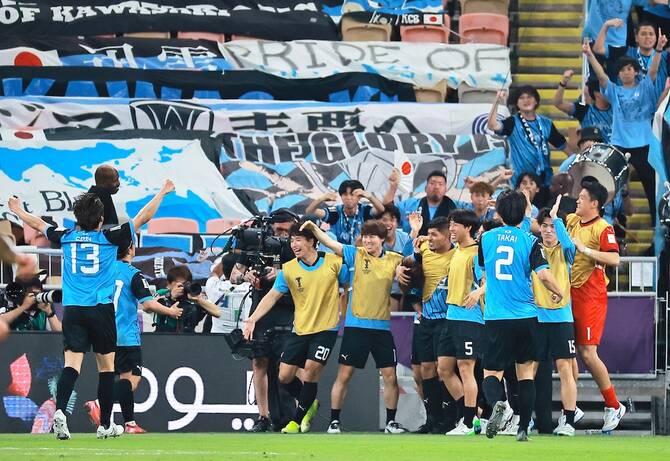
Kawasaki Frontale’s Yuto Ozeki, left, celebrates scoring their second goal against Al-Nassr. (Reuters)
Short Url
Updated 02 May 2025
Follow

How Kawasaki Frontale banished continental woes to face Al-Ahli in AFC Champions League Elite final

  • Saudi Arabia’s last team standing will welcome rejuvenated Japanese opponents on Saturday night in Jeddah

AUSTRALIA: Football works in mysterious ways at times and that is certainly the case for Kawasaki Frontale and their exploits on the continent.

For five seasons between 2017 and 2021 under the guidance of Toru Oniki they almost completely dominated the J. League, winning four league titles and finishing fourth in the only year they missed out.

When you include their third-place finish in 2016, for a six-year stretch they never finished outside the top four. They were Japan’s premier domestic football club by some distance.

But when it came to Asia, they floundered. Think of the internet meme comparing a dog built like a bodybuilder and a small pup, and that encapsulates the exploits of Kawasaki in Japan as opposed to Asia.

In six continental campaigns from 2017 to 2023, their best finish was a quarterfinal in 2017 when they squandered a 3-1 lead from the first leg to lose 4-1 in the second leg to fellow J. League side Urawa Reds, who subsequently went on to win the title.

It was a loss that exposed a soft underbelly, something that had been a criticism of the team for the decade prior, having come so close but never managing to get over the line for a maiden J. League title.

They finished runners-up in 2006, 2008 and 2009, and third in 2013 and 2016.

That loss in the quarterfinal of 2017 came just months before they clinched their first J. League title, which seemed to flick a switch in their mentality, at least in Japan, anyway.

On the continent they continued to struggle.

In 2018 and 2019 they failed to get out of the group stage, winning just two of 12 games in the process. Another group stage exit followed in 2022, bookended by Round of 16 appearances in 2021 and 2023.

But it fell well short of expectations for a side so dominant in arguably Asia’s best league. And which had overseas and national-team stars like Kaoru Mitoma, Kengo Nakamura, Shogo Taniguchi, Hidemasa Morita, Ao Tanaka, Miki Yamane, and Reo Hatate.

It was a squad stacked with talent, but having lost so many to European football Kawasaki have returned to the pack in recent years, struggling to maintain their excellence, with back-to-back eighth-place finishes.

At the end of last season, Oniki moved to Kashima Antlers (who are currently top of the table in Japan) and was replaced with Shigetoshi Hasebe, a more pragmatic-minded coach from Avispa Fukuoka.

So football being as it is, of course it is this season of change and transition that has Kawasaki on the precipice of achieving what they never could during their dominant reign — being crowned Kings of Asia.

After finishing second in the League Stage of the East Zone, they found their way past Chinese heavyweights Shanghai Shenhua in the Round of 16 but arrived in Jeddah with very little expectation upon them.

They needed extra time to sneak their way past perennial Qatari champions, Al-Sadd. A semifinal clash against Al-Nassr’s bevy of international stars was expected to be their end point, but would still have been considered a success given their current status as a club.

Hasebe and his troops had other ideas, however.

Perhaps able to play without the burden of expectation, which seemed to weigh heavily on the shoulders of Al-Nassr, it was Frontale who were able to take control and look the most at ease.

Tatsuya Ito’s sensational volley opened the scoring, and after Sadio Mane equalized, it was the pressing of Ito that created the opportunity for their second. Yuto Ozeki, part of a new generation of stars beginning to emerge, finished off, for a surprise lead going into half-time.

When the ageless Akihiro Ienaga scored to make it 3-1, very few could believe what they were seeing. With a starting XI having just one foreign player and an attack featuring players of 19 and 20, with another 20-year-old in the heart of defense, this should not have been possible.

“Our two young players stepped up,” Hasebe said after the game of Ozeki and Soma Kanda, who are both so inexperienced that neither even has a Wikipedia page.

“They may still be developing but they’ve gained experience at the under-20 level. Their main job was to contain (Al-Nassr midfielder Marcelo) Brozovic but they also contributed well going forward.

“Discipline and attitude were key tonight. I’ve spoken with the players regularly to instill this mindset and they responded well. Everyone showed great commitment. This is the football we’ve been working towards.”

Also speaking after the game, goalscorer Ito said this was as much a victory for Japanese football as it was for Kawasaki.

“This isn’t just important for our club, it means a lot for the J. League as well. It shows the level of Japanese football. Before the game, the manager told us we came here to change things and make history. I hope we can complete that mission in the next match.”

Having made it this far against the odds, there would be few willing to say they now cannot go all the way and create that history, and in the process become the seventh Japanese club to lift continental silverware.

It is the type of unpredictability that makes football the game we all love. Sometimes it does not make sense, but that is also what makes it so beautiful.


‘20 years of engagement’ — inaugural Formula 4 championship success signals bright future for motorsport in Saudi Arabia

Updated 03 February 2026
Follow

‘20 years of engagement’ — inaugural Formula 4 championship success signals bright future for motorsport in Saudi Arabia

  • Peter Thompson, founder of the Formula 4 Saudi Arabian Championship and Meritus.GP team principal, spoke about the Kingdom’s first motorsport academy and his hopes for the future

RIYADH: Last year welcomed the inaugural season of the FIA-certified Aramco Formula 4 Saudi Arabian Championship.

The series, which aims to provide the first step on the ladder towards Formula 1, was the culmination of years of collaboration between various investors and partners, led by the Kingdom’s first motorsport academy, Meritus.GP.

The championship’s mission?

To produce local driving talent, strengthen Saudi national race engineering capabilities and advance motorsport in alignment with the objectives of Saudi Vision 2030.

Five Saudi drivers emerged, with standout victories by Omar Al-Dereyaan and Faisal Al-Kabbani, both from Riyadh. Other graduates included race winner Oscar Wurz, who has since won the 2025 Central European Formula 4 Championship.

Arab News spoke with Peter Thompson, founder of Formula 4 Saudi Arabia and Meritus.GP, about the season’s success and his hopes for the future.

How did Meritus.GP build the Formula 4 Saudi Arabian Championship?

The Formula 4 Saudi Arabian Championship was the result of more than 20 years of engagement, exploration and groundwork in Saudi Arabia, in anticipation of a potential FIA-certified junior single-seater championship in the Kingdom.

Long before the first Formula 1 Saudi Arabian Grand Prix, we were on the ground exploring circuit development opportunities, assessing infrastructure readiness and evaluating whether Saudi Arabia could host a round of one of the Asian championships operated by the team. Throughout this period, we maintained long-standing relationships within Saudi motorsport circles including former Meritus.GP driver Raad Abduljawad and his brother Mohammed Abduljawad.

A defining moment came with the introduction of Formula 1 to Saudi Arabia. The Jeddah Corniche Circuit quickly became a visible symbol of this ambition, providing confidence that Saudi Arabia could support not only Formula One, but also a structured ladder of junior single-seater racing.

When did Meritus.GP receive formal institutional approval to begin Formula 4 Saudi Arabia?

More than three years of focused groundwork preceded the first race. During this period there was no formal government mandate, no guaranteed institutional backing and no commercial certainty that the project would proceed or be viable.

Then, in December 2022, a formal No-Objection Letter was issued by the Saudi Automobile and Motorcycle Federation, under the leadership of its then-CEO Sattam Al-Hozami, which allowed the project to progress from concept to reality.

Recognizing the benefits F4 would bring to the Kingdom, Mohammed Abduljawad became an investor in June 2023, and Formula 4 Saudi Arabia moved into full delivery mode.

What were the objectives of the proposal presented to Saudi Aramco?

The proposal positioned Aramco Formula 4 Saudi Arabia as a long-term national development platform aligned with Vision 2030.

Its objectives included creating a structured FIA driver pathway from grassroots to Formula One, as well as developing Saudi engineers, mechanics and officials in motorsports.

How did the championship support Saudi drivers, and what was the impact on local talent?

A core objective of Formula 4 Saudi Arabia was to create a genuine, fair and internationally credible environment in which Saudi racers could develop.

Saudi drivers competed alongside international peers under identical technical and sporting conditions, allowing performance and development to be measured objectively.

They ended up achieving race wins, podium finishes and measurable progress across the season, demonstrating that when provided with the right structure, Saudi talent can compete at international level. 

How has Formula 4 Saudi Arabia engaged with Saudi education and skills development?

Education and skills transfer formed an important part of the championship’s wider mission.

During the season, Meritus.GP engineers and senior staff visited Saudi education and research institutions such as KAUST, Alfaisal University, University of Tabuk and the Japanese College in Jeddah to discuss career pathways in motorsport engineering, data analysis, and systems integration. These engagements were designed to connect academic study with real-world high-performance engineering environments.

What level of investment was required and how did you ensure equality of performance?

Approximately $6.5 million was invested prior to the first event.

Was there any pre-season training to help Saudi drivers prepare?

During August and September 2023 Saudi drivers participated in a structured pre-season academy program at Meritus.GP’s training facility in Sepang, Malaysia.

What role did sports psychology and driver well-being play in the championship?

Driver well-being and mental performance were treated as integral components of driver development.

Formula 4 Saudi Arabia appointed a dedicated sports psychologist to support drivers throughout the season, focusing on mental preparation, confidence building, coping strategies, performance consistency and adaptation to high-pressure racing environments.