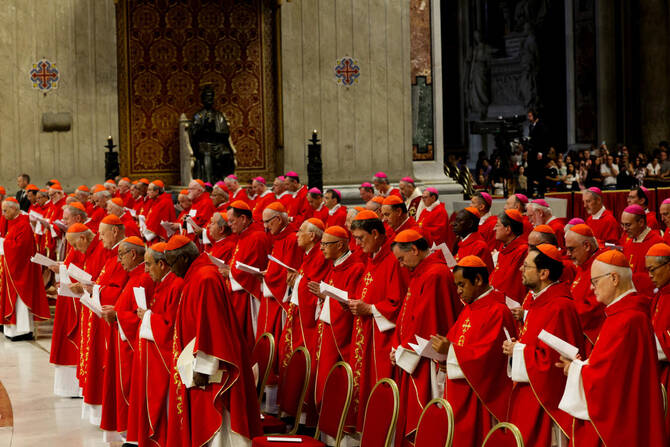
VATICAN CITY: “Conclave,” the movie, may have introduced movie-goers to the spectacular ritual and drama of a modern conclave, but the periodic voting to elect a new pope has been going on for centuries and created a whole genre of historical trivia.
Here are some fun facts about conclaves past, derived from historical studies including Miles Pattenden’s “Electing the Pope in Early Modern Italy, 1450–1700” and interviews with experts including Elena Cangiano, an archaeologist at Viterbo’s Palazzo dei Papi (Palace of the Popes).
The longest conclave in history
In the 13th century, it took almost three years – 1,006 days to be exact – to choose Pope Clement IV’s successor, making it the longest conclave in the Catholic Church’s history. It’s also where the term conclave comes from – “under lock and key,” because the cardinals who were meeting in Viterbo, north of Rome, took so long the town’s frustrated citizens locked them in the room.
The secret vote that elected Pope Gregory X lasted from November 1268 to September 1271. It was the first example of a papal election by “compromise,” after a long struggle between supporters of two main geopolitical medieval factions – those faithful to the papacy and those supporting the Holy Roman Empire.
‘One meal a day’ rule
Gregory X was elected only after Viterbo residents tore the roof off the building where the prelates were staying and restricted their meals to bread and water to pressure them to come to a conclusion. Hoping to avoid a repeat, Gregory X decreed in 1274 that cardinals would only get “one meal a day” if the conclave stretched beyond three days, and only “bread, water and wine” if it went beyond eight. That restriction has been dropped.
The shortest conclave ever
Before 1274, there were times when a pope was elected the same day as the death of his predecessor. After that, however, the church decided to wait at least 10 days before the first vote. Later that was extended to 15 days to give all cardinals time to get to Rome. The quickest conclave observing the 10-day wait rule appears to have been the 1503 election of Pope Julius II, who was elected in just a few hours, according to Vatican historian Ambrogio Piazzoni. In more recent times, Pope Francis was elected in 2013 on the fifth ballot, Benedict XVI won in 2005 on the fourth and Pope Pius XII won on the third in 1939.
The first conclave in the Sistine Chapel
The first conclave held under Michelangelo’s frescoed ceiling in the Sistine Chapel was in 1492. Since 1878, the world-renowned chapel has become the venue of all conclaves. “Everything is conducive to an awareness of the presence of God, in whose sight each person will one day be judged,” St. John Paul II wrote in his 1996 document regulating the conclave, “Universi Dominici Gregis.” The cardinals sleep a short distance away in the nearby Domus Santa Marta hotel or a nearby residence.
The alternative locations
Most conclaves were held in Rome, with some taking place outside the Vatican walls. Four were held in the Pauline Chapel of the papal residence at the Quirinale Palace, while some 30 others were held in St. John Lateran Basilica, Santa Maria Sopra Minerva or other places in Rome. On 15 occasions they took place outside Rome and the Vatican altogether, including in Viterbo, Perugia, Arezzo and Venice in Italy, and Konstanz, Germany and Lyon, France.
The alternative popes, or anti-popes
Between 1378-1417, referred by historians to as the Western Schism, there were rival claimants to the title of pope. The schism produced multiple papal contenders, the so-called anti-popes, splitting the Catholic Church for nearly 40 years. The most prominent anti-popes during the Western Schism were Clement VII, Benedict XIII, Alexander V, and John XXIII. The schism was ultimately resolved by the Council of Constance in 1417, which led to the election of Martin V, a universally accepted pontiff.
A challenge to personal hygiene
The cloistered nature of the conclave posed another challenge for cardinals: staying healthy. Before the Domus Santa Marta guest-house was built in 1996, cardinal electors slept on cots in rooms connected to the Sistine Chapel. Conclaves in the 16th and 17th centuries were described as “disgusting” and “badly smelling,” with concern about disease outbreaks, particularly in summer, according to historian Miles Pattenden. “The cardinals simply had to have a more regular and comfortable way of living because they were old men, many of them with quite advanced disease,” Pattenden wrote. The enclosed space and lack of ventilation further aggravated these issues. Some of the electors left the conclave sick, often seriously.
Vow of secrecy
Initially, papal elections weren’t as secretive but concerns about political interference soared during the longest conclave in Viterbo. Gregory X decreed that cardinal electors should be locked in seclusion, “cum clave” (with a key), until a new pope was chosen. The purpose was to create a totally secluded environment where the cardinals could focus on their task, guided by God’s will, without any political interference or distractions. Over the centuries, various popes have modified and reinforced the rules surrounding the conclave, emphasizing the importance of secrecy.
Youngest pope, oldest pope
Pope John XII was just 18 when he was elected in 955. The oldest popes were Pope Celestine III (elected in 1191) and Celestine V (elected in 1294) who were both nearly 85. Benedict XVI was 78 when he was elected in 2005.
A non-cardinal pope and non-Italian pope
There is no requirement that a pope be a cardinal, but that has been the case for centuries. The last time a pope was elected who wasn’t a cardinal was Urban VI in 1378. He was a monk and archbishop of Bari. While the Italians have had a stranglehold on the papacy over centuries, there have been many exceptions aside from John Paul II (Polish in 1978) and Benedict XVI (German in 2005) and Francis (Argentine in 2013). Alexander VI, elected in 1492, was Spanish; Gregory III, elected in 731, was Syrian; Adrian VI, elected in 1522, was from the Netherlands.


![]()

From the longest conclave to anti-popes: 10 fun facts about the secret voting to elect a pope
Short Url
https://arab.news/mqnc7
From the longest conclave to anti-popes: 10 fun facts about the secret voting to elect a pope
- The periodic voting to elect a new pope has been going on for centuries and created a whole genre of historical trivia
- The last time a pope was elected who was not a cardinal was Urban VI in 1378


Latest updates


© 2026 SAUDI RESEARCH & PUBLISHING COMPANY, All Rights Reserved And subject to Terms of Use Agreement.