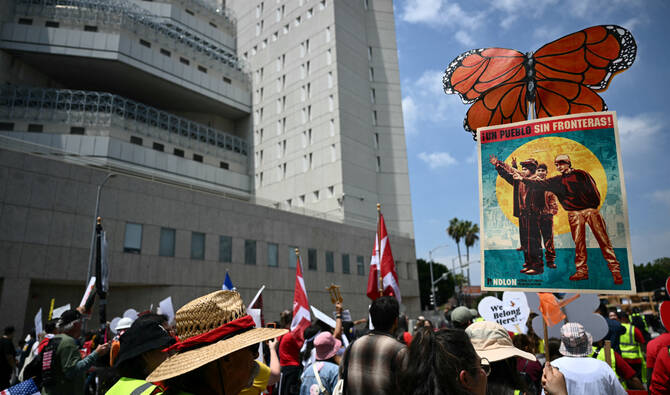
WASHINGTON: The Trump administration asked the US Supreme Court on Thursday to back its bid to end the temporary protected status (TPS) shielding more than 350,000 Venezuelans from deportation.
A federal judge in California put a temporary stay in March on plans by Homeland Security chief Kristi Noem to end deportation protections for the Venezuelan nationals.
US District Judge Edward Chen said the plan to end TPS “smacks of racism” and mischaracterizes Venezuelans as criminals.
“Acting on the basis of a negative group stereotype and generalizing such stereotype to the entire group is the classic example of racism,” Chen wrote.
Solicitor General John Sauer filed an emergency application with the conservative-majority Supreme Court on Thursday asking it to stay the judge’s order.
“So long as the order is in effect, the secretary must permit hundreds of thousands of Venezuelan nationals to remain in the country, notwithstanding her reasoned determination that doing so is ‘contrary to the national interest,’” Sauer said.
In addition, “the district court’s decision undermines the executive branch’s inherent powers as to immigration and foreign affairs,” he added.
Former president Joe Biden extended TPS for another 18 months just days before Donald Trump returned to the White House in January.
The United States grants TPS to foreign citizens who cannot safely return home because of war, natural disasters or other “extraordinary” conditions.
Trump campaigned for the White House promising to deport millions of undocumented migrants.
A number of his executive orders around immigration have encountered pushback from judges across the country.
A federal judge in Texas ruled on Thursday that Trump’s use of an obscure wartime law to summarily deport alleged Venezuelan gang members was “unlawful.”
District Judge Fernando Rodriguez, a Trump appointee, blocked any deportations from his southern Texas district of alleged members of the Tren de Aragua (TdA) gang using the 1798 Alien Enemies Act (AEA).
Trump invoked the little-known AEA, which was last used to round up Japanese-American citizens during World War II, on March 15 and flew two planeloads of alleged TdA members to El Salvador’s notorious maximum security CECOT prison.
The Supreme Court and several district courts have temporarily halted removals under the AEA citing a lack of due process, but Rodriguez was the first federal judge to find that its use is unlawful.

US Supreme Court asked to strip protected status from Venezuelans
Short Url
https://arab.news/rug2u
US Supreme Court asked to strip protected status from Venezuelans
Russia says talks on US peace plan for Ukraine ‘are proceeding constructively’
- The talks are part of the Trump administration’s push for peace, which included meetings with Ukrainian and European officials in Berlin earlier this week
- Ukrainian President Volodymyr Zelensky said much depends on the US posture after discussions with the Russians
A Kremlin envoy says peace talks on a US-proposed plan to end the nearly four-year war in Ukraine were pressing on “constructively” in Florida.
The talks are part of the Trump administration’s monthslong push for peace that also included meetings with Ukrainian and European officials in Berlin earlier this week.
“The discussions are proceeding constructively. They began earlier and will continue today, and will also continue tomorrow,” Kirill Dmitriev told reporters Saturday, according to Russian state news agency RIA Novosti.
Dmitriev met with US President Donald Trump’s envoy Steve Witkoff and Trump’s son-in-law Jared Kushner in Miami, the agency reported.
Ukrainian President Volodymyr Zelensky said Saturday that much will depend on the US posture after discussions with the Russians. This came a day after Ukraine’s chief negotiator said his delegation had completed separate meetings in the United States with American and European partners.
Trump has unleashed an extensive diplomatic push to end the war, but his efforts have run into sharply conflicting demands by Moscow and Kyiv. Russian President Vladimir Putin has recently signaled he is digging in on his maximalist demands on Ukraine, as Moscow’s troops inch forward on the battlefield despite huge losses.
On Friday, Putin expressed confidence that the Kremlin would achieve its military goals if Kyiv didn’t agree to Russia’s conditions in peace talks.
European Union leaders agreed on Friday to provide 90 billion euros ($106 billion) to Ukraine to meet its military and economic needs for the next two years, although they failed to bridge differences with Belgium that would have allowed them to use frozen Russian assets to raise the funds. Instead, they were borrowed from capital markets.
The talks are part of the Trump administration’s monthslong push for peace that also included meetings with Ukrainian and European officials in Berlin earlier this week.
“The discussions are proceeding constructively. They began earlier and will continue today, and will also continue tomorrow,” Kirill Dmitriev told reporters Saturday, according to Russian state news agency RIA Novosti.
Dmitriev met with US President Donald Trump’s envoy Steve Witkoff and Trump’s son-in-law Jared Kushner in Miami, the agency reported.
Ukrainian President Volodymyr Zelensky said Saturday that much will depend on the US posture after discussions with the Russians. This came a day after Ukraine’s chief negotiator said his delegation had completed separate meetings in the United States with American and European partners.
Trump has unleashed an extensive diplomatic push to end the war, but his efforts have run into sharply conflicting demands by Moscow and Kyiv. Russian President Vladimir Putin has recently signaled he is digging in on his maximalist demands on Ukraine, as Moscow’s troops inch forward on the battlefield despite huge losses.
On Friday, Putin expressed confidence that the Kremlin would achieve its military goals if Kyiv didn’t agree to Russia’s conditions in peace talks.
European Union leaders agreed on Friday to provide 90 billion euros ($106 billion) to Ukraine to meet its military and economic needs for the next two years, although they failed to bridge differences with Belgium that would have allowed them to use frozen Russian assets to raise the funds. Instead, they were borrowed from capital markets.
© 2025 SAUDI RESEARCH & PUBLISHING COMPANY, All Rights Reserved And subject to Terms of Use Agreement.


