WASHINGTON: A top adviser to President Donald Trump said on Sunday that the United States needs a Ukrainian leader who is willing to secure a lasting peace with Russia but that it is not clear Ukrainian President Volodymyr Zelensky is prepared to do so.
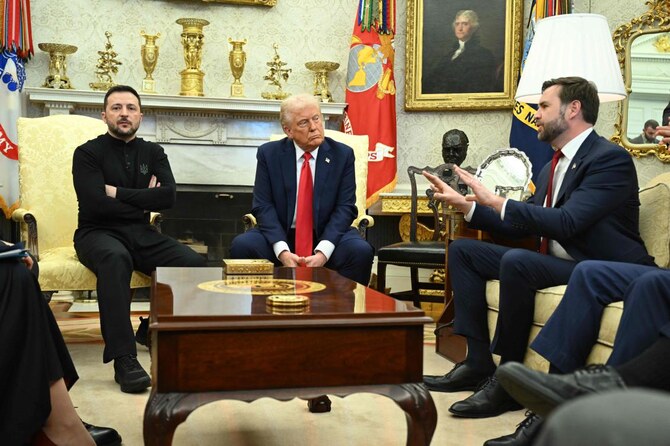
Days after a contentious Oval Office exchange between Trump, Zelensky and Vice President JD Vance, White House national security adviser Mike Waltz said Washington wants to secure a permanent peace between Moscow and Kyiv that involves territorial concessions in exchange for European-led security guarantees.
Asked whether Trump wants Zelensky to resign, Waltz told CNN’s “State of the Union” program: “We need a leader that can deal with us, eventually deal with the Russians and end this war.”
“If it becomes apparent that President Zelensky’s either personal motivations or political motivations are divergent from ending the fighting in his country, then I think we have a real issue on our hands,” Waltz added.
House of Representatives Speaker Mike Johnson also suggested that a different leader might be necessary in Ukraine if Zelensky does not comply with US demands.
“Something has to change. Either he needs to come to his senses and come back to the table in gratitude, or someone else needs to lead the country to do that,” the top congressional Republican told NBC’s Meet the Press program.
The extraordinary Oval Office exchange on Friday put tensions between Zelensky and Trump on public display. As a result, an agreement between Ukraine and the United States to jointly develop Ukraine’s natural resources was left unsigned and in limbo.
“It wasn’t clear to us that President Zelensky was ready to negotiate and in good faith toward an end of this war,” Waltz said.
On ABC’s This Week program, Secretary of State Marco Rubio said he has not spoken with Zelensky since Friday.
Rubio also said he has not spoken to Ukrainian Foreign Minister Andrii Sybiha since Trump and Zelensky clashed at the White House and failed to sign an expected minerals deal.
“We’ll be ready to reengage when they’re ready to make peace,” Rubio said on the show.
US Senator Amy Klobuchar, a Democrat, said on “This Week” that she was “appalled” by the clash in the Oval Office and that she met with Zelensky before he went to the White House on Friday and he had been excited to sign an expected minerals deal.
“There is still an opening here” for a peace deal, she said.


Trump aide Waltz says US needs Ukrainian leader who wants peace
https://arab.news/bzcpf
Trump aide Waltz says US needs Ukrainian leader who wants peace

- On ABC’s This Week program, Secretary of State Marco Rubio said he has not spoken with Zelensky since Friday
- “We’ll be ready to reengage when they’re ready to make peace,” Rubio said on the show


Macron says EU move on Mercosur deal a ‘bad surprise’
- “For France, this is a surprise, and a bad one,” Macron said
- The move showed “bad manners toward the European Parliament“
PARIS: President Emmanuel Macron denounced Friday the European Commission’s “bad manners” following its decision to provisionally apply the Mercosur trade deal and called the move a “bad surprise” for France.
EU chief Ursula von der Leyen said earlier Friday that the European Union will implement the mammoth trade deal with the South American Mercosur bloc while waiting for a top court’s ruling on its legality.
“For France, this is a surprise, and a bad one,” Macron said in a strongly-worded statement, adding the move showed “bad manners toward the European Parliament.”
“The European Commission has made the unilateral decision to provisionally apply the agreement with Mercosur, even though the European Parliament has not voted on it. It is thus taking on a very heavy responsibility.”
Speaking alongside Slovenia’s Prime Minister Robert Golob, Macron said he would make sure “that what we have negotiated hard for over the last few months is respected.”
“We will be uncompromising on compliance with these rules, because Europe has significantly tightened the rules on our producers in recent years,” Macron added.
“And so I will never defend an agreement that is lax on imports and tough on what we produce at home, because it is inconsistent for European consumers and criminal for European sovereignty,” he said.


