Paramilitary shelling hits Sudan’s presidential palace: army source

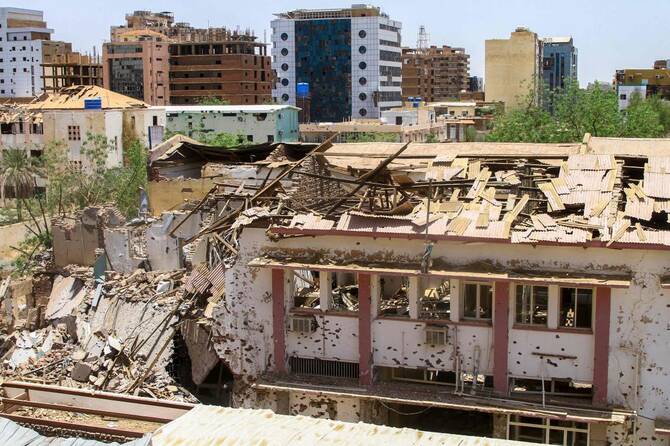
This picture shows a damaged hospital in Khartoum on Apr. 28, 2025. (AFP)
Short Url
Updated 01 May 2025
Follow

Paramilitary shelling hits Sudan’s presidential palace: army source

  • RSF used “long-range artillery” launched from their holdout position in Al-Salha
  • They targeted the army’s General Command headquarters in central Khartoum

KHARTOUM: Sudan’s presidential palace in central Khartoum was shelled by the paramilitary Rapid Support Forces on Thursday, a military source said, the second such attack on the capital in a week.
The RSF, at war with the army for two years, used “long-range artillery” launched from their holdout position in Al-Salha, located south of Khartoum’s twin city of Omdurman, the source told AFP on condition of anonymity.
There were no immediate reports of casualties.
On Saturday, the RSF targeted the army’s General Command headquarters in central Khartoum, also using long-range artillery fire, according to a military source.
The attacks come weeks after the army pushed the RSF out of central Khartoum, which the paramilitary had swept through early in the war.
In a major military offensive in March, army forces regained control of the presidential palace, the airport and other strategic areas in the capital.
But the RSF still clings to its last pockets of control in southern and western Omdurman.
Since April 2023, the war in Sudan has killed tens of thousands, uprooted 13 million and created the world’s largest hunger and displacement crises.
The conflict has effectively divided the country in two with the army holding the center, east and north while the RSF controls nearly all of Darfur and parts of the south.


Israeli attacks on Lebanon kill four, including security officer and child

Updated 54 min 22 sec ago
Follow

Israeli attacks on Lebanon kill four, including security officer and child

  • Lebanon’s health ministry says Israeli strike on village of Yanuh in the south killed three people
  • Israeli gunfire also killed one person in the border village of Aita Al-Shaab

BEIRUT: Israeli attacks on Lebanon killed four people on Monday including a Lebanese security forces member and his child, hours after the Israeli army seized a member of Islamist group Jamaa Islamiya.
Israel frequently strikes Lebanon despite a November 2024 ceasefire aimed at ending more than a year of hostilities with militant group Hezbollah.
On Monday, Lebanon’s health ministry said an Israeli strike on the village of Yanuh in the south killed three people.
The Israeli military said the strike targeted Ahmad Ali Salameh, who it alleged was Hezbollah’s head of artillery and had been working to restore the group’s capabilities.
In addition to Salameh, the strike killed a member of Lebanon’s security forces and his three-year-old child, who were passing by, according to Lebanon’s state-run National News Agency (NNA).
The Israeli military said the incident was “under review” after it was made “aware of the claim that uninvolved civilians were killed.”
Later on Monday, the health ministry reported that Israeli gunfire killed one person in the border village of Aita Al-Shaab, with the Israeli military saying it killed a Hezbollah member.
It alleged he was “gathering intelligence on (Israeli) troops and operated to rehabilitate Hezbollah’s terrorist infrastructure in southern Lebanon.”
In addition to recurring attacks, the Israeli army still has troops deployed on five border positions in Lebanon it deems strategic.
Monday’s incidents come hours after the Jamaa Islamiya group, an ally of Palestinian militants Hamas, accused Israel of seizing one of its officials, Atwi Atwi, from his home in the Hasbaya district, south Lebanon, and taking him to an unknown location.
The group, which has claimed responsibility for multiple attacks against Israel during the war with Hezbollah, condemned “the Israeli occupation forces’ infiltration.”
The Israeli military said that it “apprehended a senior terrorist” in the group who was then “transferred for further questioning in Israeli territory.”
Atwi’s capture came hours after Lebanese Prime Minister Nawaf Salam completed a two-day visit to the south, which suffered extensive damage during the conflict with Hezbollah, with thousands displaced.
Salam in a statement condemned Atwi’s “abduction,” calling it a “blatant attack on Lebanese sovereignty, a violation of the ceasefire agreement and “a breach of international law.”
Hezbollah meanwhile called on the state to “take deterrent measures and firm and clear positions, and to act immediately at all political, diplomatic and legal levels, and to work seriously to protect citizens.”
Lebanon accuses Israel of having abducted several other citizens since the start of the hostilities.
Hezbollah lawmaker Hussein Al-Hajj Hassan said last month that Israel was holding “20 Lebanese prisoners,” alleging 10 had been abducted “inside Lebanese territory after the ceasefire.”
Lebanon says Israel must release these detainees and withdraw from the border positions it retains, in addition to halting air strikes on Lebanon.