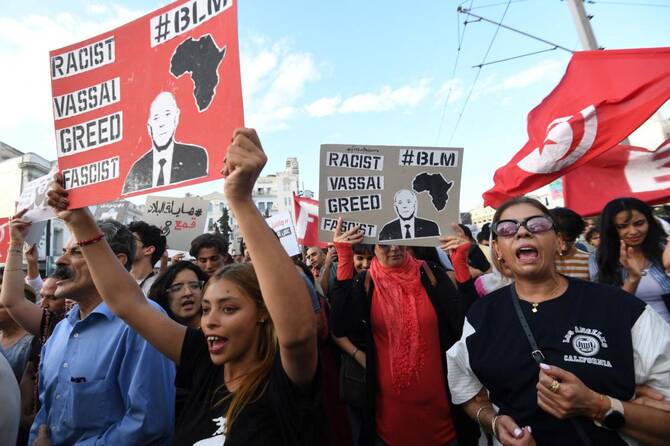
TUNIS: Opponents of Tunisian President Kais Saied protested on the streets of Tunis on Thursday, accusing him of using the judiciary and police to suppress critics, while his supporters held a counter-rally, highlighting a deepening political divide.
The anti-Saied demonstration — the second opposition protest in a week — reflects growing concerns among human rights groups that the birthplace of the Arab Spring is sliding toward one-man rule.
Demonstrators on the capital’s main thoroughfare chanted slogans such as “Saied go away, you are dictator” and “The people want the fall of the regime,” a slogan reminiscent of the 2011 uprising that toppled former President Zine El Abidine Ben Ali.
On the same street, Habib Bourguiba Avenue, Saied’s supporters rallied in his defense, chanting, “No to foreign interference” and “The people want Saied again.”
Riot police deployed in large numbers to separate the groups. No clashes were reported.
The demonstrations follow a months-long government crackdown on Saied’s critics, including the detention last week of prominent lawyer Ahmed Souab, a fierce critic of the president.
On Thursday the anti-Saeid protesters marched from the headquarters of the Administrative Court, where Souab had served as a judge before retiring and becoming a lawyer widely respected by all political parties.
They then joined other protesters in a square that is home to the headquarters of the powerful UGTT union, before heading toward Habib Bourguiba Avenue.
Souab’s arrest followed prison sentences handed down last week to opposition leaders on conspiracy charges, drawing criticism from France, Germany, and the United Nations.
Saied rejected the criticisms, calling it a blatant interference in Tunisia’s sovereignty.
The opposition accuses Saied of undermining the democracy won in the 2011 revolution, since he seized extra powers in 2021 when he shut down the elected parliament and moved to rule by decree before assuming authority over the judiciary.
They described his move as a coup, while Saied says it was legal and necessary to end chaos and rampant corruption.
The leaders of most political parties in Tunisia are in prison, including Abir Moussi, leader of the Free Constitutional Party, and Rached Ghannouchi, the head of Ennahda — two of Saied’s most prominent opponents.
The government says there is democracy in Tunisia. Saied says he will not be a dictator, but insists that what he calls a corrupt elite must be held accountable.


![]()

Tunisia leader’s opponents, supporters stage rival rallies in sharp political split
Short Url
https://arab.news/24265
Tunisia leader’s opponents, supporters stage rival rallies in sharp political split
- The anti-Saied demonstration reflects growing concerns among human rights groups that the birthplace of the Arab Spring is sliding toward one-man rule


Latest updates






© 2026 SAUDI RESEARCH & PUBLISHING COMPANY, All Rights Reserved And subject to Terms of Use Agreement.